
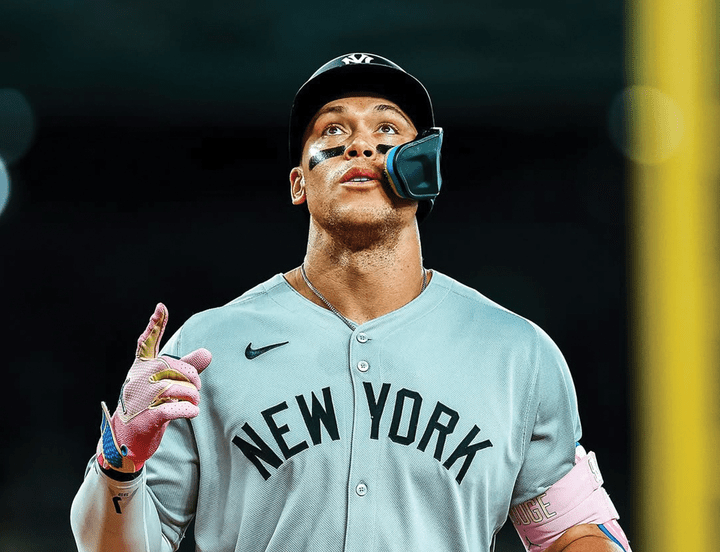
When confronted with the general notion that the Yankees make a profit on their $700 million in annual revenue, owner Hal Steinbrenner pushed back, stating that it is “not fair” to assume the Yankees make a profit every year.
 Fernando Cruz of the New York Yankees pitching during a game. Yankees owner Hal Steinbrenner claims that the franchise doesn’t always make a profit. Photo courtesy of @yankees/Instagram
“I don’t want to get into it,” he said, “but … everybody wants to talk about revenues. They need to talk about our expenses, including the $100 million expense to the city of New York that we have to pay every [year] … No [organization] spends more money [on] player development, scouting … [if] you [go] look at the revenues, you [have to] figure out the expense side as well. You might be surprised.”
In various states of surprise, satire and disbelief, baseball fans across the board commenting on his statement. One Twitter user writes, “The owner of the NEW YORK YANKEES wants you to believe that he’s losing money.”
The YouTube channel Made the Cut says he, like many other baseball fans, will “never understand” why owners talk about their expenses and revenues like this. “What’s the point of trying to convince [fans] that the most valuable franchises in Major League Baseball, per Forbes, at $8.2 Billion… don’t overall make a profit from their properties?”
According to Forbes, the Yankees generate a billion and a half more than the next team on that list, the Dodgers. While Forbes notes the Yankees operate at a $57 million loss, they more than make up for that with their market alone, which Forbes calls the “portion of franchise’s value attributable to its city and market size,” including the TV, internet content and radio deals, advertising and sponsors.
With all of these profit sources, it’s doubtful that the Yankees were operating a net even, or, more wildly, a net loss. If it is operating at such a net loss that Steinbrenner had to feel like he had to say this, why wouldn’t he be rushing to sell the team?
But this still doesn’t address the expense Steinbrenner points explicitly out – the $100 million they pay to New York.
The new Yankee Stadium was financed with over $900 million in bonds issued by the NYC Industrial Development Agency. These tax-exempt bonds, typically used for public projects, saved the Yankees between $231 million and $471 million by enabling lower-return, tax-free investments. Built on land owned by the agency, the stadium doesn’t pay property taxes; instead, StadCo (linked to the Yankees) makes annual payments.
Last year, these payments were $84 million, not $100 million as some claim. These payments don’t go into the city’s general funds, but are instead used to pay back bonds that funded stadium construction.
Municipal bonds issued for city sports stadiums can serve as a hidden subsidy for wealthy sports teams. As a result, taxpayers miss out on funds that could have supported federal and local programs.
It is worth noting that the IRS issued rules in 2008 to prevent this kind of loophole. Since the Yankees’ bonds were issued before these rules, they weren’t affected, showing how teams can take advantage of legal gaps until regulations are updated.
In essence, Steinbrenner and the Yankees’ ownership save money and don’t pay taxes regarding repayment of their debt; meanwhile, New York, and really, federal and state taxpayers at large, indirectly pay for the stadium by losing out on federal funding that could’ve gone elsewhere.
In addition, the Yankees don’t outright claim any revenues or profits from YES Network (its TV network) because they are the only team to own their network rights outright, even if it’s only 26% of YES. That’s not even including everything under Yankees Global Enterprises.
Steinbrenner’s comments are at best disingenuous, cherry-picking what suits the narrative, and at worst disrespectful to the fans who take time out of their lives to spend their hard-earned money supporting this team.
It almost reminds one of a particular sports owner, also in New York City. One who owns both a hockey and basketball team, which have histories of inconsistent success…but that’s an article for another day.
He doubles down further on it, stating to Meredith Marakovits of YES Network via Brendan Kuty of The Athletic, “It’s difficult for most of us owners to be able to do the kind of things that [the Dodgers are] doing,” Steinbrenner said. “Now, we’ll see if it pays off.”
The problem, aside from the improbable scenario Steinbrenner speaks of in which the Yankees don’t make money, is where that money is being spent and where it is going in totality.
Despite reportedly investing heavily in their farm system, many players have seen little to no return in the primary league. Aside from prominent names like Brett Gardner and Aaron Judge, can you, dear reader, identify a Yankees prospect who has achieved notable success?
Think of the Baby Bombers. This idea was based on the belief that the Yankees’ prospects were elite. The list features players like Tyler Austin, Tyler Wade, Miguel Andujar, Clint Frazier (who has criticized how the Yankees limited his and other prospects’ development), Greg Bird, Gleyber Torres to a lesser extent, and now Anthony Volpe — all of whom either didn’t meet or completely missed their MLB expectations.
The Yankees’ administrative body remains passive regarding how things are, and now, with Trent Grisham accepting the qualifying offer, the team faces a luxury tax dilemma. They are currently debating whether to follow the Dodgers and Mets’ example and incur higher taxes.
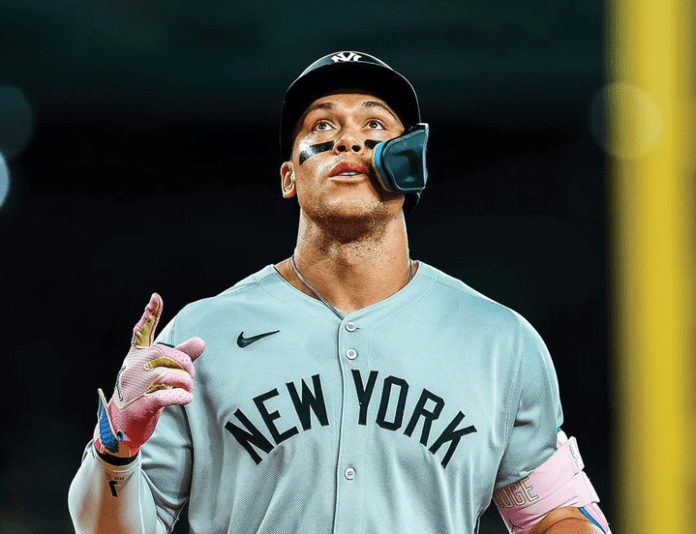 Aaron Judge of the New York Yankees pointing up towards the stadium. The Yankees generate about $8.2 billion of revenue according to Forbes. Photo courtesy of @yankees/Instagram
Controversy among sports owners is nothing new. However, it becomes especially notable when, in a league without a salary cap and less popular than the other major leagues, the owner of the most popular and valuable baseball team argues that we should prioritize their spending over profit.
All in all, his reign over the franchise has been a whole bucket of changes and stagnation, at the same time, if that makes sense. Changes in mentality, stagnant in player ability, though there were some peaks.
Profit drives a lot of discussion in sports, and even if you were to draw up a defense, this is the same owner who charged fans the same amount for 2020 season tickets as if it were a full season, then raised season ticket prices the following year.
In reality, what Steinbrenner owns is the fourth-most-valuable American sports team, behind the Los Angeles Rams, New England Patriots, and Dallas Cowboys, all of which are in the NFL. If a franchise valued at $8.2 billion can’t make money, what hope is there for the rest of the league?