
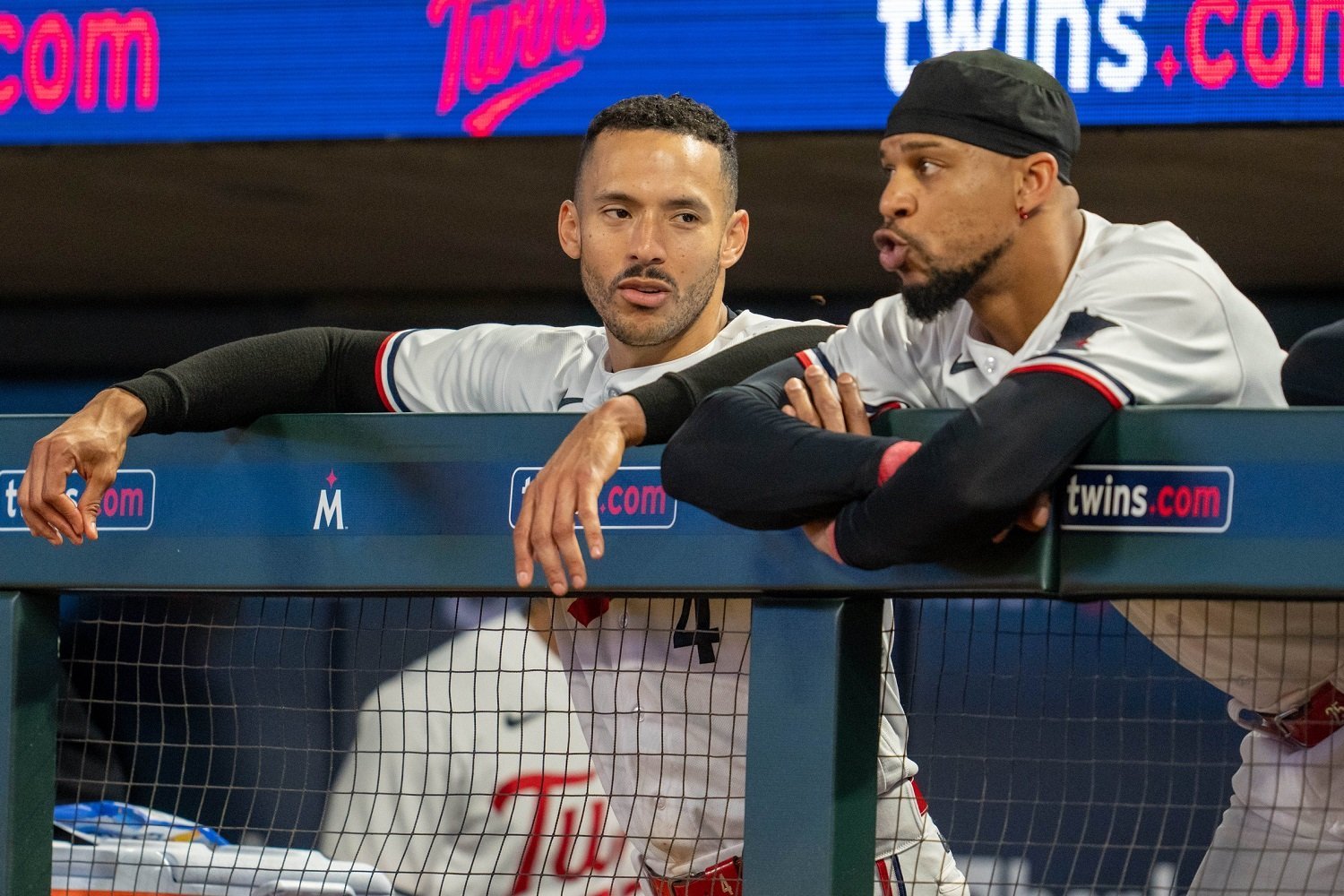
The Twins have spent the last few seasons trying to convince the baseball world that their competitive window is still open. Their message has always depended on having their two cornerstone stars in the middle of everything. That plan took its first major hit when Carlos Correa agreed to waive his no-trade clause and return to Houston at this summer’s trade deadline. The ripple effects from that decision may now be touching Byron Buxton in ways the Twins hoped they would never face.
Correa’s exit made all the sense in the world. Once the idea of Houston crept back into his head, it was almost impossible to uproot. His family is in the area. The Astros offer a more straightforward path to October, even if they fell short in 2025. The move to third base was expected to lessen the wear and tear on his body, after years of problems with his lower back and plantar fasciitis. It made too much sense, and when a player of Correa’s stature sees a version of his future that looks brighter elsewhere, it is only natural to follow it. The seed was planted, and it grew until there was no stopping it.
Minnesota told itself that this was a singular situation. Correa was unique. This was not a sign of something bigger. Now, cracks in that belief have started to show.
Earlier this week, ESPN’s Jeff Passan reported that Buxton has emerged as one of the biggest trade candidates of the winter. That alone is jarring, but the real noise came from Passan’s line that Buxton is willing to waive his no-trade clause, and not just for Atlanta, the team he watched growing up in Georgia.
Buxton has not confirmed this publicly, and until he speaks, there will be speculation on how genuine that willingness truly is. Still, even the possibility marks a notable shift. This is a player who has repeatedly said he wants to be in Minnesota for the long haul and has long been viewed as fiercely loyal to the only big-league organization he has ever known. Last month, I wrote about how the Pohlads may have pushed Buxton to break his moral code, and perhaps that is still true, but Correa’s exit may also have pointed him to greener pastures.
It’s not hard to understand why that loyalty may be softening. Buxton is coming off arguably the best season of his career, and he looks and feels healthy heading into the offseason for a second consecutive year. He knows exactly how short an athlete’s window can be, and he is undoubtedly aware of the current state of the Twins. Their payroll is dropping. Their roster faces more questions than answers. Their long-term outlook is cloudy, at best.
Then, he looks at Correa. He sees a close friend and former teammate, thriving in a competitive environment with real October expectations. He sees a player who freed himself to chase wins, stability, and long-term relevance. That image can be powerful. It can plant the same idea that once took hold of Correa. And if the idea is truly in Buxton’s mind, the Twins may not be able to root it out.
That is the uncomfortable reality for Minnesota. Correa’s departure was not simply one star leaving. It may have opened the door to another star reconsidering his loyalty. If the Twins can’t show Buxton a future where contention is more than a hopeful projection, they risk watching their franchise centerpiece walk the same path Correa did.
The Twins believed Correa’s exit was an isolated storm, but it may have been the first breeze carrying seeds of doubt into their clubhouse. Buxton has always been the player they trusted to anchor their future, yet even the most loyal stars can start to question where their path leads. If Minnesota cannot show him a future that blooms into real contention (rather than more uncertainty), those seeds may grow into a weed that will spread throughout the organization.
Did Correa’s exit push Buxton toward the door? Leave a comment and start the discussion.