
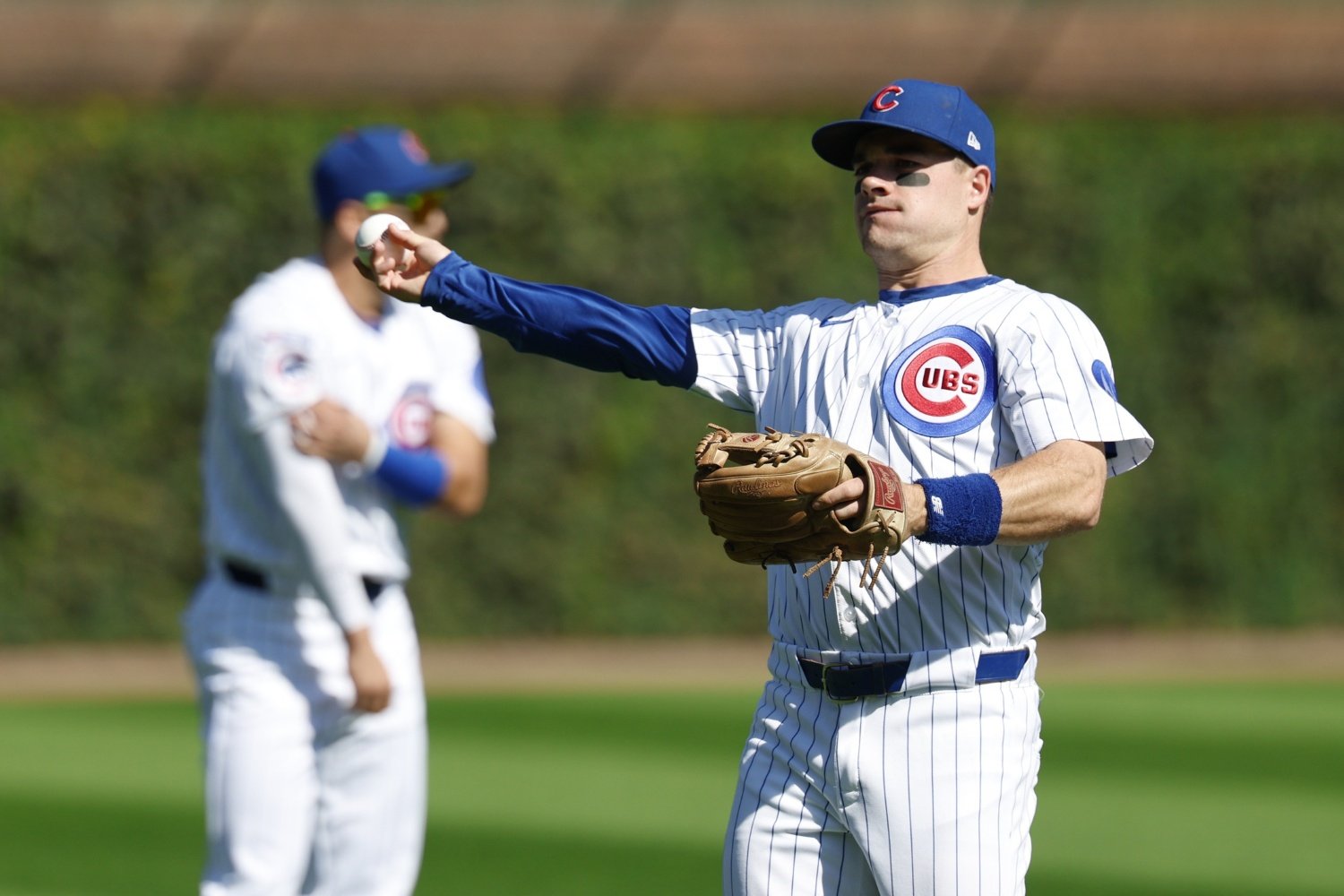
While there was room for discussion around the extent of it, we know that the Chicago Cubs attempted to sign third baseman Alex Bregman last winter. He eventually landed in Boston, though an opt-out in his contract has him back on the free agent market. The Cubs have already been connected, and such a signing could have a bearing on what shape their infield takes for the remainder of this offseason.
That’s in an entirely hypothetical world, however, and we have little reason to think the chances of a Bregman signing are good at this point. As such, we continue to operate under the assumption that the team’s infield will look much the same as it did for most of 2025: Carson Kelly and Miguel Amaya behind the plate, and Michael Busch, Nico Hoerner, Dansby Swanson, and Matt Shaw occupying their spots around the remainder of the dirt.
At the same time, third base does offer a position of intrigue. Shaw demonstrated improvement as the season wore on, but stretches throughout the regular season and into October showed us that as good as he can be on the defensive side, his offense remains a work in progress. Given that, it might behoove the Cubs to explore more of a safety net than they had at any point in 2025.
The team’s failed pursuit of Bregman left them without a true alternative to Shaw. When he struggled out of the gate (61 wRC+ in April), Craig Counsell was forced to reckon with the absence of a suitable supplement. A collection of Jon Berti, Vidal Bruján, Nicky Lopez, Justin Turner, and Gage Workman filled space both during Shaw’s time back in Iowa and other parts of the year. Only Turner finished the year still in the organization, with trade deadline acquisition Willi Castro offering more depth at the position in the season’s final two months.
Turner and Castro hit free agency this winter, with no clear indicator that either would (or should) be back. That means that the Cubs—who finished with exactly 0.0 fWAR from third base in 2025—are going to once again rely on Shaw realizing his next stages of development. That’s easier said than done, considering some of the areas of concern around him.
Shaw was far better in the second half of 2025 than in the first. His line after the All-Star break read .258/.317/.522 with a 130 wRC+, versus a .198/.276/.280 (60 wRC+) slash from the first half. The increase in power output is notable, as Shaw was able to elevate at a rate 11 percentage points above his flyball rate from the first half (46.0 percent). The way he closed the year, however, leaves a much more muddled picture than the splits imply.
For one, Shaw’s strikeout rate was up about 4.5 percentage points in the second half (23.9% overall), while his walk rate was down (8.3%). His swing-and-miss rate in September was his second-highest in an individual month, with the 25.5% whiff rate trailing only April (30.8%). His hard-hit rate, which rose steadily as the months wore on, cratered in September, with a 22.0% rate checking in 15 percentage points below his August peak. It all carried into October, where he notched only a pair of hits in 15 plate appearances and provided his only value via the walk (of which he had five).
That’s not to say that Shaw is destined to have another volatile season in 2026. We’ll likely continue to see the ups and downs associated with natural development. We just don’t know what the peaks and valleys could look like at this point. That’s all the more reason for the Cubs to pursue a legitimate safety net for Shaw this time around.
The goal with such an addition isn’t necessarily to prepare for a worst-case scenario. Instead, it’s to supplement Shaw in those moments where you don’t love a matchup or he needs an opportunity to reset for a day or two. As such, it’s not about signing or acquiring a pure third baseman as said safety net. You’re looking for a versatile player who can bring at least one particular skill, while not being a total loss filling in at third base defensively—especially given what you lose with Shaw’s glove when he’s on the bench.
Consider someone like Luis Urías, who has a career walk rate around 10% and is coming off a year in which he struck out a career-low 13.6 percent of the time. Former Cub Ildemaro Vargas doesn’t offer the same level of contact ability, but he hit well enough last year (85 wRC+) and was perfectly average in a small sample at third to offer at least an upgrade over how the team supplemented third base last season. Miguel Andujar could provide a little bit more in the way of power and contact ability, even if his ability to draw walks and his defensive shortcomings don’t entirely fit the bill. None are exciting options in a thin free-agent class this side of Bregman, but they could at least provide the type of supplementation that’s needed as Shaw continues his development.
That’s something that the Cubs need to prioritize when they build the bench. Swanson and Hoerner are going to provide you with playing time volume and established skill sets. The same largely goes for Busch, even if the team maintains a desire to protect him against certain left-handed arms. It’s not just about acquiring a player who can fill in as a body at third base, either. It’s about a clear offensive skill set, so that the lineup can hold together when Shaw’s development is at the wrong end of its volatility.