
Historically, the Chicago Cubs aren’t known for dishing out record-breaking contracts to pitchers. Just twice have they signed a starter to a deal north of $100 million, the most recent being to Yu Darvish before the 2018 season.
Now, almost eight years after that $126 million deal was signed, the Cubs are contemplating doing so again. According to a league source, the Cubs were in on Dylan Cease but bowed out as the bidding reached the $200 million mark. Cease eventually signed a seven-year, $210 million deal with the Toronto Blue Jays. A chunk of the deal was deferred, a practice the Cubs have avoided in recent years.
But there appears to be a willingness to once again add a big-money pitcher to the rotation. That’s a departure from recent offseasons, as team president Jed Hoyer looks to follow through on his promise to make pitching his top priority this winter.
The last time the Cubs were shopping in this aisle of free-agent pitching, it was out of absolute necessity. The organization’s inability to develop pitching meant its only options were to spend in free agency or aggressively pursue trade partners to bulk up the rotation.
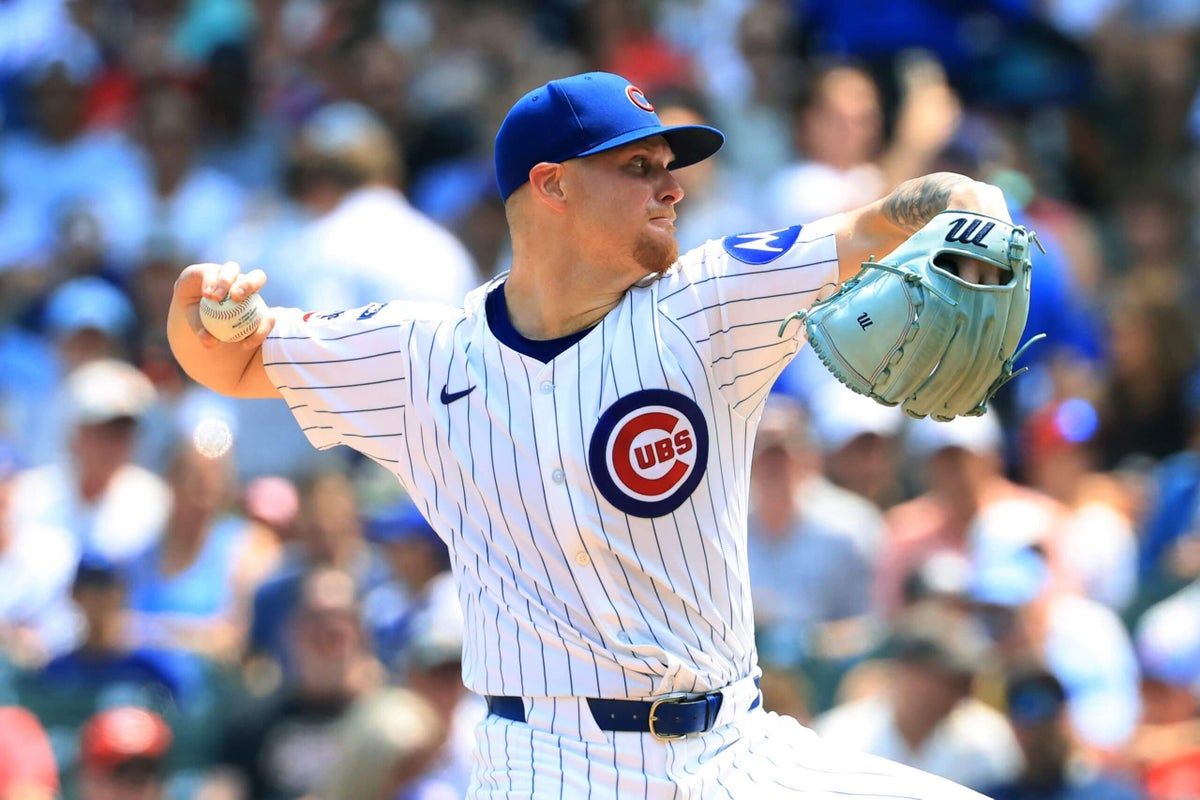
Although the farm isn’t producing arms at the level the Cubs want — there is a dearth of pitching talent in the system after top pitching prospect Jaxon Wiggins — there are finally some homegrown arms in the big leagues making major contributions. Chief among them is Rookie of the Year runner-up Cade Horton.
“I think what we saw in the second half was incredible,” Hoyer said. “If he would have thrown a few more innings, he would’ve had a real chance at that award.”
The Cubs closely monitored and limited Horton’s innings, hoping to unleash him in the postseason. However, a broken rib shortened his final start of the season. Instead of a national breakout party for Horton, the injury kept him sidelined during Chicago’s run to the National League Division Series.
But Horton’s second half gave the organization confidence that he was just scratching the surface of his talents.
Over his final 12 starts, the righty delivered a 1.03 ERA and saw his peripherals slowly start to climb. Over his first 10 outings of the season, Horton struck out just 17.5 percent of the batters he faced while walking 7.3 percent. In the season’s second half, he improved to 23.5 percent and 6.5 percent.
“I felt like I settled in, in the second half and came into my own,” Horton said.
After a dreadful outing in Houston (seven earned runs in four innings) that ended June on a sour note, Horton seemed to grow on the field and off. He took that poor performance to heart. Instead of allowing it to overwhelm him, he constantly searched for ways to improve. He expanded his arsenal and became a more dominant pitcher with seemingly every outing that followed.
“I can do what I did in the second half,” Horton said of his 2026 expectations. “Go out there and win games for my team. That’s really my main focus: going out there and helping my team win.”
There will be doubters, of course. Some will wonder if the late-season bump in strikeouts is real. Others will point to home-road splits that suggest Wrigley Field and its treacherous, windy conditions helped Horton more often than not.
Horton had a 3.59 ERA on the road as opposed to 1.63 at the Friendly Confines. But a closer look shows that in only two of his six second-half starts at home did the wind provide a significant benefit to the pitcher. After that poor outing against the Astros, his road ERA was 2.08. Surely the Cubs would take that.
A full season of a sub-2.00 ERA likely isn’t in the cards. But it’s hard to deny that Horton took major steps forward.
“I don’t know what the next version is going to look like exactly,” Hoyer said. “Because one of the things he does exceptionally well is make changes. Whether it’s adding a new pitch, refining an existing pitch, he’s a really good athlete and has a really good ability to develop and make changes. As the league adjusts to him, he’ll make adjustments.”
Offseason mechanical tweaks led to his regaining the velocity that had eluded him in an injury-marred 2024. His four-seam fastball has a unique cutting action that makes it hard for the opposition to read. That, paired with an imposing sweeper, was what got Horton drafted by the Cubs with the No. 7 pick in the summer of 2022. But he has never stopped working to get better.
Horton started to use his changeup more as this past season progressed, and to much success. After barely doling out his two-seamer in the minors and first two months in the big leagues, he upped the usage of the offering, which proved to be a major weapon.
“His ability to evolve was really special,” Hoyer said.
That doesn’t even touch on his intangibles. Teammates and coaches laud Horton for his makeup. He possesses the tools that the new-school scout seeks and also displays a competitiveness and bulldog mentality that the old-school scout would drool over.
Still, the Cubs aren’t done adding to their rotation. They can’t be. They watched the postseason and knew they were short, and that goes beyond the absence of Horton and Justin Steele. Hoyer knows his work this offseason isn’t over. But the presence of Horton makes things just a bit easier. It’s a luxury this organization lacked when it was shopping for starting pitching nearly a decade ago.
“I’m going into the offseason continuing to work and find ways to get better,” Horton said. “Going into spring training, we have something to prove.”