
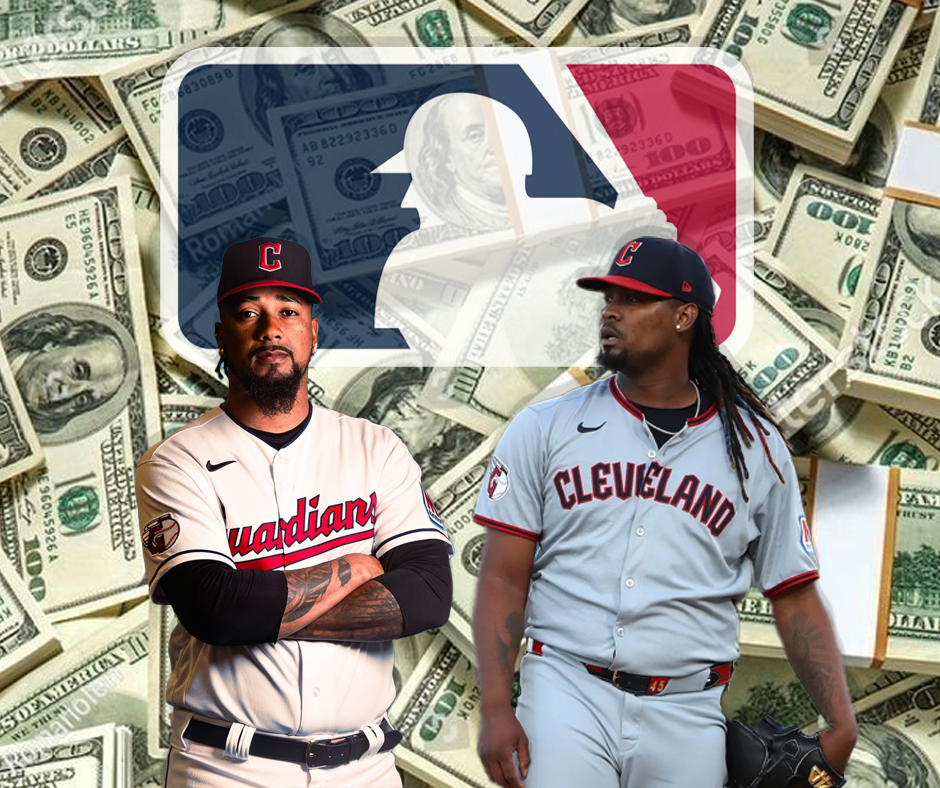
Major League Baseball was built on the belief that what happens between the white lines is real. But that faith cracked open on Nov. 9 when two Cleveland Guardians pitchers, Emmanuel Clase and Luis Ortiz, were indicted for allegedly helping gamblers cash in on rigged microbets, where bettors place wagers on a specific, small event in a sporting event. Legal sports betting has always been sold as a transparent, regulated alternative to an underground economy. But the Clase and Ortiz case shows the double-edged nature of that logic.
Federal prosecutors say the case is not about throwing games—it’s about throwing pitches for cash. This microbetting, a type of wagering that involves making rapid-fire bets as the game progresses, is a faster approach compared to standard sports betting. People can bet on a pitcher throwing slowly, outside the strike zone, or exactly as predicted—which is what has been rigged by Clase and Ortiz.
The indictment of Clase and Ortiz not only shakes the Guardians’ clubhouse, but baseball’s relationship with the legal sports betting industry. As MLB scrambles to contain the fallout, the scandal has become a clear warning: the rise of microbetting has made it possible to fix pieces of the game so small that they barely register on the field, but can pay thousands.
According to the indictment, the scheme began May 19, 2023, when Clase allegedly agreed with corrupt bettors to throw a pitch faster than 94.95 mph. Bettors won approximately $27,000.
Just weeks later, on June 3, bettors reportedly won $38,000 after wagering on a Clase pitch that was slower than 94.95 mph, and called a ball. By June 7, 2023, another betting win of $68,000 was again tied to a Clase pitch intentionally thrown slow and outside the strike zone.
After a lull and no true conviction, the alleged activity resumed in 2025. On April 12, bettors won about $15,000 on a pitch clocked under 98.45 mph and called a ball. The next day, the indictment says Clase asked a winning bettor to send some of the money to the Dominican Republic. Prosecutors have interpreted it as a cover up, alleging that Clase told the bettor that the money was for repairs for a country house.
Additional alleged rigged pitches followed, including on May 28, when Clase threw a pitch intentionally to be a ball, but the batter swung and missed, drawing a strike instead. According to the indictment, the person who bet on the pitch to be a ball sent a message to Clase out of frustration that included a GIF–an animated image file–of a man hanging himself with toilet paper. Clase responded with a sad puppy GIF.
In June, Ortiz, a starting pitcher acquired by the Guardians in December 2024, allegedly joined in on the scheme. On June 15, Ortiz agreed to throw the first pitch of the second inning for a ball in exchange for a $5,000 bribe; two bettors reportedly won $26,000 on that arrangement. Then on June 27, Ortiz allegedly agreed to another rigged first pitch for $7,000, resulting in a $37,000 payoff for bettors. Federal investigators say Clase facilitated the wagers by withdrawing $50,000 cash and handing $15,000 to a co-conspirator who placed the bets.
Overall, it is estimated that bettors exploited at least $400,000-$460,000 in fraudulent winnings from the rigged pitches.
By July, the unusual wagering behavior flagged prompted MLB to place both pitchers on non-disciplinary paid leave. Everything stayed quiet for the remainder of the season until the indictment was unsealed in November. Federal authorities arrested Ortiz in Boston while Clase returned to the U.S. for his arraignment.
On Nov. 13, Clase pleaded not guilty in federal court in Brooklyn. He was released on $600,000 bail, surrendered his passport, and was placed under GPS monitoring. Clase’s lawyer, Michael Ferrera, defended his client in a statement after the hearing, saying he “has devoted his life to baseball and doing everything in his power to help his team win.”
Ortiz pleaded not guilty earlier in the week, was released on a $500,000 bond, and ordered to stay in Boston, only allowing travel to New York or Ohio for court or legal reasons.
If convicted, both face up to 20 years in prison on multiple counts: wire fraud, honest services fraud, money laundering, and conspiracy to influence sporting contests by bribery.
As public trust wavers, MLB and its sportsbook sponsors have rushed to contain the damage. On Nov. 10, the league announced a nationwide $200 cap on pitch-level wagers and banned those bets from parlays entirely. These safeguards will be implemented across sportsbook companies that take up almost 98% of the U.S. betting market.
While the league has said that this misconduct will be mitigated, as long as pitch-level markets exist, the temptation will remain.
Legal betting has made it easier to detect suspicious patterns across all sports, but it has also enabled the creation of microbetting, specifically in baseball. Bets on pitch type, velocity, and even if a pitch will be a ball or strike exist now, despite being deemed ridiculous a decade ago.
That is the core of the problem. A player doesn’t need to tank games to cash out. He just needs to tank one pitch.
Jonathan Cohen, author of “Losing Big: America’s Reckless Bet on Sports Gambling,” explained the dilemma in an interview with PBS: “…that these players were able to bet on the speed of the next pitch is because of this technologically supercharged version of sports betting.”
This scandal is not an isolated misadventure of two players looking for extra cash. It is a symptom of a deeper shift in the sport’s relationship with money, betting, and overall trust.
As said by prosecutors in the indictment, the pitchers “sold that trust to gamblers by fixing pitches. In doing so, they deprived the Cleveland Guardians and Major League Baseball of their honest services…and they betrayed America’s pastime.”
For Clase and Ortiz, the consequences could be drastic and life altering if convicted, with their futures remaining uncertain and their reputations throughout the sports world tarnished.
For MLB, the fallout will last far longer.
Will the $200 cap work? Will sportsbooks tighten restrictions further? Will the league ban pitch-level microbets entirely? That all remains to be seen, but with the ever growing distrust in sports betting across the U.S., MLB has a big decision in regards to the integrity of their game.
One pitch. One wager. One crack in the foundation of America’s pastime, and a reminder that in an era of legalized gambling, the threats to sports integrity are no longer measured in final scores. They are measured in milliseconds, spin rate, and inches off the plate.