
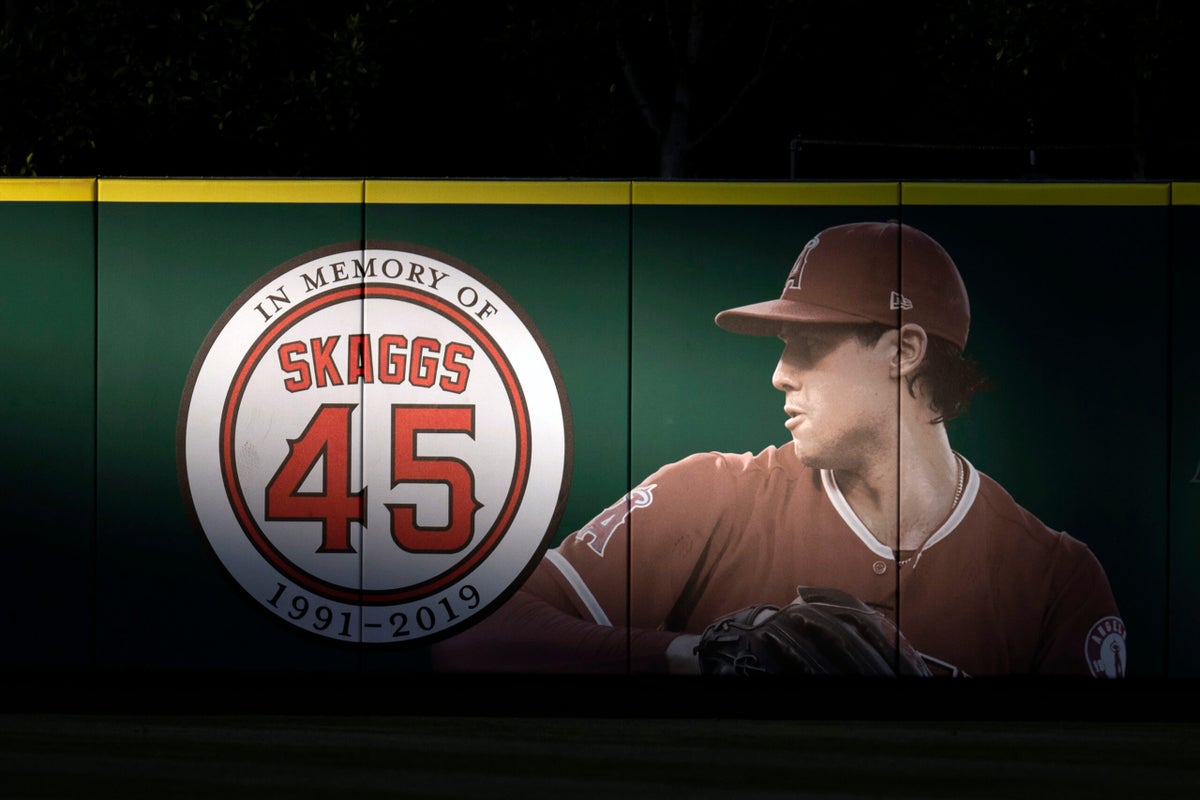
SANTA ANA, Calif. — Tyler Skaggs’ agent testified on Wednesday that he had a conversation with his client about the dangers of fentanyl at some point in the years before Skaggs’ death.
The conversation was not, however, a warning, said Ryan Hamill, the Creative Artists Agency’s co-lead baseball agent. It was, according to Hamill, intended as a credit to his client, who had overcome a 2013 opioid addiction and had been showing no signs of further drug use.
“I’m glad you have it in your rearview,” Hamill said he told Skaggs during that conversation.
Skaggs ingested a fentanyl-laced pill, which led to his death, on July 1, 2019. Ex-Angels communications director Eric Kay is serving a 22-year federal prison sentence for providing the pill, and Skaggs’ family is suing the team for wrongful death.
Court proceedings were briefly delayed on Wednesday, as a juror arrived nearly 50 minutes late for the second consecutive day. He was excused, leaving the trial with just one more alternate juror. In total, three jurors have been excused.
When trial testimony eventually began, Hamill testified that Skaggs told him about the genesis of his opioid use. It was then-Diamondbacks teammate Wade Miley who initially provided Skaggs with Percocet pills in 2013, Hamill said.
At the time, Hamill said he had noticed Skaggs was acting erratically and speaking with a different inflection. He testified that he confronted his client during an “intervention” at Skaggs’ home, where Skaggs came clean and acknowledged that he had a Percocet addiction.
Angels attorney Stephen Ladsous then established with Hamill that Miley and Skaggs were never teammates on the Angels, and that Skaggs had not been on the injured list at any point prior to making his MLB debut in 2013. This was seemingly intended to further their argument that both Skaggs’ drug sources and his drug use were not limited to the Angels, and that he didn’t abuse pills solely for recreational purposes. Miley has previously declined to comment on this topic.
Hamill also continually said that he never saw addictive behaviors in Skaggs in the years following his 2013 Percocet addiction. “Before he died, I did not think he was using,” Hamill said.
There had, however, been a conversation about drug use between the two in the years following that recovery. In August of 2018, Skaggs told Hamill via text message about a leg injury he’d been dealing with at the time. Hamill suggested asking the team to give him a Dose Pack — a prescription medication to help deal with inflammation.
Skaggs said he’d asked the Angels about getting one, but the team had advised they weren’t healthy to take, and could lead to issues like liver damage. As a result, Skaggs asked Hamill to get him one. Hamill responded, “I can go to jail for that.”
Hamill also told the story of another conversation between the two that the agent said took on more significance after Skaggs had died. In 2019, Hamill noticed that Skaggs’ wife, Carli, had not been on the road at all. “I do my own thing on the road,” Hamill said Skaggs told him.
Hamill didn’t pry, noting, “There are certain things as an agent you don’t want to know,” but made clear he did not believe Skaggs’ comment to be related to drug use.
Asked by Ladsous if he blames Skaggs for what happened, Hamill gave an emotional response.
“I don’t blame Tyler,” he said. “I just wish he would have told me.”
Hardin, the Skaggs attorney, utilized most of his cross-examination of Hamill to drive home the argument that pitchers are perpetually in pain. Hamill agreed, stating that ”every player is playing with some level of pain on a regular basis.”
Attempting to help bolster the Skaggs side’s damages case, Hardin attempted to ask Hamill about his client’s potential future value as a pitcher. The judge wouldn’t allow that testimony, given that it was never addressed during Ladsous’ direct examination. Still, Hamill noted, “I think he would have had a very lucrative career.”
Hardin also asked Hamill if he was present for the day when Skaggs and his mother, Debbie Hetman, met with surgeon Dr. Neal ElAttrache prior to Skaggs’ August 2014 Tommy John surgery. Hamill testified that he was, and that he recalled a conversation about not allowing Skaggs to be prescribed pain medication post-surgery, given his past Percocet use.
Hamill said he couldn’t remember if ElAttrache was present for this conversation, stating only “maybe” when asked. Hetman previously testified that ElAttrache had been notified.
That was notable, as ElAttrache — team surgeon for the Los Angeles Dodgers and Los Angeles Rams — had been called to testify earlier in the day on that exact topic. When questioned by Theodora, ElAttrache said he couldn’t recall ever being told about Skaggs’ past drug use.
ElAttrache said that his patient notes would not have necessarily included that information, even if he had been notified.
Forms filled out by Skaggs, and shown by defense lawyers, indicate that Skaggs did not disclose his past drug use. ElAttrache said he likely would have found different methods for addressing Skaggs’ post-surgery pain, had he been made aware.
Theodora established with ElAttrache that the surgery was being paid for through workers’ compensation, meaning the Angels would have had access to view those patient forms, and that Skaggs would have been aware of that fact.
Skaggs attorney Leah Graham tried to draw a distinction between ElAttrache — a renowned surgeon — and Angels team doctor Craig Milhouse, who testified earlier in the trial to prescribing 600 opioid pills to Kay from 2009-13. Skaggs lawyers have argued it was unnecessary and fueled Kay’s addiction.
“Have you ever prescribed 600 opioids to a patient,” Graham asked. ElAttrache said he hadn’t, noting he’d “never have a reason” to do so.
Graham also showed an email that ElAttrache wrote to then-Angels GM Billy Eppler shortly after Skaggs died. He expressed his “deepest sympathies” and his belief that Skaggs was a good person.
“He treated everyone at every level with kindness and respect,” ElAttrache wrote in the email. “I’m privileged to have known him.”