
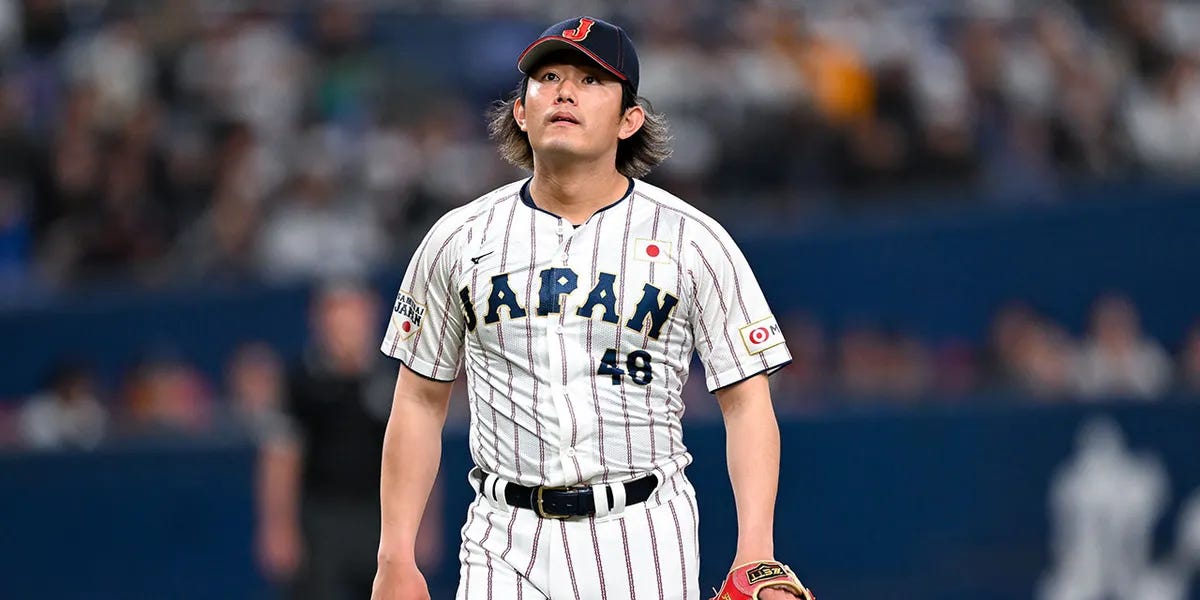
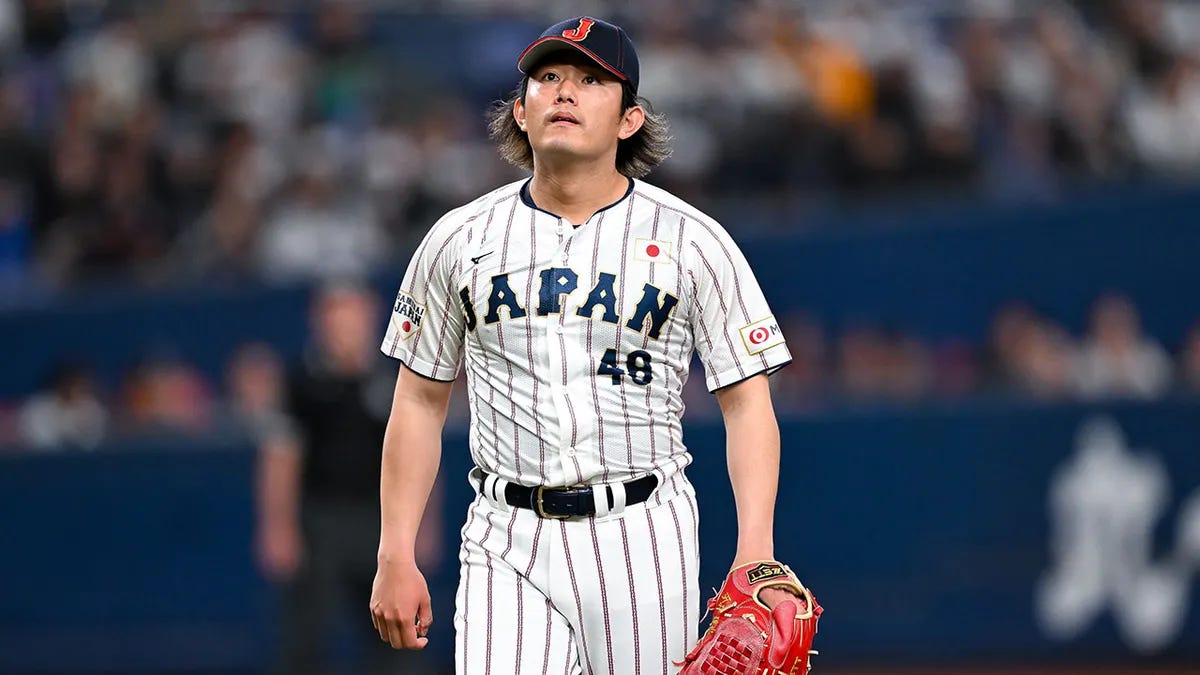
 It’s not a guarantee that Tatsuya Imai will be a Dodger – he said in an interview he’d rather “take them down” than join them.
Atlanta Braves President of Baseball Operations Alex Anthopoulos was up front and clear after the season that he wanted to add to the team’s rotation this winter.
“I would say rotation is absolutely front burner for us.”
He elaborated on that two weeks ago, after the team acquired utilityman Mauricio Dubón via trade and brought back closer Raisel Iglesias on a one-year, $16M deal. “We’re pretty deep when it comes to (the rotation). That doesn’t mean that we don’t want to insulate ourselves and have as much depth as we can and try to find someone that can help.” In the wake of uncertainty behind several members of the rotation coming back from injury – will Grant Holmes’ UCL that he rehabbed without surgery hold up? Will Reynaldo López be back to form after his shoulder surgery? – adding to the rotation is something the organization feels they need to do.
But in a bit of a surprise, this winter’s pitching market has moved faster than expected. Here’s what I noticed about the acquisitions so far.
As we discussed on Monday, the quality of a pitcher’s stuff matters a lot more than the results they’ve gotten on those pitches in this market. Dylan Cease, despite only once finishing with an ERA below 3.47, got $210M across seven years from the Toronto Blue Jays. After deferrals, the MLBPA is valuing the deal at $184.63M, an average annual value of $26.38M.
But the ‘Salaries for Stuff’ movement has spread beyond just Cy Young finishers.
Cody Ponce, a former Milwaukee Brewers 2nd-rounder who put up a 5.86 ERA for the Pittsburgh Pirates before decamping for the Pacific Rim after 2021, signed on Tuesday with Cease’s Blue Jays. After three mediocre years in Japan’s NPB, he won the KBO’s MVP award after leading Korea with a 1.89 ERA, striking out 252 in his 180.2 innings.
He promptly followed in the footsteps of fellow countryman Erick Fedde, who won the KBO’s 2023 MVP award and then came back stateside, by declaring his intention to sign domestically and return to MLB.
But unlike Fedde, who signed for two years and $15M with the Chicago White Sox, Ponce took advantage of the league’s focus on ‘Salaries for Stuff’ and got paid. He doubled Fedde’s guarantee with only one additional year, signing for three seasons and $30M guaranteed.
And again, it’s because of the Stuff.
Ponce raised his fastball velocity from averaging 93.2 with the Pirates in 2020 to averaging 95 and touching 98 with the Hanwha Eagles. Per Eno Sarris of The Athletic, Ponce added a kick-change while pitching in Asia and backs that with a cutter and a curveball. And my friend and fellow substacker
, who writes , discussed some potential changes to Ponce’s arsenal stateside that can help him get over the learning curve from KBO to MLB, including bringing back his old gyro slider and making his cutter the primary heater instead of the four-seamer.
Don’t worry, relievers are sharing in the joy of Salaries for Stuff. Of the three notable closers that aren’t ‘Raisel Iglesias returning to the Braves’ that have already signed, all three are among the best in the free agent market with regard to Stuff+. Ryan Helsley, who signed for 2/$28M with the Baltimore Orioles, was second among all MLB relievers and 1st among free agents in Stuff+ at 127, with Devin Williams (3/$51M with Mets) 2nd among free agents (and 28th overall) at 114 and Emilio Pagán (2/$20M with Reds) 4th among free agents (and 37th overall) at 112.
Further reporting has Pete Fairbanks (5th in the FA class and 37th overall at 112 Stuff+) on the shortlist of those expected to sign within the next week.
With MLB seemingly heading towards a lockout of the players next winter, something that I’ve speculated about has indeed come to fruition: Most free agents with any sort of leverage are avoiding one-year deals.
Outside of the qualifying offer players, who are locked into a one-year deal at $22.025M unless they negotiate a long-term extension, only one player has signed for more than seven million dollars on a one-year deal. Raisel Iglesias is getting his same $16M salary from the Braves to come back for one season, but outside of that, it’s a lot of smaller deals – 1/$7M for Cedric Mullins and 1/$3M for Jake Fraley, both with the Tampa Bay Rays, or 1/$2.75M for James McCann to be the backup catcher to Gabriel Moreno in Arizona with the Diamondbacks.
We’ve also seen multiple player options on deals, as both Helsley and Pagán have player options or opt-out clauses to preserve flexibility and ensure they have a contract for 2027. Of the 212 free agents who received multiple contract predictions on FanGraphs writer Jon Becker’s tracking sheet, 160 of them are expected to receive multi-year deals, an unusually high number that illustrates the desire on the part of players to not potentially be twisting in the wind without a team next winter.
ESPN wrote on Monday about the impact of the pending lockout on negotiations this winter, with some teams operating as usual but several organizations being more hesitant to make significant commitments. The Chicago Cubs were specifically mentioned, with the story relaying comments from president Jed Hoyer made at the end of last season. He explained that the organization is working to have most of its player contracts end after 2026, just to have as clean a balance sheet as possible heading into a potential labor stoppage and lost games. As of Wednesday night, only shortstop Dansby Swanson (signed through 2029) and reliever Phil Maton (signed through 2027) have guaranteed money from Chicago past this upcoming season.
The success of Los Angeles Dodgers pitcher Yoshinobu Yamamoto, considered undersized by MLB standards at 5-10, 176, has MLB teams being more open to non-prototypical-sized starters.
And Tatsuya Imai might just be the next beneficiary.
Measuring in at 5-11, 154, the 28-year-old has drawn comparisons to similar diminutive starters like Tim Lincecum (5-11, 170) and Marcus Stroman (5’7, 180).
But his stuff is anything but.
Fresh off a 1.92 ERA across 163.2 innings of work in his most recent NPB season, Imai throws six pitches but lives off a four-seamer/slider/changeup trio.
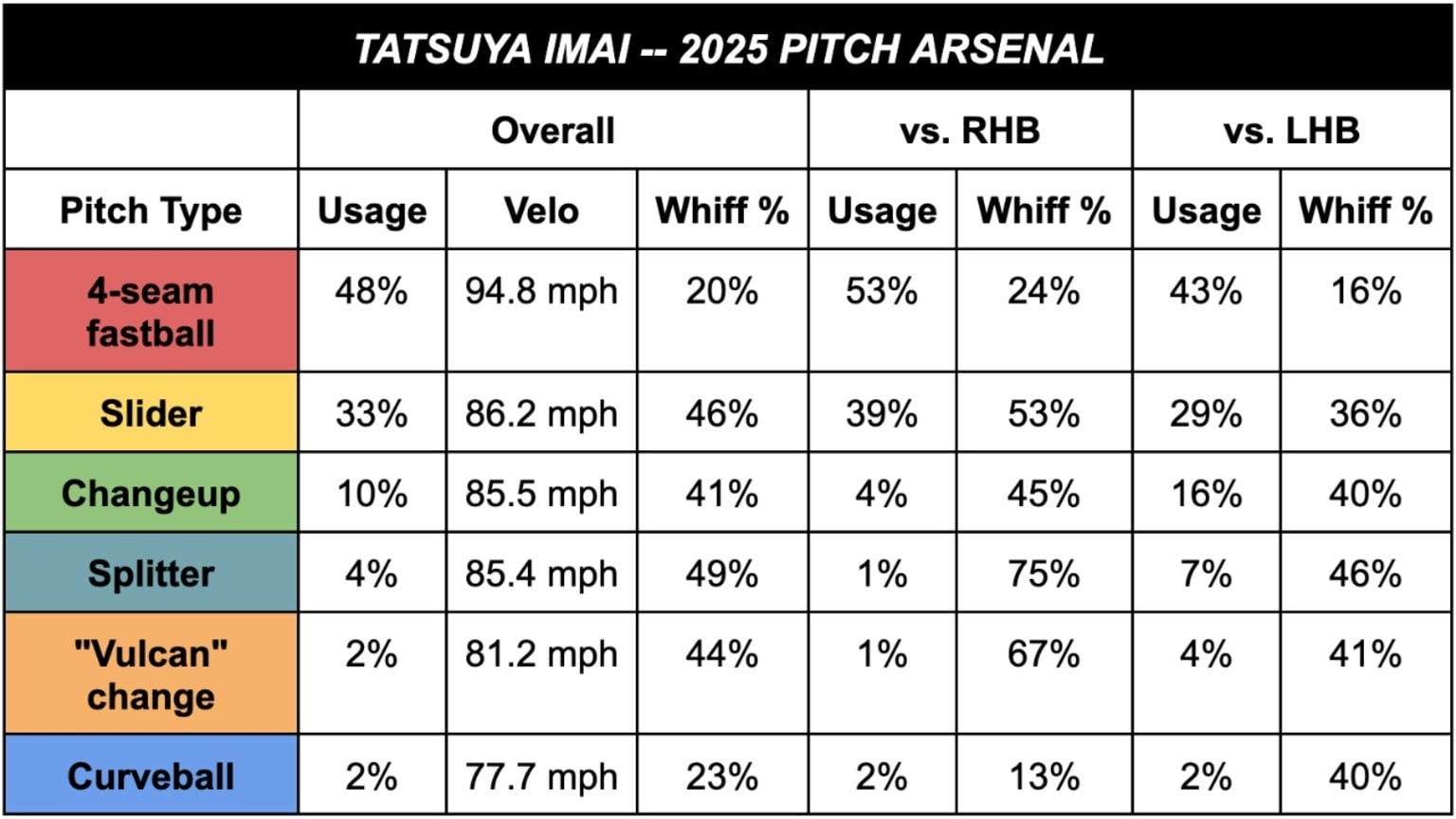 Credit NPB Pitch Profiler (and Google Translate)
Throwing out of a low slot, his pitch mix mirrors Seattle Mariners veteran Luis Castillo but sports the fastball of Minnesota Twins starter Joe Ryan, which grades out as a 107 Stuff+ (at only 93.6 mph, not Imai’s 95+). He also sports a trio of offspeed pitches, throwing both a conventional changeup as well as a Vulcan change and a plus splitter. His slider often gets compared to that of Trey Yesavage of the Toronto Blue Jays, referred to as a “reverse slider” because it breaks arm side instead of glove side, opposite the standard movement of a slider.
It’s a wicked package on paper, albeit one that I’m curious to see how it utilizes a splitter out of that specific low slot – Yesavage has a lot of success with his 4S/splitter/slider attack because of his exceptionally high slot, which helps the vertical deception of both the slider and the splitter off of the fastball. Castillo throws almost sidearm as well (15° arm angle in 2025), and he eschews a splitter altogether.
Imai is reportedly coming to the United States this week to meet with interested teams; his posting window began on November 19th, and he needs to sign a deal by January 2nd or else return to play in NPB for 2026. Any team signing Imai will need to allocate funds to his posting fee, as well; it’s a sliding scale based on the value of the contract, although that payment is not accounted for in CBT calculations.
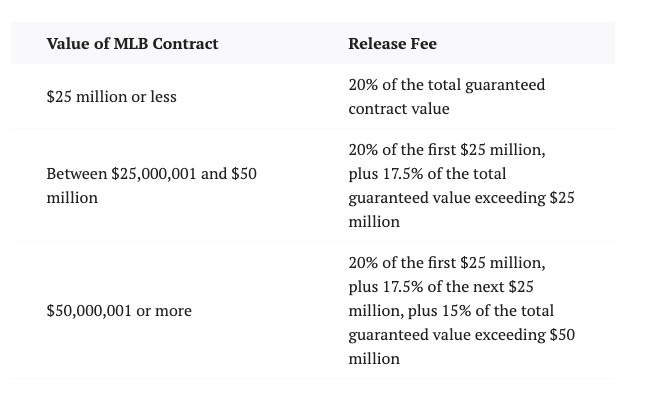
For the Jon Becker-tracked median projection of 6/$127.5M, Imai’s posting fee would come out to roughly $21M in additional spend this offseason. That’s roughly one quarter of the earnings of Atlanta Braves Holdings from their real estate investments and mixed-use development, meaning that The Battery Atlanta can directly contribute towards the success of the 2026 team by covering that one-time expense.
I’m honestly a bit skeptical as to the longevity of a player that measures in at 154 pounds, although it’s not without precedent in MLB. Just this last season, both Reese Olson of the Detroit Tigers and Daniel Palencia of the Chicago Cubs played and excelled at a listed weight of 160 pounds.
Let’s see if Alex Anthopoulos agrees with me.