
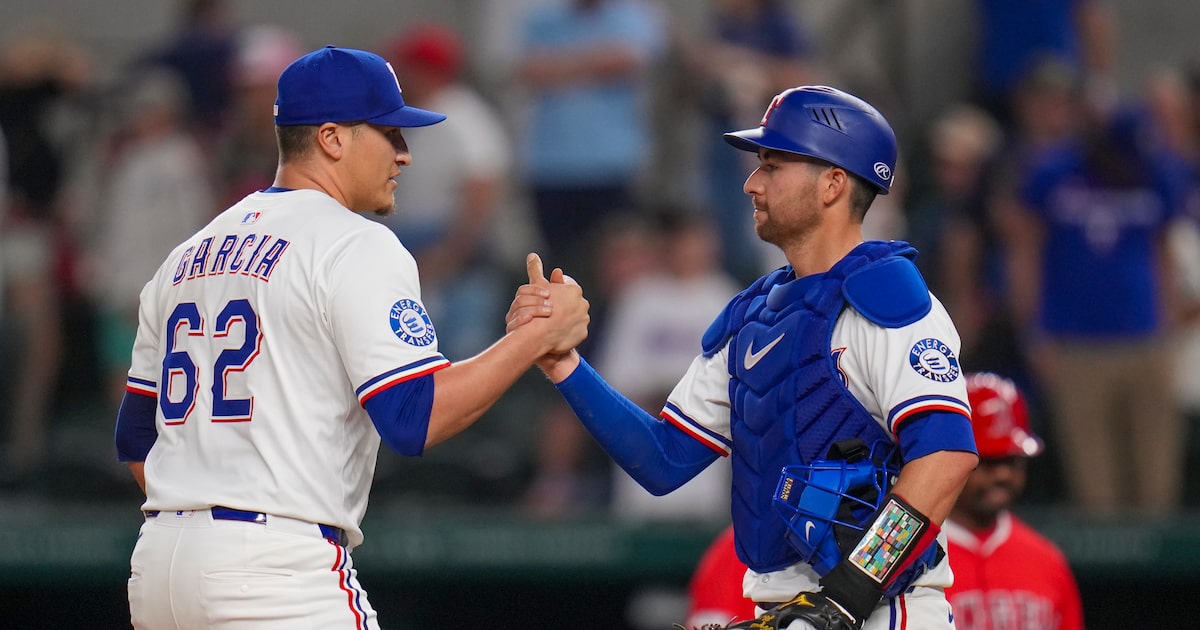
As the winter meetings approach, it might be a stretch to call the Rangers‘ catching situation “dire.”
Then again, it might be pretty accurate.
Allow us to take stock. They currently have on-hand Kyle Higashioka and recent waiver acquisition Willie MacIver. Higashioka, who turns 36 in April, started 68 times behind the plate. It would be difficult to imagine him carrying any heavier of a workload than that going forward. MacIver, who turned 29 in October, made his MLB debut in 2025, starting 29 games behind the plate and posting an OPS of .576, which was lower than that of since non-tendered Jonah Heim. MacIver has minor league options, which makes him a potentially nice depth option. That’s the list. There is nothing on the horizon in the minors.
At the winter meetings, teams like to shop, which often means surveying options. The Rangers have to be in more of a must-buy option, which isn’t ideal when talking with agents or other teams, especially with a talent pool as shallow as catcher. Oh, and did we mention the Rangers are a little low on funds these days? OK, well they are. And prospects to dangle in trades? Um, running a little low there, too.
Rangers
Can we add one more thing? At the moment, they stand to be in even more dangerous waters at this time next year when Higashioka is a free agent.
So, hey, go work some magic guys.
Or, as Chris Young likes to say: “Every challenge is an opportunity.”
The Rangers’ “opportunity” here is to first view addressing the catching issue through several lenses, rather than simply looking for the best available player on the market. Besides, the best available free agent, Philadelphia’s J.T. Realmuto, is likely well out of their price range. The same can be said in terms of prospect equity about the chance of pursuing Baltimore’s Adley Rutschman, who might be the top name moved on the trade market.
Ideally, they’d solve the issue. If not, they hope to address it, buying a couple of years for their farm system to try again. Or they could procrastinate, doing just enough to get through 2026, knowing they’ll have to do this all over again next year. Lastly, they could pursue a hybrid attempt, putting together a patchwork group for the upcoming season while simultaneously pursuing a prospect catcher who could be ready by the start of 2027.
There are options in each category.
Solving it
It requires a trade partner with catching depth, which is something of an oxymoron, but both Kansas City and the Chicago White Sox qualify. Salvador Perez is still catching more than half the Royals’ games and 21-year-old prospect Blake Mitchell might be ready for everyday play by the start of 2027. It puts 22-year-old Carter Jensen, a player the Rangers have liked for a while, in a bit of a vise. He’s blocked from significant MLB playing time and may be pushed soon by Mitchell.
Jensen, a left-handed hitter with a minor league OBP of .364, is also the No. 2 ranked catching prospect in the game and the 39th-ranked prospect overall, according to MLB Pipeline. He won’t be cheap. In all likelihood, the ask for him would be Sebastian Walcott, the No. 6 ranked prospect in all of baseball and the closest thing the Rangers have to an untouchable. Maybe there is a package with secondary prospects to explore.
Maybe it pushes the Rangers toward another option: the White Sox, who have two young catchers, Kyle Teel and Edgar Quero, sharing duties. Makes sense for the White Sox to leverage one for more talent and give a legitimate starting role to the other. Neither is likely to cost Walcott, but would likely command multiple prospects from the next tier down.
The Dodgers, with elite Will Smith behind the plate and under long-term control, might consider moving Dalton Rushing, who entered 2025 as the game’s No. 22 prospect. A bit higher prospect than Teel was, but also two years older. The Dodgers’ deep farm system could create the right circumstances for a package that might be more amenable to the Rangers if they consider moving Walcott. Right-hander Emmett Sheehan, for example, could slide right into the Rangers’ rotation and reduce the need for free agent spending on starting pitching.
Buying time
The thinking here would be about getting two or three years worth of serviceable catching, while hoping that 2024 first-round pick Malcolm Moore really steps up his development or that another catcher arises from a so-far underachieving group of prospects.
The pool here would be arbitration-eligible guys available via trade, like perhaps Pittsburgh’s Joey Bart or San Diego’s Freddy Fermin. Bart, in his second year of arbitration eligibility, would have two years to free agency. He had a big year in 2024, but his 2025 season was more in line with his career norms, a .696 OPS and a 3.5-to-1 strikeout-to-walk rate. Fermin, who at 30 is a year older than Bart, has similar offensive numbers, but is a bit better on the defensive end. He’s also in his first year of arbitration, so he’d have three potential years to free agency, though he’s always profiled more as a platoon/backup.
To go here, the Rangers could probably draw from their second-tier of talent, but make no mistake, there is a big drop between the top tier (Walcott) and the second tier, which probably starts with big upside right-hander Caden Scarborough or infielder Devin Fitz-Gerald.
Short-term patches
The idea here would be to most likely land a free agent like Higashioka last year, willing to take a max two-year deal around $6 million-7 million per year. The group is basically Victor Caratini, who has had solid offensive numbers the last two years and has one season in which he caught more than 80 games, and Danny Jansen, who started 82 games last year between Tampa Bay and Milwaukee and has a .721 career OPS.
One other even shorter-term possibility: Minnesota’s Ryan Jeffers, who is in the last year of salary arbitration and has averaged 73 starts a year behind the plate the last five seasons. The Twins tore down most of their roster at the trade deadline last year. They could go a little farther this winter. Jeffers is projected to get about $6.5 million in salary arbitration. It’s a hair over what Heim was projected to make, but a lot more production. The downside: You are paying $6.5 million plus a prospect. Makes him more like an $8.5 million investment.
The hybrid plan
The Rangers could pluck from more than one of these schools to potentially build a fix that handles the short term and provides possibilities for the long term. Go get one of the free agents and trade for a catching prospect who might not be ready to step in immediately, but might be in a year or even at mid-season, somebody like the Athletics’ Daniel Susac or Cleveland’s Cooper Ingle.
It’s a lot to try to juggle and massage, but the Rangers don’t have any choice. They are in a catching crunch.
Podcast: Cowboys’ playoff hopes, farewell to Rangers heroes and CFP talkBaseball Hall of Fame reveals committee members who will consider Bonds, Clemens, others
Find more Rangers coverage from The Dallas Morning News here.
Click or tap here to sign up for our Rangers newsletter.