
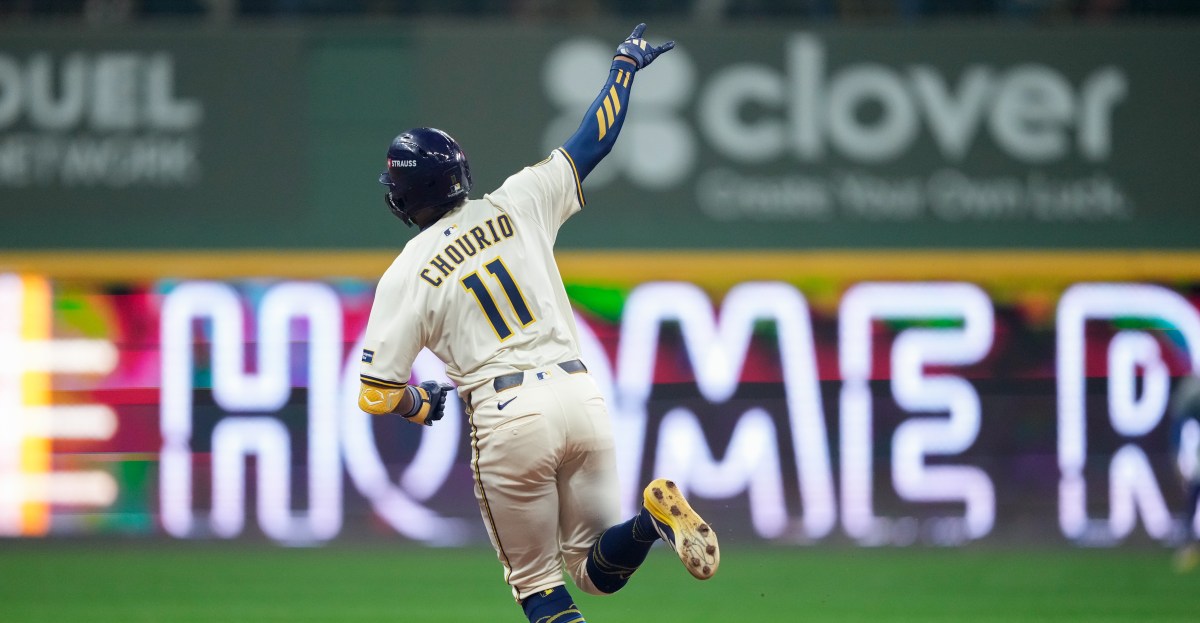
Jackson Chourio’s 2025 season was not, exactly, a disappointment. Despite a slow start, he finished with a 112 OPS+ and between two and three WAR (2.2 via Baseball Reference and 2.9 via FanGraphs) while playing a whole bunch of center field, something he wasn’t exactly expecting to do at the beginning of the season. It can also be said that he didn’t build particularly well on the torrid streak he was on at the end of his rookie campaign in 2024, which is in some ways disappointing. But after a reasonably strong finish and a good postseason, it was evident that Chourio, who does not turn 22 until March, still has potential that is bursting at the seams.
As Chourio neared the end of a historic age-20 season when he was a rookie, I was curious about where his success at such a young age stood in historical context. I wrote that in the expansion era (1961 onward) there had only been 24 seasons in which a position player as young as Chourio earned three or more WAR (he finished with 3.8 via Baseball Reference and 3.9 via FanGraphs).
Two years later, Chourio is still in rarefied air. I wanted to write an update to that story and see what the following seasons looked like for players who were that good that young. So, I made a list: all the expansion-era players who earned six bWAR through their age-21 seasons (Chourio is at exactly six). That list has 18 players, including Chourio:
Mike Trout (2011-13, 19.9 WAR)
Ken Griffey Jr. (1989-91, 15.6 WAR)
Alex Rodriguez (1994-97, 14.4 WAR)
César Cedeño (1970-72, 11.9 WAR)
Carlos Correa (2015-16, 11.7 WAR)
Johnny Bench (1967-69, 10.7 WAR)
Juan Soto (2018-20, 10.4 WAR)
Bryce Harper (2012-14, 9.9 WAR)
Ronald Acuña Jr. (2018-19, 9 WAR)
Jason Heyward (2010-11, 8.4 WAR)
Rickey Henderson (1979-80, 7.9 WAR)
Tony Conigliaro (1964-66, 7.5 WAR)
Giancarlo Stanton (2010-11, 6.9 WAR)
Fernando Tatis Jr. (2019-20, 6.8 WAR)
Albert Pujols (2001, 6.6 WAR)
Julio Rodríguez (2022, 6.2 WAR)
Tom Brunansky (1981-82, 6.1 WAR)
Jackson Chourio (2024-25, 6 WAR)
Again: an exciting list. Three of those players are already in the Hall of Fame (Griffey, Bench, Henderson), two are just waiting until they’re eligible (Trout, Pujols), two are active players who are almost certain to get there (Soto, Harper), two are active players who might have a shot (Correa, Stanton), and three others are some of the more exciting under-30 players in the game (Acuña Jr., Julio Rodríguez, Tatis Jr.). Alex Rodríguez, of course, would’ve been a Hall of Famer without steroids. Heyward and Cedeño aren’t Hall of Famers but they had excellent careers. The only players on this list who either didn’t retire with over 40 bWAR or aren’t on a solid path to getting there are Conigliaro, who had three good seasons in his early 20s but was hit in the face by a pitch when he was 22 and was never the same after, and Brunansky, whose age-21 rookie season was his best, but who had a long career and finished with over 1,500 hits and 271 homers.
Now, what did those players do in their age-22 seasons? I’ve grouped them into a few categories, with their age-22 WAR total in parentheses.
Category One: Always Awesome
Mike Trout (7.7), Alex Rodriguez (8.5), Johnny Bench (7.4), Juan Soto (7.3), Rickey Henderson (6.7), Albert Pujols (5.5), Julio Rodriguez (5.5)
These players were great at the beginning of their careers and maintained basically that level from the start. Trout won his first MVP in his age-22 season, but his WAR totals were actually better the two years prior, both seasons in which he finished second in MVP voting. How easy it is to forget that, not that long ago, Trout was the best player we’d seen in a generation.
A-Rod had one of the best age-20 seasons ever in 1996, took a modest step back in 1997, and was back over eight WAR in 1998. Steroids or not, he’s one of the greatest players ever. Bench had a historic rookie season in 1968 when he was 20, and two years later he set a record for catchers by hitting 45 homers, which won him his first of two MVP awards; he is now considered the greatest catcher of all time, non-Josh Gibson division.
Soto, at age 20, had a 142 OPS+ and was a crucial contributor to a World Series winner. His age-21 season happened during Covid, but by rate stats it is his best year to date: he hit .351 and won the slash-line triple crown. At 22, Soto had 7.3 WAR and finished second in MVP voting. He’s basically been that guy for his whole career.
Henderson was actually bad in his first season in 1979, when he was 20… but then had 8.8 WAR (and 100 stolen bases) in his next season. His age-22 season came in the 1981 strike year, in which he had 6.7 WAR and 56 steals in only 108 games. Henderson would have at least six WAR in each of the first ten seasons in which he played at least 100 games. He is a top-30-ish player all time.
Pujols and J-Rod are outliers on this list because they reached the six-WAR threshold while playing in just one season; Pujols had 6.6 in 2001 and Rodríguez had 6.2 in 2022. Both players had moderate sophomore “slumps,” as both had 5.5 WAR in their age-22 seasons. But for Pujols, that 5.5 WAR season was the “worst” of his first ten years, and while Rodríguez hasn’t quite hit the inner-circle MVP contender status that many expected after his rookie season, he has averaged 5.7 WAR through his first four years.
Category Two: More sporadic, but it has mostly worked out
Bryce Harper (7.3), Ronald Acuña Jr. (2.4 in 46-game Covid season), Fernando Tatis Jr. (6.6), Carlos Correa (6.7)
Harper, one of the most-hyped prospects ever, won Rookie of the Year at 19 with a 5.2 WAR season. He made an All-Star Game at 20 but played only 118 games that year, then had a rough age-21 season with 1.0 WAR in 100 games. Then, at 22, he exploded for one of the best seasons of the 21st century, a 9.7 WAR masterpiece in which he hit 42 homers while hitting .330/.460/.649 and had a 198 OPS+. That was Harper’s first of two MVPs, but his WAR totals from the five years that separated those two awards were 1.6, 4.7, 1.7, 4.5, and 1.9. He’s probably on his way to the Hall of Fame, but it hasn’t been a linear journey.
Acuña, the player who Chourio is most often compared to, showed major early promise and had a fifth-place MVP finish when he was 21. But then there was a pandemic, and the first of two major knee injuries in Acuña’s career, which cost him half of 2021 and part of 2022. When Acuña was fully recovered in 2023 (at age 25), all he did was become the first player to ever go 40/70, and he won the MVP. Unfortunately, he struggled through the first third of the 2024 season before tearing his ACL again, but he looked good in 95 games after returning in 2025.
Tatis’s early career is more difficult to parse. He entered 2019 as a consensus top-three prospect, and in just 84 games at age 20 he hit 22 homers—as a shortstop—and earned 4.0 WAR. He was even more impressive in the shortened pandemic season, and then at age 22 he led the NL in homers and finished third in MVP voting. But then he had a dumb injury and got suspended for PED use. His hitting has never returned to pre-suspension levels, but he’s still a solid offensive presence, and after a position switch he’s become one of the best defensive outfielders in the league. Even after the PED suspension, Tatis has averaged 5.6 WAR per 162 games.
Correa, the first pick in the 2012 draft, earned 4.7 WAR in 99 games and won Rookie of the Year when he was 20. He followed that up with a seven-WAR season in 2016 and 6.7 in his age-22 season. He then had three down-ish years, but returned to form in 2021 and was fifth in MVP voting. Correa’s health is an issue as he reaches his 30s but he still has 45.7 career WAR via Baseball Reference and it’s not out of the question that if he can stay relatively healthy and have a couple more (what would now have to be called surprising) good seasons, he will have a Hall of Fame case.
Category Three: A mostly upward trajectory
Ken Griffey Jr. (5.8), Giancarlo Stanton (5.4)
Junior was always good—he was third in Rookie of the Year at age 19 and then got MVP votes in nine of the next ten years. But it took a few years before we got to the fully realized version of Griffey: his home run totals in his four seasons, which covers ages 19-22, were 16, 22, 22, and 27. It was when he was 23 that Griffey’s power bat blew up, and he finished in the top five in MVP voting in four of the next five years, missing out only in an injury-shortened 1995 season.
Stanton might have the most “typical” trajectory of anyone on this list. His WAR totals in his first five seasons: 2.8, 4.1, 5.4, 2.8 (only 116 games), and 6.5. That 6.5 number led the NL, as did his 37 homers and .555 slugging percentage that season. Stanton had some injuries in 2015 and 2016 but then won an MVP at age 27 in 2017 when he led the majors with 59 homers and 132 RBI and led the NL with 8.1 WAR. After that, he was traded to the Yankees, and while he’s had his moments (especially in the postseason), it has been a struggle to stay healthy and effective. Still—Stanton is the sport’s active leader in homers with 453, and with two guaranteed years left on his contract, he’s got a real shot at reaching 500. There has never been a player with 500 homers and no ties to PEDs who didn’t make the Hall of Fame. Stanton could be the first real test of that.
Category Four: The Early Peakers
César Cedeño (7.4), Jason Heyward (5.5), Tony Conigliaro (3.7), Tom Brunansky (2.8)
This is an interesting group. Cedeño, at age 21, was a power-speed threat who played breathtaking center field defense. He led the league in doubles, stole 55 bases, hit 22 homers, and hit .320/.385/.537. At 22, he followed that up with a nearly identical .320/.376/.537 batting line, 25 homers, 56 steals, and a second straight Gold Glove. From 1974-77, he was still good… but not as good. He didn’t slug over .461 in any of those four seasons, and the dip in power dropped him from 7-8 WAR territory to four straight seasons of between 4.5 and 6 WAR. Then, at age 27, he hurt his knee and was never the same. In eight seasons from 1970-77, from ages 19-26, Cedeño earned 40.2 WAR in 1,111 games. From 1978 until his retirement in 1986, he earned 12.9 WAR in 895 games, despite starting that run at what is typically viewed as the start of a player’s peak, his age-27 season.
Heyward was a valuable player for a long time, mostly because he was an excellent defensive corner outfielder. But he had a couple early seasons in which he was a good hitter, too, and he had seasons of 6.4, 5.5, 5.5, and 7.0 WAR between 2010 and 2015 (with a couple of other not-as-good seasons sprinkled in there). But after 2015, though he was only 26, Heyward never again earned more than 2.4 WAR in a season. He just couldn’t figure it out with the bat; he had a 114 OPS+ through his first six seasons and an 88 OPS+ over his next ten. He still finished with 41.5 WAR (though FanGraphs isn’t as kind), 1,575 hits, five Gold Gloves and a myth-building World Series speech.
We already discussed Conigliaro and Brunansky, but a quick review: Conigliaro looked like a star but his unfortunate injury altered his career in a major way, and he was basically done with major-league ball after his age-26 season. Brunansky played 14 years and was a useful offensive player in most of them, but he never again came close to the heights of the 5.6 WAR he earned at age 21.
What does it mean for Chourio?
Chourio did take a step back in 2025, but it doesn’t really mean anything; A-Rod, Harper, Heyward, and Conigliaro were all worse at 21 than they were at 20 (Trout had a lower WAR total but I’m not going to call an 8.9 WAR season “worse”), and Pujols and J-Rod both took modest steps back after excellent first seasons at 21.
What this exercise tells me is that the career that Chourio has had at his age is a major harbinger of future success. 15 of these 17 players had or are having excellent careers, and of the two remaining, one had extenuating circumstances; only Brunansky can be truly viewed as a cautionary case. The other thing it tells me is that many great baseball players kind of just are always great baseball players; I came into this expecting to see a major “jump” for some of these players at 22, but that’s not really what I found. Most of them were already good when they were 20, and that makes sense, because you have to be good to get that kind of shot at that age.
For as jittery as we might be about Chourio not having taken a meaningful step forward in 2025, I think we can safely say that it does not at all mean that isn’t still on the precipice of stardom. Could it mean that? Sure. But the much more likely scenario is that, given broad career success of the players who Chourio accompanies on this list, big things are in his future.