
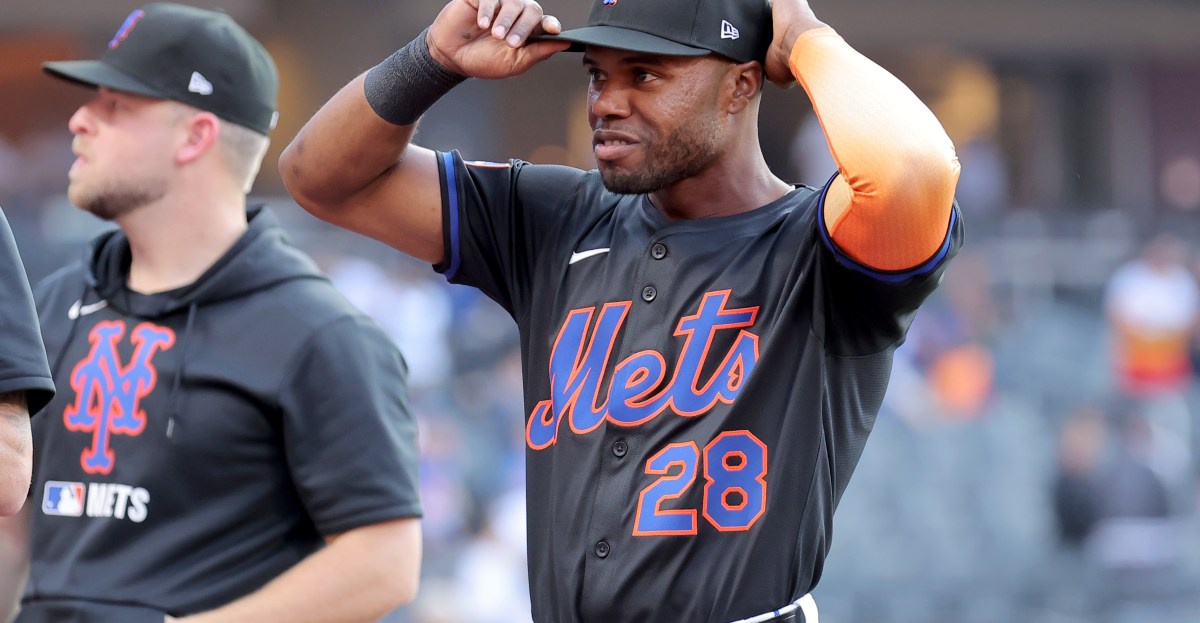
The Rays made an aggressive move this week, getting out ahead of the bustle and competition of the winter meetings by signing outfielder Cedric Mullins to a one-year, $7 million contract.
The move brings a respected veteran presence to a young and fluid outfield group, and marks a meaningful investment in a player whose recent track record suggests both reliability and potential for rebound.
Mullins, now 31, arrives with extensive AL East experience after seven and a half seasons with Baltimore and a brief stint with the Mets. While his offensive production has declined since his six-win, 136 wRC+ All-Star campaign in 2021, the Rays appear to be betting that last season’s struggles at the plate were not reflective to his true talent.
Tampa Bay has long targeted players with disciplined approaches, and Mullins’ consistently low chase rate over his career, solid bat-to-ball skills, and strong baserunning profile align with what the organization tends to value overall when adding talent from the outside. Add in that he can man center field, and it’s an easy addition that the Rays Your Voice podcast was already championing this off-season.
Whether Mullins becomes the primary center fielder remains an open question. Online reactions quickly leaned in that direction, but his defensive profile is more nuanced. Outs Above Average continues to view him positively in center, while other metrics suggest he has lost some range with age. The Rays, though, have the flexibility to align their outfield in multiple ways. Jonny DeLuca remains a capable option in center field, and Mullins’ versatility gives the club the ability to shift players around depending on matchups, ballpark, and health.
Tampa Bay’s decision to commit $7 million to Mullins signals confidence that he represents a meaningful upgrade over the in-house depth options. While players such as veteran addition Jake Fraley and in-house answer Jake Mangum offered cost-controlled alternatives, Mullins brings a stronger overall track record, a solid clubhouse presence for a young team that had only four players on the roster with 5+ years of service time, and a history of reliably above-average baserunning.
Mullins’ evolving offensive profile may also intrigue the Rays’ hitting group. Over the past year, he has increased the rate at which he lifts and pulls the ball, a shift that has historically allowed left-handed hitters to unlock additional power. The adjustment came with a drop in his batting average on balls in play, but it also hints at mechanical malleability the Rays may believe they can refine. Mullins’ swing tendencies, particularly his approach with two strikes, were also atypical in ways that could either be optimized or strategically left untouched depending on the club’s evaluation.
What may be more interesting than adding a proven vet, though, may be what the implications for the broader roster.
With a crowded mix of left-handed outfielders, the signing should accelerate trade conversations involving players like Josh Lowe, Chandler Simpson, or Mangum. The team’s projected payroll, which is expected to fall in the $80–90 million range, will additional balancing before the offseason is complete.
Overall, Mullins represents a stabilizing force: a veteran with postseason experience, a strong defensive reputation, and the type of well-rounded skill set that has historically helped the Rays thrive. If the hitting coaches can coax even a partial rebound at the plate, the signing could prove to be one of the more quietly effective moves of their winter.