
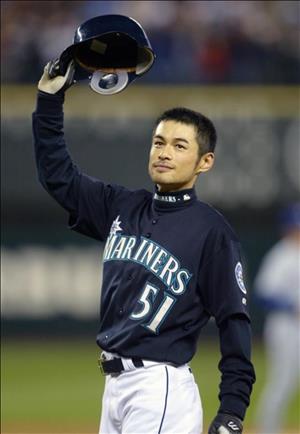
On July 27, 2025, fomer Seattle Mariners outfielder Ichiro Suzuki is inducted into the National Baseball Hall of Fame in Cooperstown, New York. Born in Japan in 1973, Ichiro played professionally in his native country until 2001, when he began his U.S. career with the Mariners as the first Japanese position player in the major leagues. The Mariners’ career leader in hits, batting average, triples, and stolen bases, he joins Ken Griffey Jr., Edgar Martinez, and broadcaster Dave Niehaus as Mariners representatives in the Hall of Fame. Across his professional career in the U.S. and Japan, Ichiro tallied 4,367 hits – the most in baseball history.
Japanese Icon
Ichiro is acclaimed as one of the greatest leadoff hitters and defensive right fielders of all time. His career achievements in Major League Baseball include 10 All-Star selections, 10 Gold Glove awards for defensive excellence, and three Silver Slugger awards as the best-hitting right fielder in the American League. While he played the backside of his career with the New York Yankees (2012-2014) and Miami Marlins (2015-2017), Ichiro is most closely associated with the Mariners, for whom he played 14 seasons and later worked as a front-office special assistant and unofficial team ambassador. The Mariners retired his No. 51 jersey during a ceremony at T-Mobile Park on August 9, 2025.
Ichiro had been met with some skepticism when he arrived in Seattle a quarter of a century earlier. At 5 feet 11 inches tall and 170 pounds, he was unimposing physically, and while he had captured seven consecutive batting titles with the Orix Blue Wave in Japan’s Pacific League, no position player had ever made the transition from Japan to Major League Baseball. Would his skills translate to tougher competition? Convinced that they would, the Mariners paid Orix $13.25 million for exclusive negotiating rights, and then signed Ichiro to a three-year, $14 million contract in November 2000. As Manny Randhawa would write for MLB.com:
“Then emerged on the scene a diminutive outfielder who upended the game with a peerless combination of artistry, precision and flair in an era dominated by brute strength and record-breaking power. He changed the landscape of the game on two continents, bridging 5,000 miles of ocean between them with a throwback brand of baseball that thrilled fans and utterly flummoxed the opposition. His impact on Japanese baseball and its export to the West – and even on Japan as a whole – cannot be overstated” (“Ichiro Suzuki Has Had a Lasting Impact …”).
Ichiro captivated his U.S. audience right away. He made his major league debut in front of 45,911 fans in Seattle on April 2, 2001, collecting two hits against the Oakland Athletics. In his eighth game, in Oakland, he threw out a runner at third base with a throw so beautiful, wrote the Seattle Post-Intelligencer, that it should be “framed and hung on the wall at the Louvre next to the Mona Lisa” (“Ichiro Sparkles …”). The Mariners won 116 games that season, tying the major league record. Ichiro won the American League batting title with a .350 average, amassed 127 runs and 56 stolen bases, and became the second player to win his league’s Rookie of the Year Award and MVP Award in the same year, joining Fred Lynn of the Boston Red Sox, who did it in 1975.
The rest of his Seattle careeer was more of the same. In 2004 he accumulated 262 hits, breaking the major league record of 257 set by George Sisler in 1920. A dazzling performance at the 2007 All-Star Game in San Francisco, in which he hit an inside-the-park home run, earned him game MVP honors. He piled up more than 200 hits in each of his first 10 seasons. All the while, aspiring Asian ballplayers looked his way for inspiration. Cleveland outfielder Steven Kwan, of Chinese and Japanese descent, said Ichiro “was a player who looked like me: Left-handed, played the outfield. It kind of gave me hope at a really young age to see that someone who looks like me, plays like me, is able to succeed at the highest level and, not only that, gain the respect of everybody in the league too” (“As Ichiro Suzuki …”). Arizona outfielder Corbin Carroll grew up in Seattle, frequently attended Mariners games “and was similarly in awe of Suzuki. Carroll, who is of Taiwanese descent, said he still remembers sitting in the right-field bleachers with his family as his mother snapped a photo of Suzuki striking his signature pose” (“As Ichiro Suzuki …”).
Ichiro’s Seattle tenure flamed out in 2012. The club had missed the playoffs for 10 consecutive seasons and was in the throes of rebuilding, so on July 23, 2012, the M’s traded Ichiro to the Yankees for two pitching prospects. Six years later, after stints with the Yankees and Marlins, he returned to Seattle, signing a one-year contract in March 2018. He appeared in 15 games that season and returned briefly in 2019 when he joined the Mariners for a two-game series in his native Japan. Ichiro announced his retirement at the same time. Seattle sportswriter Greg Johns, traveling with the Mariners, wrote that Ichiro “gathered himself for a final hurrah in front of a sold-out Tokyo Dome crowd that cheered his every move and then bid farewell to baseball and his Japanese fans in a touching tribute that brought goosebumps to an entire nation and tears to the 45-year-old’s eyes” (“Ichiro Retires …”).
Baseball Immortal
The Baseball Writers Association of America selects Hall of Fame members in an annual vote. No one doubted that Ichiro would be elected when the results were announced on January 21, 2025, though the voting was controversial nonetheless. Ichiro, who was on the ballot for the first time following a mandatory five-year waiting period, came within one vote of being a unanimous selection, a feat achieved by only one player, Yankees relief pitcher Mariano Rivera in 2019, in 81 years of voting by the baseball writers.
Joining Ichiro in the Class of 2025 were pitchers Billy Wagner (b. 1971) and CC Sabathia (b. 1980). Outfielder Dave Parker (1951-2025) and first baseman Dick Allen (1942-2020) were inducted posthumously. Wagner, a left-handed relief pitcher, recorded 422 saves over 16 seasons. Sabathia was one of six pitchers in MLB history with at least 250 wins, a .600 winning percentage, and 3,000 strikeouts. But when the baseball world gathered in Cooperstown, New York, for the July 27 induction ceremonies, Ichiro was the unquestioned star of the moment. Wrote MLB.com:
“There he was, in the flesh, at the Otesaga Resort Hotel on the eve of his induction into the National Baseball Hall of Fame: Ichiro Suzuki himself. So strong is Ichiro’s aura that even two of the game’s all-time greats – Mike Schmidt and Carlton Fisk – sheepishly debated whether they should approach him and say hello. (Don’t worry, they did, and of course Ichiro knew exactly who they were.)
“What does it say about Ichiro that he can leave even his fellow Hall of Famers in awe? And what does it say about his global impact that tons of Mariners fans and Japanese visitors flocked to this tiny, remote village and that Main Street even had a temporary store devoted entirely to Ichiro merchandise?” (“Ichiro Headlines …”).
In an acceptance speech lasting some 19 minutes, Ichiro thanked former and current Mariners owners and front-office executives Hiroshi Yamauchi, Pat Gillick, Howard Lincoln, Chuck Armstrong, Jerry Dipoto, Kevin Martinez, and John Stanton. He spoke of his maniacal dedication to baseball, his rigorous offseason workout routine, and his ongoing quest for excellence. He told of his childhood dreams, though, he said, “I could never imagine as a kid in Japan that my play might lead me to a sacred baseball land that I didn’t even know was here” (“Ichiro Headlines …”).
Ichiro said that after he retired in 2019, he and his wife Yumiko Fukushima had a date night at a minor league baseball game. “We did it the American way by eating hot dogs,” Ichiro said. “Of all the experiences baseball has given me, enjoying a hot dog at a game with the person most responsible for helping me reach this moment is the most special” (“Ichiro Headlines …”).
Sources:
Anthony Castrovince, “Ichiro Headlines HOF Ceremony With Poignancy and Humor,” MLB.com, July 27, 2025, accessed November 3, 2025 (https://www.mlb.com/news/ichiro-suzuki-hall-of-fame-induction-2025); “Ichiro Suzuki: Hall of Famc Class of 2025,” Major League Baseball website accessed November 3, 2025 (https://www.mlb.com/mariners/fans/ichiro-hall-of-fame#hof-weekend); Kimmy Yam, “As Ichiro Suzuki Becomes 1st Asian MLB Hall of Famer, Asian Players Share How He Paved the Way for Them,” NBC News, July 26, 2025, nbcnews.com accessed November 3, 2025 (https://www.nbcnews.com/news/asian-america/ichiro-suzuki-becomes-1st-asian-mlb-hall-famer-asian-players-rcna220513); Manny Randhawa, “Ichiro Has Left a Lasting Impact on Baseball — and He’s Far from Finished,” MLB.com, July 24, 2025, accessed November 3, 2025 (https://www.mlb.com/news/featured/ichiro-suzuki-lasting-impact-on-baseball-japan); Stephen Cohen, “For Better or Worse, Mariners Bringing Back Ichiro,” Seattle Post-Intelligencer, March 7, 2018, accessed November 4, 2025 (https://www.seattlepi.com/sports/baseball/article/Mariners-bring-back-Ichiro-on-1-year-deal-12732142.php); John Hickey, “Ichiro Sparkles With Bat, Arm,” Ibid., April 11, 2001, accessed November 5, 2025 (https://www.seattlepi.com/sports/baseball/article/Mariners-bring-back-Ichiro-on-1-year-deal-12732142.php); “Ichiro Suzuki,” Baseball Reference career statistics, awards, and biographical information, Baseball-Reference.com accessed November 5, 2025 (https://www.baseball-reference.com/players/s/suzukic01.shtml);
Licensing: This essay is licensed under a Creative Commons license that
encourages reproduction with attribution. Credit should be given to both
HistoryLink.org and to the author, and sources must be included with any
reproduction. Click the icon for more info. Please note that this
Creative Commons license applies to text only, and not to images. For
more information regarding individual photos or images, please contact
the source noted in the image credit.

Major Support for HistoryLink.org Provided
By:
The State of Washington | Patsy Bullitt Collins
| Paul G. Allen Family Foundation | Museum Of History & Industry
| 4Culture (King County Lodging Tax Revenue) | City of Seattle
| City of Bellevue | City of Tacoma | King County | The Peach
Foundation | Microsoft Corporation, Other Public and Private
Sponsors and Visitors Like You