
2025 stats: 76 G, 191 PA, .264/.309/.368, 94 OPS+ (91 wRC+), 1.9 bWAR… 0.00 ERA
I’ve always thought it’d be fun to compile an encyclopedia of all the San Francisco Giants utility infielders in the 21st century. A completely frivolous tome of all the what was his name again players that scratch together 150 to 200 plate appearances in a year, that get a start once every week, that fill in at third one day in the 9th inning in a blowout, then cover first for two innings the next day because your usual guy had to come out with a migraine.
Maybe these players stick around for a couple seasons, endearing themselves to a small corner pocket of the fanbase, leaving their small mark on an era, starring in a franchise highlight (if their lucky) — but their departures are just as muted as their arrivals: a Friday afternoon DFA, a quiet slip into Free Agency, a name tacked onto a trade package, a tweeted retirement announcement. One day you’re recording the 27th out of a perfect game, and the next you’re cut by the Arizona Diamondbacks. Life’s egalitarian swipe. We are all Joaquín Árias at some point.
This year’s Árias: Christian Koss.
Koss’s entry in my non-existent book this past season (tentative titles: Pine Riders; Put Me In, Coach; In A Pinch) wrote itself. The kid is the picture definition of a utility infielder. An inch over 6-feet and 180 pounds, a carrot in cleats would be an apt physical description. Non-athlete, normal looking would be others. Drape him in a purple robe and hand him a hymnal, Koss could be singing in the church choir. Put him in a pastel polo and plop him behind a desk, and he could be managing your savings account.

Aug 16, 2025; San Francisco, California, USA; San Francisco Giants third baseman Christian Koss (50) during the second inning against the Tampa Bay Rays at Oracle Park. Mandatory Credit: Darren Yamashita-Imagn Images Darren Yamashita-Imagn Images
This, of course, is part of the charm with utility players. Would I think about Kelby Tomlinson half as much as I do now if he didn’t play in rec specs? Heck, no! And Koss, intentionally or not, embraced the small role he was given and elevated it on and off the field. His fashion choices throughout the year were nothing short of impeccable. Mid-June he rolled into Dodger Stadium rocking a “Read A Banned Book” t-shirt on the same night Clayton Kershaw felt the need to “reclaim the rainbow” on Pride Night.
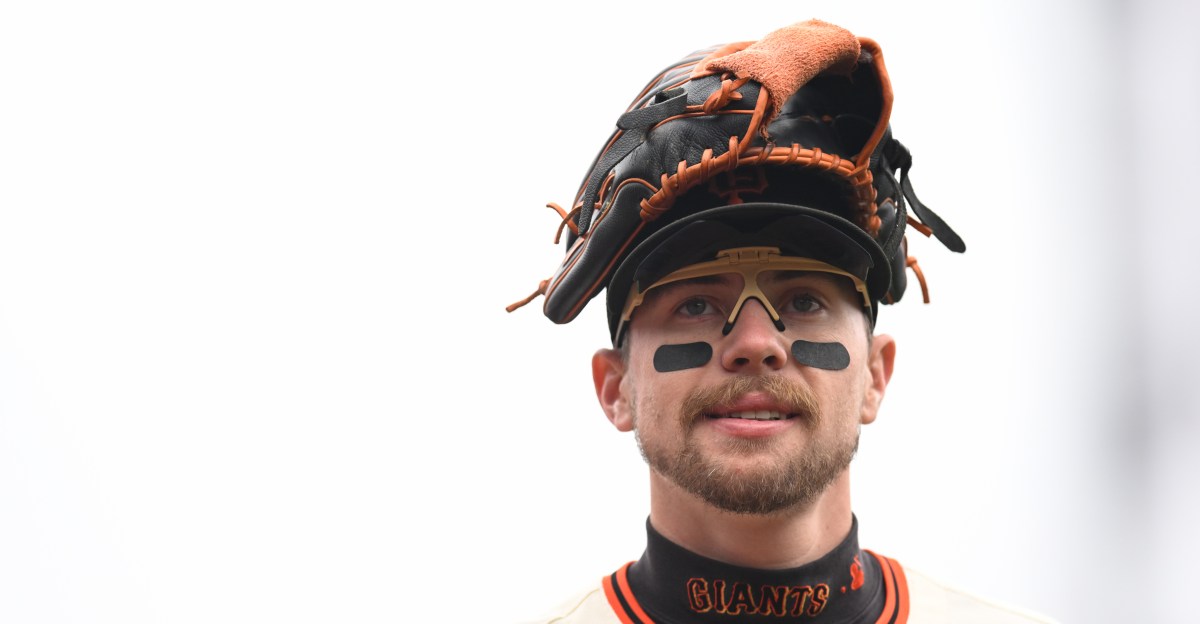
On the field, he tucked his pants up above his knees, welcomed comparisons with early-aughts Barry by rocking the mock turtleneck undershirt, alternated between a ginger goatee and ginger mustache, combed his hair aggressively to one-side, rocked Pit Vipers, eye black and flip-up shades, and sweated personalized armbands with KO$$ stitched on them.
Call it Fall Ball punk; call it nostaglic-nerd-swag. Whatever it was, it slayed. You can’t spell Koss without a K-O.

Traded to the Giants organization in March of 2024, the 26 year old Koss quietly went about his business, gaining promotion to Triple-A after hitting .386 with a 1.000+ OPS over 25 games in Double-A. His numbers leveled during the second half of the season to a more modest .257 average and .747 OPS across 54 games in Sacramento, but he kicked back into gear the following February. A .341/.426/.512 (47 PA) slash line in Arizona alchemized an innocuous camp invite into a golden ticket, out-playing Brett Wisely and his left-handed-upper-hand for a bench role in the bigs.
Koss made his Major League debut batting ninth and playing second base in Houston on April 1st. He went 0-for-4 with a strikeout, a walk, and a run scored. After five minor-league seasons with three different organizations, baseball didn’t magically become easy for him once he finally reached the Majors. His first hit on the 13th in New York was just one of five singles he managed in 23 at-bats over April. May wasn’t much of an improvement offensively, but he provided other value with his base-running abilities and solid glove, and he did bag the first highlight clip of his career — a 2nd inning grand-slam that just cleared the fence in left, flipping a 3-run deficit into a lead the Giants would hold against Arizona (with help from a 3-run homer by another light-hitting bat, Jung Hoo Lee).
Foot firmly in the door, more and more opportunities found him. Tyler Fitzgerald played the way the Edmund Fitzgerald floated, and injuries to both Matt Chapman and Casey Schmitt meant by the end of June, Koss had started at all infield positions but first, as well as served as designated hitter, pitcher and pinch runner.
When Fitzgerald was optioned down to Sacramento on June 24th, Koss started that night’s game in his place and cashed in his second career homer with another liner to the first row. He’d collect a total 10 hits over the next seven games, four of them for extra base hits, helping raise his June average to .353 with a .529 slug (35 PA), while striking out only twice.
Koss started heating up exactly when the Giants needed someone to get hot. Chapman had been on the IL since the 10th. Schmitt joined him on the 30th.
Acting as a balm to those injury stings didn’t last long, unfortunately. In fact, he was just the next bummer in a long summer of them for San Francisco.
Koss strained his left-hamstring running to first on June 30th — the same game he was robbed of another first-row homer by a fan interference call. While the umpires deliberated, relegating his homer to an out before upgrading back up to a double, Koss had to leave the field, and back in the dugout, he hit us with one of the most gut-wrenching images of the year. One that I’m sure will live on as a Giants meme for decades (especially if this current trend of mediocrity continues).

Absolutely devastating. The face of utter disappointment. For fans watching at home, it looked like he was bummed about missing out on the game-tying homer, but now we know what he knew then. Something was off. Koss knew he was probably headed to the injured list, and he knew the injury was coming at the worst time for the team, and the worst time for him. Half-a-decade working for the opportunity Koss had just got and it lasted a week. Robbed twice in a day.
July was ripped cleanly from Koss’s calendar. He went to the IL on July 1st and returned on August 1st and needed another month to get back up to speed. When Matt Chapman went back to the IL on August 10th, Koss was there, starting in ten of the next 11 games, but he went just 6 for 35 at the plate. It was his last chance at consistent playing time. Things got more spotty as the season slogged on. He took just 29 trips to the plate over September as the season trailed off.
The brutal rhythms of life for a utility infielder. Baseball’s laconic pace punctuated with even more stops and starts. How can one excel, or at least be comfortable, if they are constantly shuffled from one position to another? How can one keep from staying focused and loose when you are constantly battling stiffness in the knees from all that pine riding? Rough, sure, but that is the gig. Thank-less, though pretty relaxed in terms of expectations. Koss ended the year with a below average 94 wRC+, the Giants went 35 – 41 in the games he played in (24 – 25 in starts though) — yet he gets a pretty light-hearted and favorable player-review, spared from my typically eviscerating barbs. “No fair!” cry the everyday position players.
Context is important though. No he’s not weighed on the same scale as some, but Koss filled a necessary role. In the vast mosaic of 21st century Giants utility infielders, Koss’s year is striking (especially if you get heavy-handed with the statistical filter feature on Stathead).
Did you know Koss and Chase D’Arnaud in 2018 are the only Giants this century to make at least 100 plate appearances while logging innings at second, short, third and pitcher in a year? Add a 54 game filter (a third of a regular season) and Koss stands alone! Open that search up to the entire Live Ball era, and just four Giants in the last 105 years can claim that feat. (Though credit where credit is due: d’Arnaud played the whole infield, and Greg Litton did time at every defensive position but centerfield in 1991.)
Filter out the everyday infielders since 2000 (excluding 2020) with a 200 PA limit, and Koss comes out as boss — at least in regards to wins above replacement. His 1.8 bWAR tops this vaunted list of Tomlinsons and Dubons and Burrisses, while both his oWAR (1.1) and dWAR (0.9) rank second.
Versatile, well-rounded, fashionable, nearly two wins better than a replacement, and boasts an unblemished ERA after four innings pitched… was Christian Koss’s 2025 the best utility season in Giants history?