
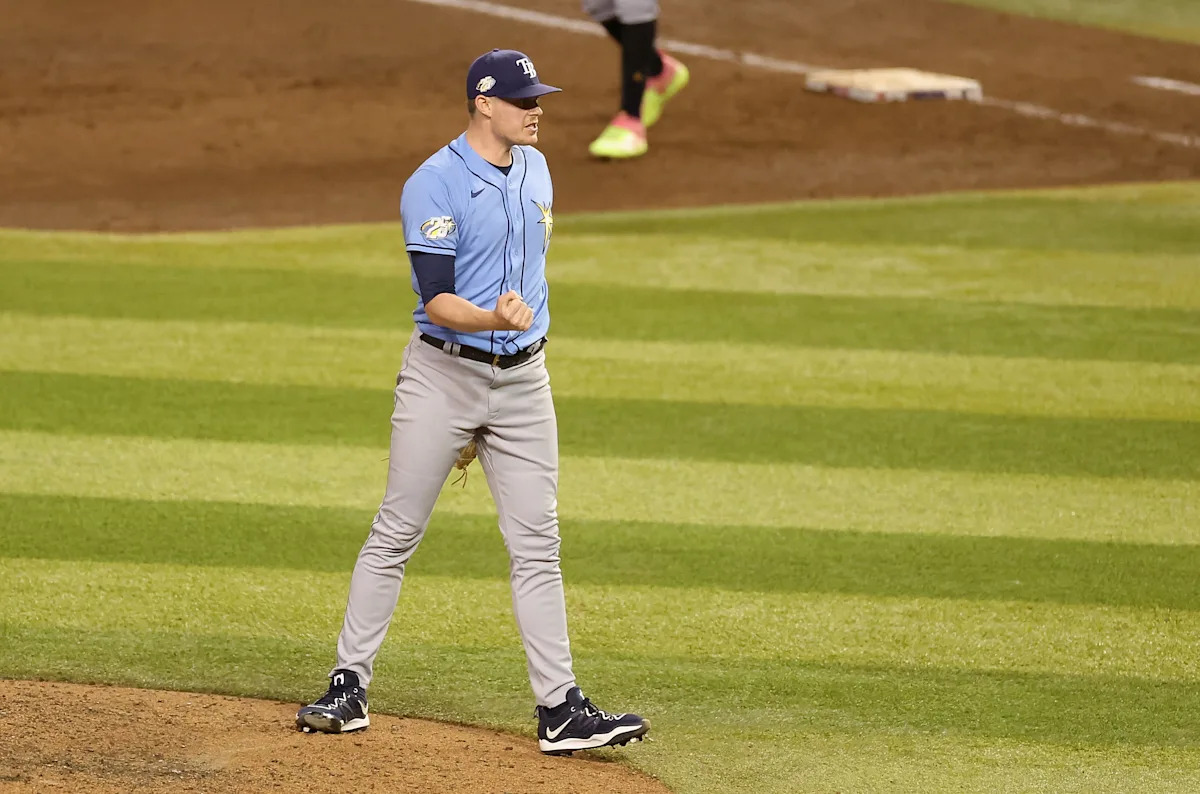
According to Nick Piecoro, the Diamondbacks have been in discussions with free-agent relief pitcher Pete Fairbanks. GM Mike Hazen has made no secret of this desire to improve the D-backs bullpen, an area which has been one in desperate need of improvement for years. Last month, I looked at the situation, and found that this season, the team was no better than 25th in the majors across the four main metrics of ERA, FIP, xFIP and fWAR. This is not a new problem, and various philosophies have been tried in the past to break the trend: nothing has achieved any sustained success. Is Hazen going to try a new direction?
The report of talks with Fairbanks suggest this might be the case. The team under Hazen has never bought into the notion of paying really top dollar for a closer. The highest-priced reliever in recent years was Mark Melancon, who was signed to a two-year deal in December 2021, but even that was not excessive: $6 million in 2022 and 2023, with what ended up being a $2 million buyout on a 2024 option. It was, however, a disaster. He went 3-10 with a 4.66 ERA in the first season, and then missed the entire second season with a strained shoulder. The team ended up paying him $14 million, for 56 innings of well below replacement level pitching.
Advertisement
$6 million is not a lot these days. Last winter, fifteen different relievers signed contracts with an Average Annual Value (AAV) higher than that – including former Diamondback Paul Sewald, hardly an ace. The early signs this year, are that the market will be even more competitive. After Emilio Pagan’s two-year, $20 million deal to stay with Cincinnati, we have already had four bullpen arms sign contracts with eight-figure AAVs. Fairbanks could well become the fifth, Piecoro’s article speculating he is looking for something around the two-year, $28 million contract Ryan Helsley signed with the Baltimore Orioles.
Anything around that amount would be uncharted territory for Arizona. In a season which feels like failure is not an option for Hazen and manager Torey Lovullo, I can see the appeal: go big or go home. But this is a team which has multiple holes, rather than one which is a closer away from playoff contention. They need to replace multiple starting pitchers, while both the corner infield and outfield could do with help. Were the payroll staying the same as last year, that would be a challenge for Hazen. Indications are that it’s going to be lower, reducing further the resources he has to spend.
There are two main questions here. Firstly, should we be spending big on a reliever? I’ve actually got an article going up tomorrow on the topic, but to give you a sneak preview: no, we shouldn’t. The second question presumes Hazen thinks otherwise; given that, is Fairbanks a good target? It would be a rarity for Arizona, in that he is a current closer. Fairbanks is one of just nine pitchers to have recorded more than twenty saves over each of the last three seasons, averaging 25 a year from 2023-25. With an ERA of 2.98 in that time, there are only a handful of pitchers with both more saves and a better ERA. Him looking for big money makes sense.
Fairbanks is now a huge strikeout guy, averaging 8.7 and 8.8 K/9 over the last two seasons. That factors into a FIP last year of 3.63, considerably higher than the 2.83 ERA posted. Steamer’s current projection for next season is more in that range, at 3.56, which would be… okay, I guess. It’d still significantly improve the D-backs bullpen, whose collective ERA in 2025 was more than a run worse (4.82). But I agree with Michael, who concluded, “I’d peg Fairbanks as a competent closer, but the D-backs will need to get more strikeouts out of him to make the acquisition worthwhile.”
Advertisement
For $14 million, I’d probably rather get Merrill Kelly back next year (something John Gambadoro said is possible today). If I was GM, I would be looking more among the middle tier of relievers, or even at a bounce-back candidate. A team like Arizona needs to be finding value for money, and that’s not something you are likely to find by paying relievers an AAV over ten million dollars.