
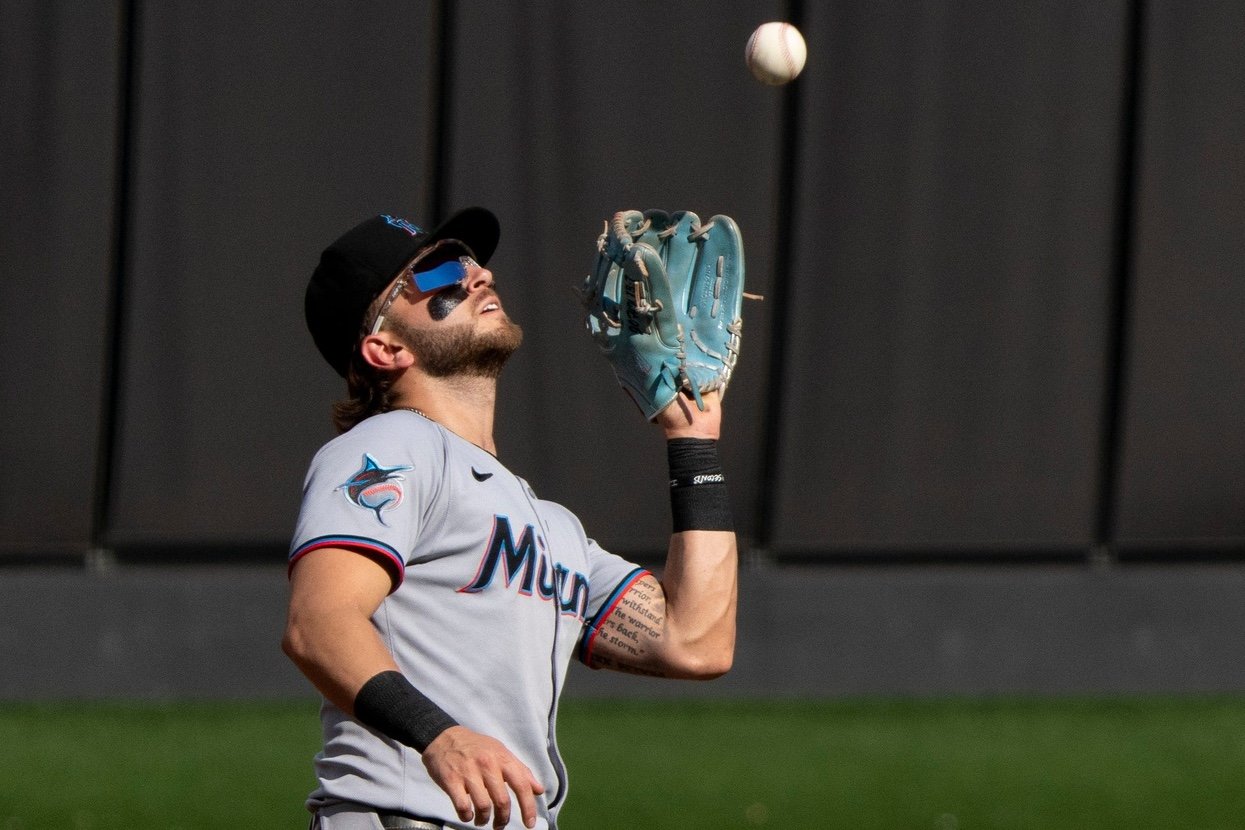
Earlier this week on the Marlins Hot Stove Show, Miami Marlins Clayton McCullough revealed that Connor Norby could be utilized as an outfielder next season. That’s notable considering the organization has previously been so adamant about Norby devoting all of his energy to third base. Every defensive appearance he’s made since mid-August of 2024—minor league and major league, including rehab assignments and even spring training—has been at the hot corner.
Norby’s conversion to third base has been unsuccessful. He lacks the dexterity to adjust to in-between hops and the reaction time to get in front of extremely hard-hit balls. As a result, he has totaled minus-9 outs above average and minus-10 defensive runs saved in less than a full season’s worth of action. His primary focus is continuing to develop there, per McCullough, but it’s no longer sensible for that to be his sole focus, especially when the Marlins have another in-house option, Graham Pauley, who has shown himself to be a great third baseman.
The Marlins will attempt to increase Norby’s defensive versatility by revisiting positions he used to play as a prospect in the Baltimore Orioles organization. During his MiLB career, he spent 497 innings in left field and 206 ⅔ innings in right field, with the vast majority of those reps coming at the Triple-A level.
Grinding tape from the 2023 and 2024 seasons, I was encouraged by Norby’s performance, even though it was a bit rough around the edges. The ceiling for his defense is higher in the outfield corners than at third base.
Norby definitely has enough athleticism to be an outfielder. His 28.8 ft/sec Sprint Speed from 2025 is right on par with the typical center fielder and comfortably above most corner guys. He runs well enough to compensate for poor initial reads and overcome circuitous routes. His arm strength is also an asset.
Here is the top highlight that I’ve come across from Norby’s outfield days, approximately 230 feet on the fly directly to the catcher’s facemask despite his momentum taking him into foul territory:
In this next scenario, there was no chance at a double play, but he flaunted the upper limit of his throwing range from more than 300 feet away:
norby of_arm strength (309 ft).mp4
Norby’s main weakness in the outfield was his overzealousness. He would occasionally attempt desperation throws to the plate like the one above even when it meant gifting the trail runner(s) a free 90 feet. I saw him misplay balls when rushing to field them off the ground, and turn singles into extra-base hits with ill-advised dives.
But his communication with teammates on fly balls was fine and he demonstrated an understanding of who had priority in each situation. Although he didn’t look particularly smooth when navigating around outfield walls, he made all the plays that he was supposed to make.
Regardless of which moves the Marlins make over the course of this offseason, I’d like to see Norby get reacquainted with the outfield in spring training. Ultimately, the 25-year-old’s playing time will be influenced most of all by his offensive adjustments (.251/.300/.389 slash line in 88 games last season). He’ll need to be more selective against right-handed pitching and more of a power threat against lefties to stake his claim to an everyday role.