
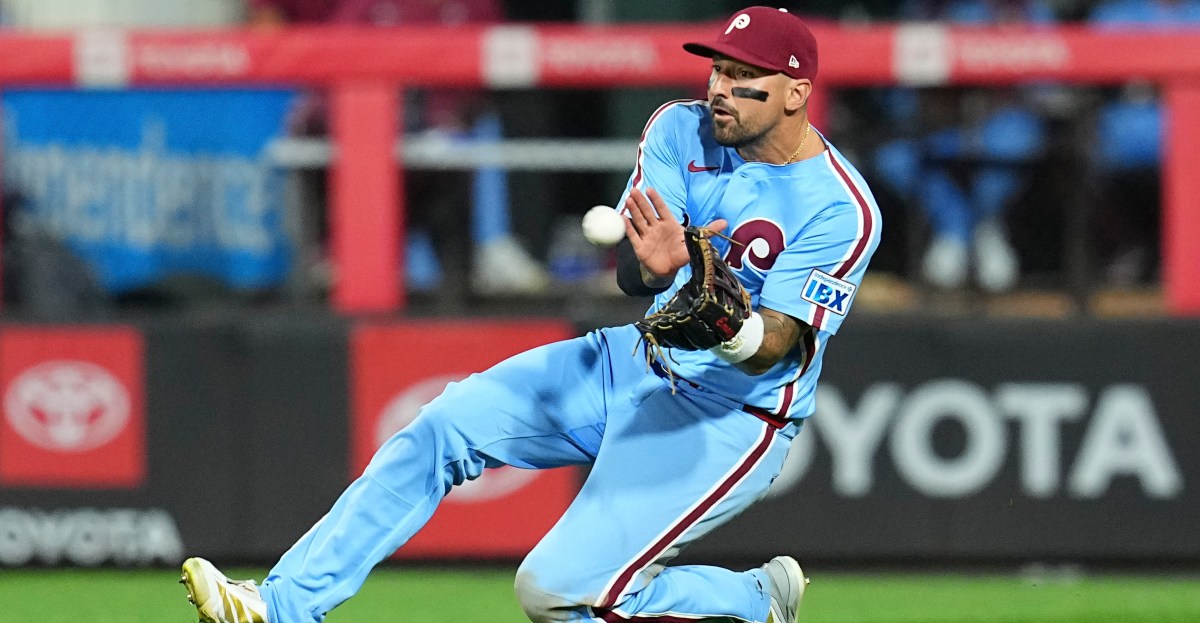
Any discussion on this topic has to include the elephant in the room on the current Phillies roster and number six on the Athletic’s list, Nick Castellanos. The Phillies surprised many when they signed Castellanos to a five year, $200M deal prior to the 2022 season. It came just days after the team signed Kyle Schwarber and sent a message that the Phillies were serious in their quest to return to the postseason, as it put the team over the luxury tax for the first time in its history.
Unfortunately, Castellanos was never quite the player the Phillies thought they were getting. He was coming off of a career year in 2021 with the Cincinnati Reds that saw Castellanos set a new personal best with 34 home runs and collect down ballot MVP votes. He had some good moments in Philadelphia, including making the 2023 All-Star team and demolishing the Braves in the 2023 NLDS with four home runs in four games, but Castellanos never came close to replicating his 2021 season. His bat was at best slightly above average and circumstances outside of his control led to Castellanos playing in the field much more than the Phillies likely originally envisioned. There in right field, he was routinely one of the worst defenders in baseball. Now, the Phillies are reportedly doing everything in their power to subtract Castellanos from their roster despite one year and $20M remaining on his contract.
Another relatively recent contender for worst contract was the extension Ryan Howard signed with the club in April of 2010. To be clear, it’s very hard to fault the team for handing out the contract at the time. Howard was coming off of his fourth straight season with 45+ home runs and 135+ RBIs, was 30 years old, and was at the core of a team that just went to the World Series two years in a row and won it all in 2008. It was extremely reasonable to give the star first baseman a five year, $125M extension that would keep him in Philadelphia through at least the 2016 season with a club option for the 2017 season. The $25M average value of the deal was the second highest in baseball at the time, behind only Alex Rodriguez’ $27.5M.
However, fate was not on Howard or the Phillies’ side. Howard’s 2010 was a down year for his previous standards but still very good, as he slugged 31 homers with an .859 OPS despite missing time with an ankle injury. 2011 was Howard’s sixth consecutive season with at least 30 HRs and 100 RBIs as the Phillies set a franchise record for wins and seemed destined for another title. But one October night changed the trajectory of Howard’s career and the next half decade of Phillies baseball. Howard tore his Achilles’ tendon running to first as the last out of the 2011 NLDS, serving a devastating injury to the insult of the Phillies being upset by the Cardinals and exiting the postseason in the first round.
Howard was never the same again. He played in just 151 games combined in the 2012 and 2013 seasons and was a shell of his former self. In the five seasons that covered that extension from 2012 to 2016, Howard hit .226 with a .719 OPS and was worth -5 WAR. The injury robbed Howard of his prolific power, as he never again crossed the 30-homer mark in a season. The rise of the defensive shift and the evolution of pitching gameplans also helped in his downfall, as Howard was never again able to recapture even a fraction of his former glory. He did play out the length of the contract, but that was mostly because it had become an albatross. It ended with an awkward final game in Philadelphia where the team celebrated Howard and his accomplishments despite his desire to keep playing. But he never again made it back to the Majors despite spending time in the minor league systems of the Braves and Rockies.
These are just two recent examples of some of the worst contracts the Phillies ever agreed to. Obviously, we have the gift of hindsight, especially in Howard’s case, but it’s easy to see now how these deals hindered the team for years. So, what was the worst contract the Phillies ever signed?