
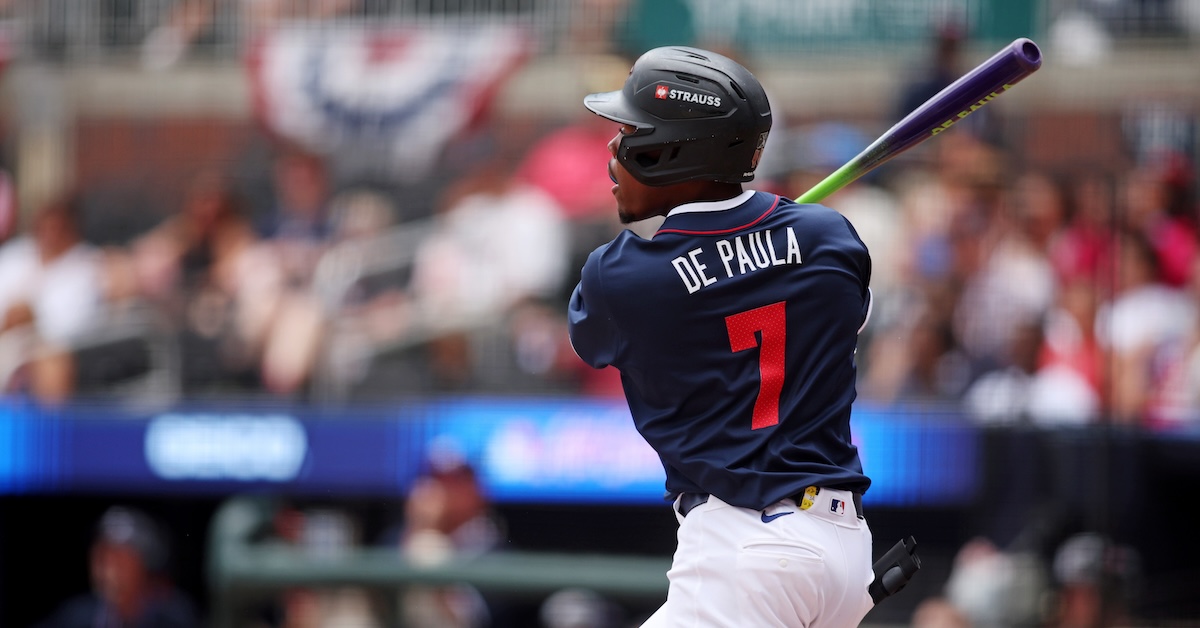
 Josue De Paula Photo: Brett Davis-Imagn Images
Below is an analysis of the prospects in the farm system of the Los Angeles Dodgers. Scouting reports were compiled with information provided by industry sources as well as our own observations. This is the sixth year we’re delineating between two anticipated relief roles, the abbreviations for which you’ll see in the “position” column below: MIRP for multi-inning relief pitchers, and SIRP for single-inning relief pitchers. The ETAs listed generally correspond to the year a player has to be added to the 40-man roster to avoid being made eligible for the Rule 5 draft. Manual adjustments are made where they seem appropriate, but we use that as a rule of thumb.
A quick overview of what FV (Future Value) means can be found here. A much deeper overview can be found here.
All of the ranked prospects below also appear on The Board, a resource the site offers featuring sortable scouting information for every organization. It has more details (and updated TrackMan data from various sources) than this article and integrates every team’s list so readers can compare prospects across farm systems. It can be found here.
Other Prospects of Note
Grouped by type and listed in order of preference within each category.
More Fringe Relievers
Mason Estrada, RHP
Luke Fox, LHP
Antoine Kelly, LHP
Lucas Wepf, RHP
Roque Gutierrez, RHP
Cam Day, RHP
Livan Reinoso, RHP
Alex Makarewich, RHP
Ricardo Montero, RHP
Estrada signed for a little over $440,000 out of MIT after he was pumping 95 mph at the Combine. His delivery is very violent, and he needs to prove he can throw strikes in a pro setting to be considered for the main section of the list. Fox is a 23-year-old lefty from Duke who has touched 96 and can offer multiple breaking ball shapes from a funky crossfire angle that is very difficult on fellow southpaws. Kelly is a former Brewers second round pick out of a junior college who has struggled to throw strikes in a couple different orgs, and signed a minor league deal with the Dodgers this offseason. He was up to 99 last year. Something in Wepf’s big frame and wonky delivery lends a ton of deception to his mid-90s four-seamer, allowing it to threaten a 40% miss rate out of the bullpen despite a downhill plane. It’s a double-edged sword, as mechanical inconsistency drives double-digit walk rates, and his 40-man platform year ended in June due to right knee problems. Barrel-chested with a freaky short stride, Gutierrez has fringe average velocity, his arm is often late, and his primary offerings got hammered in Double-A. But his high arm slot and vertical hand position give a promising look to his split change if he can locate enough to play a bigger role. Day hasn’t produced results dating back to college, and a messy delivery doesn’t leave much mystery as to why, but he’s touched 99 mph and his slider shows above-average potential, so an up-down relief future remains a possibility. Reinoso, who went to high school in Joe Maddon’s native Hazleton, PA, has had perhaps the most interesting career arc of any player on this list. He played five collegiate seasons at three different schools (Chesapeake College, Erskine College, and Tennessee Wesleyan), all as an infielder. In his lone season at Wesleyan, he played both ways as the team went 56-8 and Reinoso slashed .417/.495/.921. He had a brief Savannah Bananas tenure in 2022, and in that season signed with the Dodgers as a pitcher. He’ll show you 96-99, but with lots of effort and little command. Makarewich has a plus-plus breaking ball and will peak in the upper 90s, but he doesn’t throw strikes. Montero is one of several burly righties with upper-90s heat and poor feel to pitch.
DSL Arms
Adrian Torres, LHP
Joseph Deng Thon, RHP
Luis Gamez, RHP
Shai Romero, RHP
Torres, 17, is a 6-foot-3 lefty who was sitting 93-96 and touched 97 in the DSL. He was walk-prone and got hurt after just shy of 10 innings. The Dodgers have a growing scouting and dev presence in Africa, and to this point Deng (who is from Sudan) is the most exciting player they’ve signed. He looks like a young Tracy McGrady throwing a baseball, a super lanky 6-foot-6 teenage righty whose fastball peaked at 98 in 2025. Deng generates over seven feet of extension and has exciting, almost unprecedented physical traits for a baseball prospect, but he has also thrown just 3.2 pro innings and could not throw strikes. He’s a name you need to know, but he’s sushi raw, too undercooked to have real prospect value. Yet. Gamez is a boxy 19-year-old Mexican righty with a low release of lateral action stuff, including a 92-95 mph fastball and a 82-86 mph slider. Romero can touch 99 but doesn’t locate.
Not Enough Stick to Stick
Chris Newell, OF
Brendan Tunink, OF
Jaron Elkins, OF
Austin Gauthier, UTIL
Nico Perez, 2B
Damon Keith, OF
Newell is a power-hitting outfielder from UVA who took off in mid-2025 after he made tweaks to his approach. He has plus power but can only hit fastballs and hangers, and he strikes out nearly a third of the time. Tunink and Elkins are former high school draftees who each signed for a little more than $400,000. Both of them have big tools but struck out roughly 30% of the time in the lower levels. Gauthier and Perez are smaller, well-rounded second basemen (Gauthier plays everywhere, Perez eventually might) who are good replacement players. Gauthier was a better fit for the three-man bench era, when his ability to feasibly cover several positions made him a roster fit despite fringy tools across the board. Keith is Newell’s right-handed complement, with even more juice but a very grooved swing.
Depth Starters
Samuel Sanchez, RHP
Payton Martin, RHP
Chris Campos, RHP
Sanchez, 20, is a physical A-ball pitcher with an easy delivery. He throws quality fastball strikes with his riding 90 mph heater, but his secondary pitches aren’t very nasty. Martin and Campos are athletic, undersized righties who struggle to pitch off their fastballs and need to work backwards more than is typical of a big league starter.
System Overview
The Dodgers have found myriad ways to lean into their financial advantages, and those trickle down into the search for small wins on the minor league side. One of the reasons they do so well at the margins is that, well, their guys at the margins are pretty interesting. Whether due to their favorable location, the chance to sneak a World Series ring onto the mantle, or because they’re willing and able to pay top dollar (relatively speaking), the Dodgers get their pick of minor league free agents.
They also play the penny slots. As an example, take another glance at all those relievers with big fastballs or other outlier traits and no ability to throw strikes. No one of those guys is particularly likely to develop enough control to contribute meaningfully, but if just one of them does, the Dodgers will have found a leverage reliever out of nowhere. The strength of the big league club allows and encourages big, low probability swings like this: These are the only types of players who are going to be capable of breaking through to the big league roster, so you might as well accumulate a bunch of them and hope one of them figures it out. In a similar vein, they’ve been able to use mid-six-figure draft bonuses to coax some toolsy high schoolers into the org.
Even though the Dodgers are perpetual buyers, they still find a way to trade for prospects pretty frequently. They stick their noses into multi-team deals and trade for players who were recently drafted or signed so they can get their dev team’s hands on them early in the player’s career. Zyhir Hope, Mike Sirota, River Ryan, Christian Zazueta, James Tibbs III… the list is long. Acquiring players early in their pro careers prevents the sort of short-term roster surplus that can plague teams with lots of star big leaguers who can’t be usurped by most prospects. When the Dodgers have a Michael Busch (a damn good player, but not Freddie Freeman), he gets flipped for multiple valuable pieces, and the Dodgers snowball their players the way the Rays tend to, just with a much higher octane financial fuel.
The Dodgers’ 2025 DSL group was uncharacteristically shallow because they used their pool space to sign Roki Sasaki. As much as any one org can box out entire continents, the Dodgers are doing that. Their global clout tends to give them better access to the best Taiwanese, Korean, and Japanese players, and they’re also operating a facility in Africa without much competition there. Few teams would be able to bankroll some of this stuff, let alone execute it well. The Dodgers do both and are arguably the best overall franchise in American sports right now. This system is awesome and one of the best handful in the game despite lacking much polished impact pitching.