

Last week, I published a breakdown (here) of what could be enough “starZ” to make up a competitive roster. This week you’ll read my musing about how the Cardinal FO could apply such a model to their current roster and look to build a roster that can be competitive.
There are multiple ways to get to 90 (or more wins), or 42 fWAR. As described in last weeks’ article, a team needs to start by targeting 8-9 “starZ” players of a variable mix of pitchers and hitters. There are different ways of getting to 42 fWAR from 8-9 players who provide ~75% of the WAR needed to hit that 90-win target.
Advertisement
No one strategy appears better, but a strategy beats dependence on hope and luck. Likewise, the old saying that “luck is the residue of good design” shines through the profiles I’ve built. Here are some roster building strategies that can get a team to the competitive level.
Build around a core (unicorn) player.
From an fWAR standpoint, the 90th percentile break point for hitters is 3.75 fWAR. Meaning, if you are a 3.8 WAR player you are in the top 10th percentile. Is this a “core” player? A star? The 90th percentile range is extremely wide, by comparison to others. The top player in 2025 was Aaron Judge at 10.1 fWAR. Wow! Realize that his performance alone was almost as valuable as three (!) 90th percentile players. The unicorn players (Ohtani, Judge, Witt) are so special that building around them is a reasonable strategy. All the sudden, a 3.8 fWAR player looks positively pedestrian, even though he is top 10th percentile.
The weakness of this strategy is … a team either must invest a ton of resources into acquiring the unicorn (beyond many teams’ capability) or wait for that unicorn to emerge from their pipeline (once in a lifetime).
Advertisement
The challenge for an FO with this strategy is not only acquiring such a player but making sure that the core player is just that. For instance, Cal Raleigh put up 9+ fWAR in 2025. He performed in the same stratosphere as Judge, Witt and Ohtani. Can the Mariners expect that kind of performance going forward (for roster construction purposes) or was that an outlier season likely never to repeat? Given the same roster, if Raleigh returned to his prior baseline of 4-5 WAR (still pretty darn good), the M’s would face a deficit of ~4 wins they’d need to make up just to remain static. If they assume more 9 win seasons from the Dumper, they might surely be disappointed. They may find they are really not a roster constructed to win 90 games and it took an outlier season from Raleigh to make the playoffs.
Recognizing there are only a few such “core” players, what is the rest of the league to do? This strategy works when you can get “that” player (Soto…Ohtani…Judge). But for everyone else?
Build a quantity of top 20th percentile players
One of the things that jumps out in the data is that a team must have 6 or more top 20th percentile performers to even expect to sniff the playoffs. Even at 6 such players, those teams tend to win in the mid-80’s and squeak in due to circumstances or miss with a frequency that is hard to sell as good roster management. Crapshoot. For Colorado fans, this approach would be welcome. In St. Louis, not so much. Competitive teams really need to target more than this.
Advertisement
Only one team with less than 5 top 20th guys made the playoffs in 2021-2025. That was Detroit in 2024. That team that needed every bit of a 13-0 run against the White Sox and was still a team that sold at the trade deadline and yet still snuck into the playoffs with 86 wins. Hard to characterize this anomaly as great roster construction by an FO. Perhaps an example of luck being the residue of good design? Not to get off track, but many of the exceptions in this analysis happen to be AL Central teams. Go figure!
Below the graph that shows how different distributions of “starZ” pitcher and hitters comes out. A reminder from last time: The messiness of the points comes from using the nudge feature of scatter plots so each data point is shown. For example, lots of teams had 4 star pitchers and 4 star pitchers. Without a nudge, we’d see one dot at x=4, y=4. With the nudge you see something more. (4,4) produces lots of 90-win teams, but far from guaranteed. Note how going from (4,4) to 4 pitchers and 3 hitters (4,3) influences the anticipated outcome. Something to chew on for the “pitching, pitching, pitching” advocates.
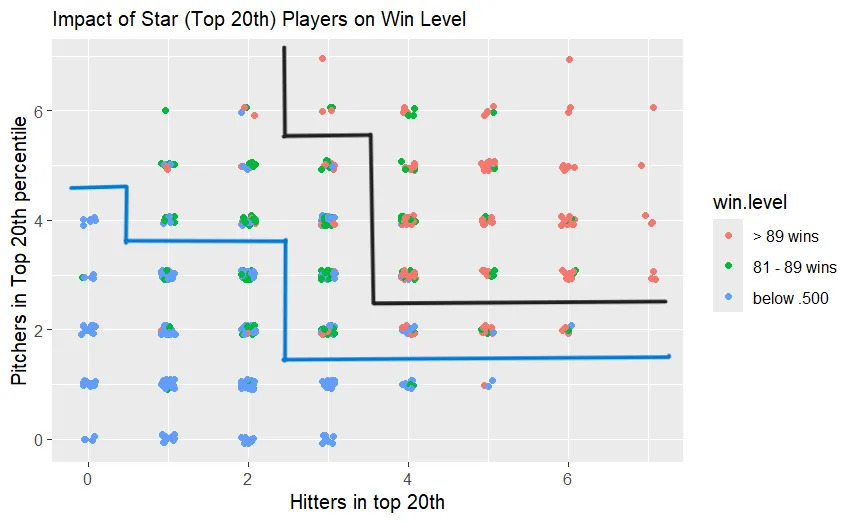
In this picture, the black line defines what I see as the floor of what a well-constructed roster should look like. Yes, it is an uneven floor. I am a carpenter, but not a master carpenter. Between blue and black is the crap shoot area. Crapshoot teams reliably win in the 80’s but too often it is the low 80’s and they miss the playoffs at a higher than 50% rate.
Advertisement
If you look at this closely, you can see that 3 “starZ” pitchers and 4 “starZ” hitters is the lowest combination that begins to result sustainably in 90 wins and playoff appearances. In this plot, teams need to target this as the absolute floor and work up and right in their roster construction exercise. Either direction seems to work, but the hitters direction has more room to mine. It’s really hard to get over 4 “starz” pitchers (due to innings constraints and the market place and injuries). It is more common to get above 4 “starZ” hitters.
Use platoon advantages to build a composite “starZ” player
A strategy that admittedly needs more exploration, I suspect that this is what allows the teams in the 6-8 range of “starZ” to attain 90-wins and/or playoffs. This strategy would seem to be limited to the group of teams that are in the “crapshoot” zone and need another player or two to get to the desired 8-9 “starZ” and/or they play in a division where less than 90-wins can still be reliably competitive (ala. AL Central).
Here you take a group of not quite enough star power, and you use platoon splits to create a position that produces “starZ” level WAR even though neither of the contributors individually show up in my “top 20th percentile” queries. This will be the subject of a separate deep dive, and you will probably thank me for not making this article even longer.
Advertisement
This strategy is effectively limited. Teams only have 4 bench spots and roles like back-up catcher are cemented in, so the opportunity to create a blended “starz” player is limited, likely to one. I will dig into this more someday.
Roster construction Cardinal’s style
If you build a team projected to perform in the Crapshoot tier, you are going to get seasons a lot like what we’ve seen the past 5 years in St. Louis. In 2022, career years vaulted the Cardinals into the playoffs. In 2023, 2024 and 2025, many of the same players declined or regressed to the mean and they missed. Badly or barely, depending on the year.
Look more closely at the 2025 season for the Cardinals. They had 2 “starZ” pitchers and 3 “starZ” hitters. Find that spot (2,3) on the plot. Sure enough, Crapshoot. Sure enough, the Cardinals missed the playoffs by five games, and that was with a 4-game losing streak to end the season. Wildly varying results, mostly negative, are the most predictable thing about rosters constructed with this target.
Advertisement
In 2025, the 5 Starz were Winn, Donovan, Contreras, Gray and Liberatore. Not enough, as we saw on the field and also as we see in the data. When people say the Cardinals need more “star” players, they are correct. They need around 4 more (ie. 9, not 5), but not necessarily “four hitters better than Burleson”. But the need is also not 4 Ohtani’s. The need is 4 more players who can reasonably be expected to perform in the top 20th percentile of the league, clustered around the median Starz profile (3.8 WAR hitters and 2.6 WAR pitchers). This observation makes the challenge a bit less daunting, no?
Breaking it down a bit, the 2025 Cardinals has 3 hitters finish in the top 20th percentile (none in the top 10th) and 2 pitchers finished in the top 20th (one in the top 10th). Teams with 4-5-6 good players regularly just miss the playoffs. And they did.
By comparison, the 2022 Cardinals had 5 top hitters and 3 top pitchers. Eight starZ frequently translates to 90+ wins and a playoff appearance. And they did.
When you take the current roster and project it forward to 2026, do we see 8-9-10 players that can reasonably expect to be top 20th? This assumes health of course. One of the reasons a team needs to construct their roster with 8-9-10 such players is to provide a margin of error for when under-performance or injury reduces a high projection for a player to little or nothing.
Advertisement
I tried to take all this backcasting data (the results) and build it into a future-look roster building exercise for the Cardinals 2026 season. This works down the notion of what they might try and how they might construct a roster built to compete in 2026. I’m not predicting they will do this, but I found it a useful mental exercise. First, let’s set the planning parameters, based on these assumptions:
They could look to construct a roster that can be reasonably expected to win 90 games. So, we look to build a floor of 42 projected fWAR.
Then, we scope down the exercise, concentrating on the starZ they need and the value they must produce. 73% of 42 fWAR is 31 fWAR.
To match the uneven ranges of performance between hitters and pitchers, I split the ~31 needed starZ WAR at 19 for hitters (5 hitters averaging 3.8 fWAR) and 13 for pitchers (5 pitchers average 2.6 WAR). Ok, that’s 32 fWAR. It’s ok to aim higher than the lowest bar.
They can work from there to adjust to market conditions (and current roster features). Maybe 6 or 7 starZ hitters and 3 starZ pitchers is more achievable with this roster. Who knows? Payroll budget, trade and free agent market conditions, ability to dump NTC contracts all influences potential outcomes.
Given these parameters, how might it look?
On the pitcher side, the Cardinals had 2 such starZ performances in 2025 (Gray, Liberatore). Gray is gone. Can they reasonably project Liberatore finish top 20th next year? I’m not so sure. Maybe both can exceed the minimum 1.6 fWAR, but exceeding the average 2.6? Even if he can, they need least three more starZ level pitchers. It’s hard to imagine any of the MiLB options bringing a 2.6 fWAR performance in 2026, so these acquisitions must come from the outside (or endure a longer rebuild period).
Perhaps this just solved the TLR/Duncan debate about whether you build the staff from the Ace down to the back, or from the Closer back to the front. In roster construction, build the starter set first. Bullpen later, if you get that far. This also, perhaps, identified why it may take a bit longer to get this team back on track.
Advertisement
On the player side Herrera, Contreras, Winn and Donovan could all be reasonably expected to fit the “starZ” profile (minimum 2.7 fWAR). Three of them did it last year and Herrera came close even with lost time to injury. However, collectively they would be unlikely to average 3.8 fWAR, so as a group they’d fall well short of a targeted 19 fWAR of needed starZ hitter production.
Some might want to add Burleson to the group to round it out at the minimum 5 starZ needed. Problematically, it is unlikely to find enough playing time for Contreras, Herrera and Burleson to all hit that target in the same season. To overcome the PT issue, Burly would have to play outfield, and that would project to diminish his production below the minimum threshold. So realistically, they need a different player who plays a different position who can produce 3.8 or more fWAR just to get to the minimum of 5 starZ hitters producing 19 WAR. One of Contreras, Burleson and Herrera may be needed to go to help bring back a quality pitcher or an outfielder.
If the pitching comes up short, they will need 1-2 more “starZ” hitters to offset. The graph above says, where there is uncertainty, hedge your bets with more star hitters. To me, this is the perfect fit for Wetherholt. Given enough playing time, you don’t have to really squint to envision 2.7 WAR. 3.8 though? In good roster construction, he becomes a hedge this year, not a dependency.
If they’ve constructed this roster as described, you are looking at ~31-32 fWAR in production from 8-9 players. This is the proverbial “core”. Now comes the last part. They will need 10 more fWAR from the rest of the group. A good bullpen will roll out 5 of those WAR. They may need another arm or two to achieve that target.
Advertisement
The remaining position players, four bench players and the back-end starters will need to be high enough quality to put up another 5 fWAR. An essential part of this equation is not to have zero (or negative) fWAR coming from a player who gets a lot of playing time, ala Jordan Walker. The bench guys individually don’t have to contribute much, but they can’t subtract in large quantities. Put another way, a 1 fWAR outfielder might not look very special, but could represent a 2+ improvement over Walker. 2 seems trivial on a 78-win team, but if you otherwise construct a roster with enough “starZ”, a 2-win delta on the role player group that needs to deliver 5 fWAR is very impactful.
In summary, there is an answer to how many “starZ” do the Cardinals need to build a competitive roster. At minimum, they need an outfielder that can be counted on to put up 3.8 fWAR (or better) and 3 pitchers that can be expected to provide 2.6 fWAR +/- each. That’s the minimum, in my view, as I follow this data.
Back to you.