
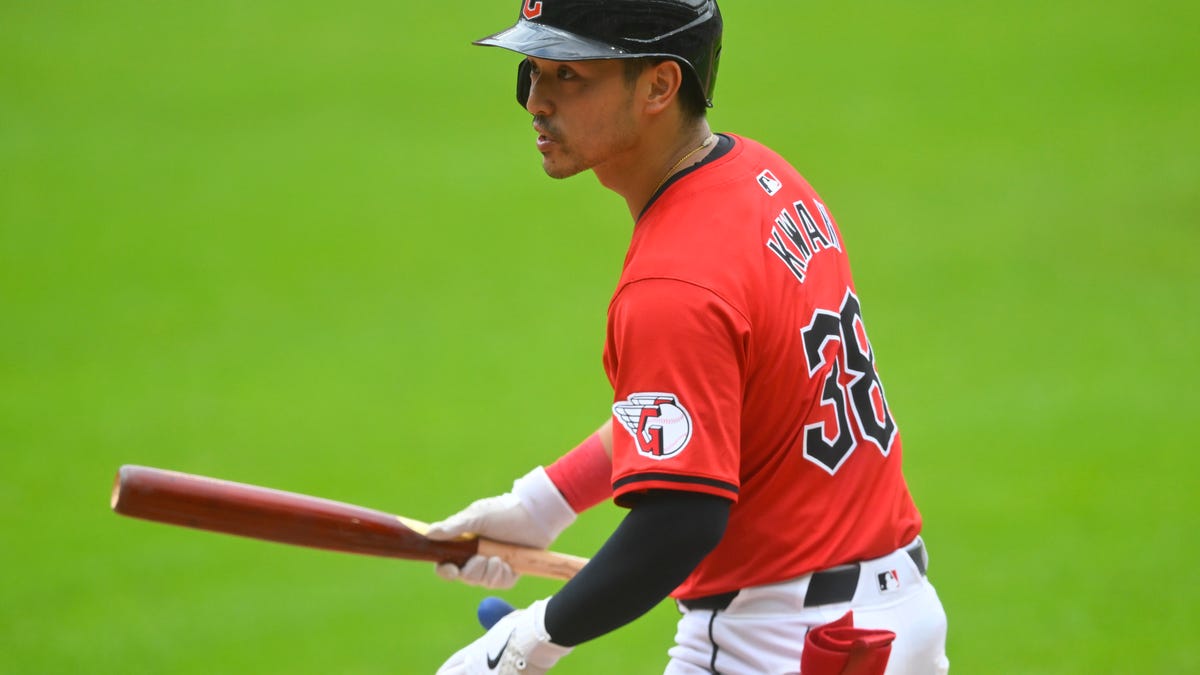
CLEVELAND — As the Guardians look to construct their 2026 roster — and specifically a lineup that needs improving — one factor will continue to hang over any discussions, both internal and external: left fielder Steven Kwan, and whether he’ll be on the move or remain in Cleveland.
Kwan, a two-time All-Star and four-time Gold Glove winner, was mentioned extensively in trade talks at last summer’s deadline. The Guardians opted to hold onto him, and they went on to complete a historic comeback to capture a second consecutive American League Central title, albeit with postseason exit in a Wild Card Series loss to the Detroit Tigers.
Kwan is again arbitration eligible and is under club control for two more seasons. He’ll hold a high value on the trade market, especially with the Guardians front office known around the league to be one that doesn’t panic or often budge from its perceived value of players.
Regardless, the decision about Kwan is one of the most important aspects in how the Guardians move forward. Here are the arguments for and against dealing the All-Star left fielder:
The case against the Guardians trading Steven Kwan (and re-signing him to a contract extension)
The Guardians won 88 games last year despite having the AL’s lowest-producing offense. The argument against dealing Kwan boils down to one question: if Kwan isn’t hitting leadoff, how is the lineup better?
He was an All-Star in 2024 and 2025. He’s won a Gold Glove in all four seasons he’s been in the major leagues. He’s accrued at least 3.0 fWAR in all four of those seasons, meaning he’s been roughly an All-Star caliber player each year.
Even during stretches when he hasn’t hit to his highest level, his defense in left field has more than made up for it. If Kwan is taken out of the lineup, it would require a very specific trade for it to benefit the Guardians in 2026. Any deal involving Kwan in this matter would likely be for a major-league-ready hitter who is younger and more controllable, but could also carry more risk in development.
It’s possible the right fit and value can be found, but it’ll likely leave the Guardians with higher share of risk, and they’ve shown that even with a young, controllable roster they can also compete now. Perhaps the idea should be adding and developing, not reshaping.
The case against trading Kwan is also essentially a case for signing him to a long-term extension. Kwan can become a free agent after 2027. The Guardians could look to sign him to an extension that eats into one or two of his free agent years, which would also better line up with star third baseman Jose Ramirez’s contract situation. And after trades that sent Andres Gimenez and Myles Straw to Toronto and Josh Naylor to Seattle, the Guardians have ample room to add a Kwan extension onto their payroll for 2026-2028 and potentially beyond.
This is all before mentioning that Kwan is a fan favorite. And although teams cannot operate solely to that end, extending Kwan would certainly be received well. The room in the payroll exists to absorb an extension, and the Guardians could keep Kwan in Cleveland a few extra seasons to align with Ramirez’s contract, which would further solidify this contention window.
The case for the Guardians trading Steven Kwan
The Guardians lineup could use some more power. Yes, there are other ways to score runs. And, yes, Cleveland’s brand of “Guards Ball” has worked wonders at times. But it can be difficult to keep it going for long periods of times.
“Guards Ball” can be an entertaining way to win games. But a three-run home run never hurt anybody, either.
Kwan is an All-Star-caliber hitter because of his ability to make contact and his tremendous control of the strike zone, but can the Guardians really survive trying to win every game 2-1, and with a rally of singles?
If the Guardians can keep pushing Kwan’s trade value even higher, they’d likely be able to bring back a quality hitter (or two) who can impact the 2026 lineup and give Cleveland additional years of control beyond 2027.
They could also potentially shore up center field, which would allow Chase DeLauter and George Valera to have the inside tracks in left field and right field, rather than the Guardians hoping one can handle center. Although they can’t really afford to lose production, perhaps a different kind of hitter would be of more value to them as they try to avoid teams simply pitching around Ramirez every time he’s at the plate.
And, if Kwan and the Guardians cannot agree to a long-term extension — the front office can only operate within the financial parameters it is given, after all — they might deem it more valuable to add an impact hitter who can remain in Cleveland beyond 2027 rather than holding onto Kwan for one or two years before having to watch him leave, either via trade at a later date or free agency.
If Kwan is going to be traded eventually, his value will likely never be higher than it is right now. The Guardians front office stuck to its demands at the trade deadline. It’s possible a team will finally cross over that line and reach those demands this winter, in which case Cleveland would know it’s receiving top dollar.
Plus, if the fit is right — likely more power and/or a better fit in center field — the pros might finally outweigh the cons.