
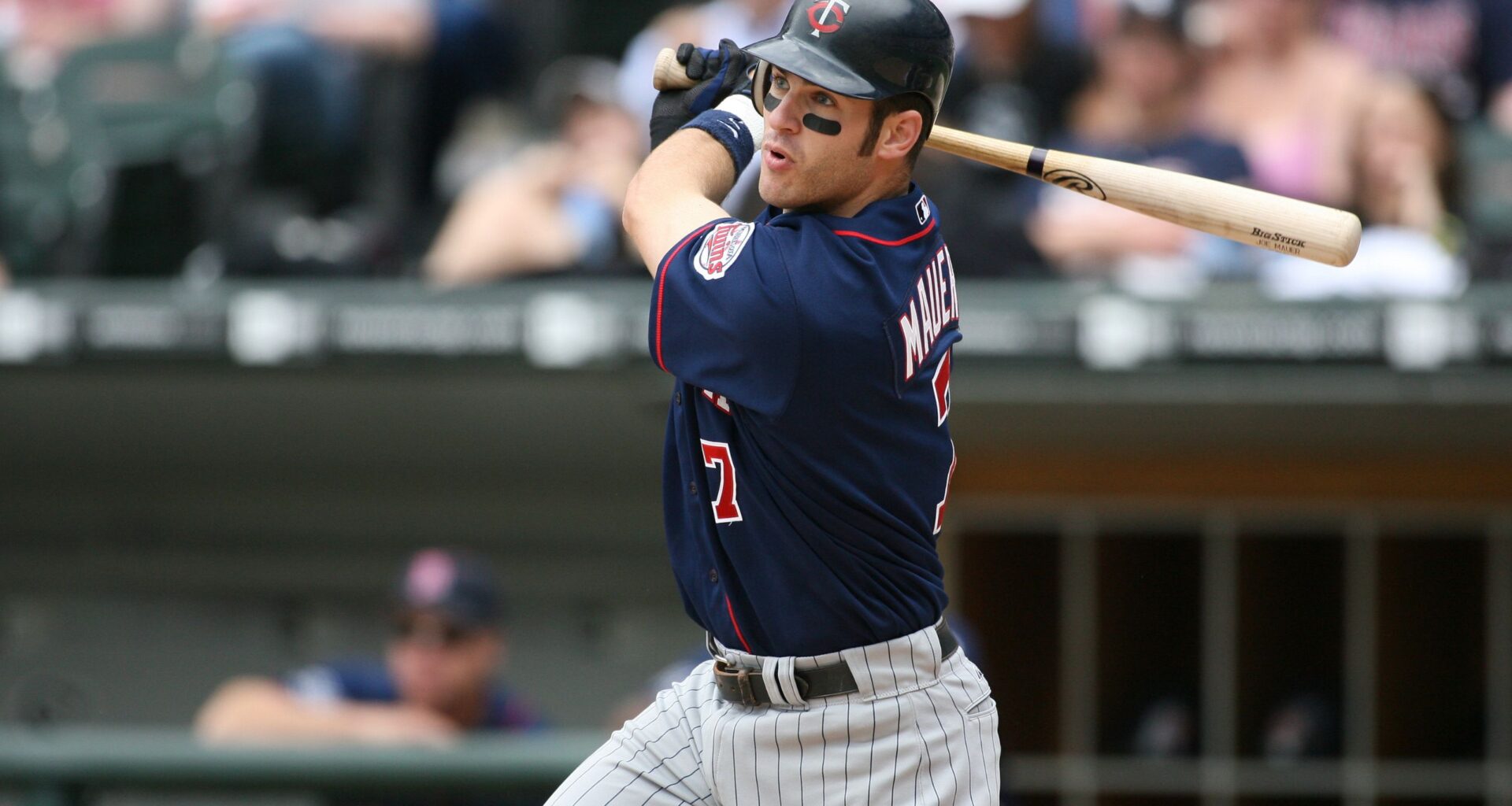
Image credit:
Joe Mauer (Photo by Ron Vesely/MLB via Getty Images)
Ahead of this year’s draft lottery, we’re revisiting the 1-1 pick history of every team who has a chance to land the first-overall selection in the 2026 MLB Draft.
The White Sox have the best shot to pick first with 27.73% odds. They benefited from the fact that both the Rockies and Nationals (who would have had equal odds for the top pick) are ineligible from receiving a lottery pick this year. The White Sox haven’t picked first overall since the 1970s.
The Giants and Cardinals are the only teams eligible for the draft lottery who have never before picked first overall in the draft.
Thanks to the Baseball-Reference draft database for research assistance and to Allan Simpson’s Ultimate Draft Book to help contextualize historic drafts. This piece has been updated and expanded based on last year’s revisit of eligible lottery teams.
Astros (0.34%)
2014 — Brady Aiken, LHP, Cathedral Catholic HS, San Diego
2013 — Mark Appel, RHP, Stanford
2012 — Carlos Correa, SS, Puerto Rico Baseball Academy, Gurabo, P.R.
1992 — Phil Nevin, 3B, Cal State Fullerton
1976 — Floyd Bannister, LHP, Arizona State
Houston’s complete bottoming out and multi-year tank in the early 2010s led to three consecutive first-overall picks and eventually one of the more competitive teams in recent years. They nailed one of those first-overall picks and whiffed on two of the more prominent recent-era draft busts with the other two.
Aiken checked all the boxes for a prep pitching prospect and ranked as the No. 1 prospect in the class. He never signed a contract because of a post-draft physical that caused the Astros to back out of a would-be $6.5 million deal. The Guardians drafted Aiken with the 17th pick a year later, but he pitched in parts of just three minor league seasons.
The Astros passed on Appel in the 2012 draft to sign Correa, but after the Stanford righty rejected a $3.8 million offer from the Pirates he was available for Houston with the top overall pick once again in 2013. This time the Astros signed him for $6.35 million but never saw a return on that investment. Appel never lived up to expectations, spent seven seasons in the minors and eventually made just six relief appearances for the Phillies in 2022.
In the 2012 draft the Astros had to sort through both a muddled draft class, and the first year of the new bonus pool era of the draft. They nailed it by taking Correa, who ranked as the No. 6 player in the class, and leads all 2012 first-rounders with 45.7 bWAR since—narrowly topping 18th overall pick Corey Seager (43.0). Correa was the rookie of the year in 2015, made multiple all-star teams, won both a gold and platinum glove award and helped power the Astros to a 2017 World Series—which hasn’t aged quite well as this pick.
Houston has had the first-overall pick in several drafts that featured unusual financial circumstances. The 1992 draft was one of the first in which “signability” became a common draft feature, and that year Astros owner John McMullen capped the team at $700,000 for its first-overall selection. The team took Nevin, the top-ranked player in the class coming off a Golden Spikes Award season with Cal State Fullerton, and a fine pick in hindsight. Though seeing Derek Jeter go five picks later to the Yankees might hurt.
The 1976 selection of Arizona State lefty Floyd Bannister was a no-brainer for the Astros at the time. He was the clear best player available in the draft and wound up being one of that draft’s most productive players with a 15-year career and one all-star appearance.
Mets (0.67%)
1994 — Paul Wilson, RHP, Florida State
1984 — Shawn Abner, OF, Mechanicsburg (Pa.) Area HS,
1980 — Darryl Strawberry, OF, Crenshaw HS, Los Angeles
1968 — Tim Foli, SS, Notre Dame HS, Sherman Oaks, Calif.
1966 — Steven Chilcott, C, Antelope Valley HS, Lancaster, Calif.
The Mets haven’t had the first-overall pick in more than 30 years. The closest they have come was the 2004 draft when they picked third overall and selected RHP Philip Humber out of Rice. Their 1-1 pick history is filled with notable hits and misses, with a number of notable draft storylines.
Wilson was a clear frontrunner for the first-overall pick in the 1994 draft and tied what was then the draft record with a $1.5 million bonus. Wilson pitched seven seasons (just one with the Mets) but in hindsight mid-first-round bats like Nomar Garciaparra, Paul Konerko and Jason Varitek would have been better options.
A legendary Team USA college national team headlined the 1984 draft class. Eighteen of the 20 players on the roster wound up being first\-round picks. College players in general started to become a more prized commodity in this draft. The Mets went a different direction with Pennsylvania prep outfielder Shawn Abner, who played six big league seasons but never lived up to his first pick status.
The 1980 draft began a run of excellent drafting for the Mets that culminated a few years later in a World Series championship. From 1980-1986 the team drafted 69 big leaguers—blowing away every other team in that span. Los Angeles area high school outfielder Darryl Strawberry led a strong crop of SoCal prep products and was a tremendous pick for the team. He won the 1983 rookie of the year, made eight all-star teams and won three World Series championships in a 17-year career that amassed 42.2 bWAR—the most of any player from this draft.
The Mets were torn between a pair of high school players for the first-overall pick in 1968: Notre Dame HS SS Tim Foli and Selma HS RHP Lloyd Allen. Of the two, they made the right choice, though Foli spent just two of his 16 big league years with the organization.
In the second ever draft, the Mets had the first-overall pick with two players who most teams viewed as the top overall talents in the class: Arizona State outfielder Reggie Jackson and Antelope Valley High catcher Steven Chilcott. The Mets went with Chilcott, who never made the majors and was out of baseball five years later. They were forced to wonder “what if?” for the 21 years that Jackson dominated the league and amassed 74 bWAR in his Hall of Fame career.
Royals (0.84%)
The 2006 draft turned out to be far better than it was perceived at the time. With their only first-overall pick in organization history, the Royals passed on No. 1 prospect, LHP Andrew Miller out of North Carolina and a handful of others, and instead signed Hochevar, who didn’t sign with the Dodgers in the 2005 draft. Kansas City seemed focused on adding a pitcher in the 2006 draft, but a number of other arms turned out to be superior choices including Clayton Kershaw, Max Scherzer, Tim Lincecum, Ian Kennedy and Adam Ottavino.
Giants (1.01%)
Never had a No. 1 overall pick
The Giants have had the second overall pick twice, but they’ve never picked 1-1. They had the second overall pick in 1985, a class scouts speculated was the best ever at the time. Nearly four decades later seems to be the case in hindsight as well. In that draft the team took Mississippi State first baseman Will Clark who would ordinarily look like a great pick despite the fact that the Giants passed on outfielders Barry Bonds (Pirates, sixth) and Rafael Palmeiro (Cubs, 22nd) and lefthander Randy Johnson (Expos, 36th).
San Francisco also picked second in 2018 when it selected Georgia Tech catcher Joey Bart, who ranked as the No. 5 player in the class.
Rangers (1.34%)
1973 — David Clyde, LHP, Westchester HS, Houston
1969 — Jeff Burroughs, OF, Wilson HS, Long Beach, Calif.
The Rangers have a pair of No. 1 overall picks, though both happened in the first 10 years of the draft when the system looked entirely different than it does today. California high school outfielder Jeff Burroughs was the consensus top hitting talent in 1969. He won an MVP award in his second full major league season as a 23-year-old, though he never again reached that sort of peak in a 16-year career that included a pair of all-star appearances and 17.7 bWAR.
Clyde was a heralded Texan sensation out of high school who became the first prep pitcher to be selected with the first-overall pick. He injected plenty of buzz into a new Dallas-based Rangers franchise at the time and impressed a sellout crowd in his major league debut in the same year he was drafted as an 18-year-old. He made 18 starts that season, but ultimately fell short of his massive expectations. Clyde pitched in five seasons with the Rangers and Indians.
Diamondbacks (1.51%)
Arizona hit on both its first-overall picks, though eventually traded both those players away to the Braves—Swanson before he reached the major leagues and Upton after six seasons that included two all-star appearances and 13.7 bWAR. Swanson ranked as the No. 2 player in a shortstop-heavy 2015 draft. Upton was the top overall player in the 2005 draft.
While Upton never reached his superstar billing, he had a 16-year career with four all-star appearances, three Silver Slugger awards, hit 325 home runs and finished top-five in MVP voting in 2011. His 32.3 career bWAR is sixth-best from the 2005 class, behind Andrew McCutchen, Ryan Braun, Troy Tulowitzki, Ryan Zimmerman and Alex Gordon.
Swanson, likewise has come short of superstar status, but has been a productive big leaguer through his first 10 seasons while managing 4+ bWAR in each of his last four seasons in his age 28-31 years. He’s a two-time Gold Glove winner, two-time all-star and has received down-ballot MVP votes in three separate seasons.
Marlins (1.85%)
Scouts called the 2000 draft an unpredictable group of players at the time, but the Marlins nailed their one and only No. 1 overall pick with high school first baseman Adrian Gonzalez. Gonzalez is clearly the best player in the first 14 picks of that draft. He was a well above-average major league hitter who made five all-star teams and earned four Gold Glove awards and three Silver Slugger awards. He finished his 15-year career as a .287/.358/.485 hitter with a 129 OPS+, 317 home runs and 43.5 bWAR. That WAR total is good for third-best in the 2000 draft behind Chase Utley (Phillies, 15th, 64.5) and Adam Wainwright (Braves, 29th, 45.2).
Cardinals (2.35%)
Have never had a No. 1 overall pick
The Cardinals have never had the first or second overall pick in the draft and in 2024-2025 had their first picks inside the top 10 this century. The team’s highest pick was third overall in the 1996 draft when they signed righthander Braden Looper for $1.65 million. The Cardinals have drafted fourth overall once, in 1991 when they signed third baseman Dmitri Young, and the fifth overall once, in 1998 when they selected outfielder JD Drew.
Drew (along with agent Scott Boras) was a pivotal figure in the draft when he didn’t sign with the Phillies as the second overall pick in 1997. He instead signed with the independent Northern League in an attempt to be declared a free agent. This caused MLB to rename the draft the “First-Year Player Draft” to close the would-be loophole. Drew eventually signed for a then-record $3 million the following year with the Cardinals and was the first player drafted out of an independent league.
Rays (3.03%)
The Rays have a solid track record with their four No. 1 overall picks. Josh Hamilton is one of the most exciting players to ever come out of North Carolina. Despite a turbulent path to the majors he was one of the game’s most disruptive hitters at his peak. He finished his nine-year career with an MVP award, five all-star appearances, a batting title and three Silver Sluggers, though none of his major league time came with the Rays.
Delmon Young didn’t have that sort of peak. In hindsight at least a dozen other names might have been better selections, but he did have a 10-year major league career.
David Price was an easy selection for the Rays and then first-time scouting director RJ Harrison in 2007. Price lived up to his potential with a 14-year career that included a CY Young Award, five all-star appearances and a pair of seasons in which he led the league in ERA. He finished his career with 40.2 bWAR, third in the 2007 first round behind Josh Donaldson (46.7) and Jason Heyward (41.8).
In 2008 the Rays became the first team to pick No. 1 in back-to-back drafts. They didn’t hit on Tim Beckham in the same way they hit on Price in 2007. Beckham ranked No. 3 in the class at the time and had a seven-year career that peaked with a 22-homer 2017 season.
Braves (4.54%)
The Braves haven’t picked inside the top 10 since 2019 and they haven’t picked inside the top five since the 2016 and 2017 drafts. The team has just two first-overall picks in organization history and can feel pretty good about hitting on both.
The clear top prospect in the 1990 draft was Texas high school righthander Todd Van Poppel. The Braves reportedly offered him a $1 million contract before the draft, but Van Poppel turned that down and wound up signing a deal with the Athletics for a $500,000 bonus and a major league contract worth $1.2 million. Chipper Jones proved to be a pretty good Plan B. Jones was the best player from the draft, became one of the best players in Braves franchise history and had a 19-year Hall of Fame career that included a World Series championship, eight all-star appearances and the 1999 NL MVP. He’s still with the team as a special assistant.
The 1978 selection of Bob Horner wasn’t quite the slam dunk that Jones was, but it was still solid. He was in the big league lineup just days after signing and wound up winning the 1978 rookie of the year award. In his 10-year career Horner amassed 21.9 bWAR, made the 1982 all-star team and earned down-ballot MVP votes in three seasons. Like the Jones selection, Horner wasn’t even the team’s top overall choice. They preferred Kirk Gibson, as did many other teams, but he fell to the Tigers at No. 12 overall because teams were scared about his desire to play football instead.
Athletics (6.55%)
Monday’s name is emblematic of the draft. He was the first player selected in the first draft that took place from an Arizona State program that has produced some of the most baseball talent in the history of the draft. Monday was also the most productive first-rounder of the 1965 draft. He had a 19-year career, totaled 33.1 bWAR, made two all-star teams and won a 1981 World Series championship with the Dodgers. If the A’s could do this pick over, they would probably take one of RHP Nolan Ryan (Mets, 12th round), C Johnny Bench (Reds, 2nd round) or RHP Tom Seaver (Dodgers, 10th, didn’t sign).
Orioles (9.24%)
Baltimore’s 1-1 track record looks rock solid, with two no-brainer first-overall picks that panned out and a third surprising selection that is looking smart in a draft class not doing so hot.
Holliday surged during the spring season to get into the mix atop the draft board alongside the consensus top talent, Georgia high school OF Druw Jones. Holliday just finished his second big league season and is solidifying himself as a big leaguer, while Jones spent his 2025 season at the High-A level of the minors. Angels 13th overall pick Zach Neto has been the most productive big leaguer from this class so far, but this group is far from settled.
Both Rutschman and McDonald were overwhelming favorites at the top of their respective draft classes and didn’t make the decision too difficult for the organization either time.
McDonald was a tremendous athlete who showed size, stuff, velocity and control with LSU, then had a solid, but unspectacular nine-year career. The 1989 draft wound up producing a trio of 70+ bWAR players: Jeff Bagwell (Red Sox, 4th round, 79.5), Frank Thomas (White Sox, 1st round, 73.6) and Jim Thome (Indians, 13th round, 72.9).
Rutschman was the wire-to-wire leader atop a 2019 class that also had Bobby Witt Jr., who would have been a consensus first-overall prospect in many other drafts. Rutschman already has a pair of all-star appearances and a Silver Slugger award in his first four seasons. He ranks third in the first round with 15.1 bWAR, behind Witt (21.7) and D-backs 16th overall pick OF Corbin Carroll (15.7)
Pirates (16.81%)
2023 — Paul Skenes, RHP, LSU
2021 — Henry Davis, C, Louisville
2011 — Gerrit Cole, RHP, UCLA
2002 — Bryan Bullington, RHP, Ball State
1996 — Kris Benson, RHP, Clemson
1986 — Jeff King, SS, Arkansas
No team with a shot at earning the No. 1 pick in this year’s draft lottery has picked first more than the Pirates. It seemed hard for the Pirates to miss in a 2023 draft class that was loaded overall and had three names up top that each had a case for 1-1 in Paul Skenes, Dylan Crews and Wyatt Langford. Skenes has been one of the best pitchers in baseball since his rookie season, and in the last two seasons he’s third among pitchers in fWAR—behind only Tarik Skubal and Cristopher Sanchez.
The 2021 draft was a muddled class at the top. The Pirates opted to sign No. 5-ranked catcher Henry Davis to an under-slot deal and spread their bonus pool money around to later picks. He’s a big leaguer but has yet to find his footing in parts of three seasons.
The Pirates signed Gerrit Cole to an $8 million deal that was a draft record for eight years until Adley Rutschman topped it in 2019. While Cole leveled up as a pitcher immediately after leaving Pittsburgh, even in hindsight the only player that might have served them better in the 2011 first round was eighth overall pick Francisco Lindor.
The 2002 draft was the Moneyball draft in which the A’s severely underperformed despite having seven picks in the first 39 picks. The Pirates, meanwhile, also swung-and-missed at No. 1 by taking righthander Bryan Bullington out of Ball State. He pitched sparingly in parts of five seasons and was never more than a below-average big leaguer.
Righthander Kris Benson in 1996 fared better. He was a more productive big leaguer than the seven players taken after him. He finished fourth in the 1999 rookie of the year voting and made 200 starts over a nine-year career, with 13.1 bWAR in total.
The Pirates’ first No. 1 pick was Arkansas shortstop Jeff King, who had a fine 11-year career and managed 16.9 bWAR, but the Pirates passed on players like Greg Swindell, Matt Williams, Kevin Brown and Gary Sheffield to take him. The 1986 draft is now most notable for being the draft the Royals signed Bo Jackson in the fourth round.
Twins (22.18%)
2017 — Royce Lewis, SS, JSerra Catholic HS, San Juan Capistrano, Calif.
2001 — Joe Mauer, C, Cretin HS, St. Paul, Minn.
1983 — Tim Belcher, RHP, Mount Vernon Nazarene (did not sign)
The Twins have had the first-overall pick three times, and twice this century. It’s a mixed bag with upside moving forward. Their most recent first pick, Royce Lewis, has shown flashes of greatness but has struggled to stay on the field. He reached the 100-game threshold for the first time in 2025, but that came with the worst performance of his career.
Minnesota was criticized in 2001 for passing on righthander Mark Prior, the top-ranked player in the class, because of signability concerns. The Twins instead maintained conviction in selecting Joe Mauer at the time and stand vindicated more than two decades later. Mauer is one of the best players in Minnesota franchise history. His 55.2 bWAR tops both Prior (16.6), No. 2 ranked Mark Teixeira (50.6), as well as the entirety of the 2001 first round.
The Twins have failed to sign their first-round picks more than any other organization, with six first-rounders failing to agree to deals. Belcher in the 1983 draft was one of those six.
White Sox (27.73%)
The White Sox have had five separate top-five picks in the last 12 years, but they haven’t picked first overall since 1977. This is their best chance since, and while missing out on last year’s draft lottery might have felt bad at the time, there’s a more appealing top overall prospect leading the 2026 class (Roch Cholowsky) than the 2025 class had at the time, or ever wound up having.
In 1977 the White Sox passed on hometown prep righty Bill Gullickson—who many viewed as the top player in the class—and took the sweet swing of Maryland high school first baseman Harold Baines. Baines is still one of just three prep first basemen ever taken with the first-overall pick (along with Ron Blomberg in 1967 and Adrian Gonzalez in 2000). He was the smart pick over Gullickson and had a 22-year Hall of Fame career that included six all star games. The 1977 class also produced Hall of Famers Paul Molitor (White Sox, third overall) and Ozzie Smith (Padres, fourth round).
There were lots of misses in the 1971 draft class. The White Sox tabbed Illinois high school catcher Danny Goodwin for the first-overall pick, but weren’t able to agree to a deal with him. Goodwin would sign four years later with the Angels as the first-overall pick of the 1975 draft out of Southern University. The best players from the 1971 draft didn’t come from the first round. The Phillies drafted shortstop Mike Schmidt (106.9 bWAR) in the second round; the Royals drafted shortstop George Brett (88.6 bWAR) in the second round; and the Cardinals drafted first baseman Keith Hernandez (60.4 bWAR) in the 42nd round.