
“I come to praise Caesar not to bury him.” — William Shakespeare
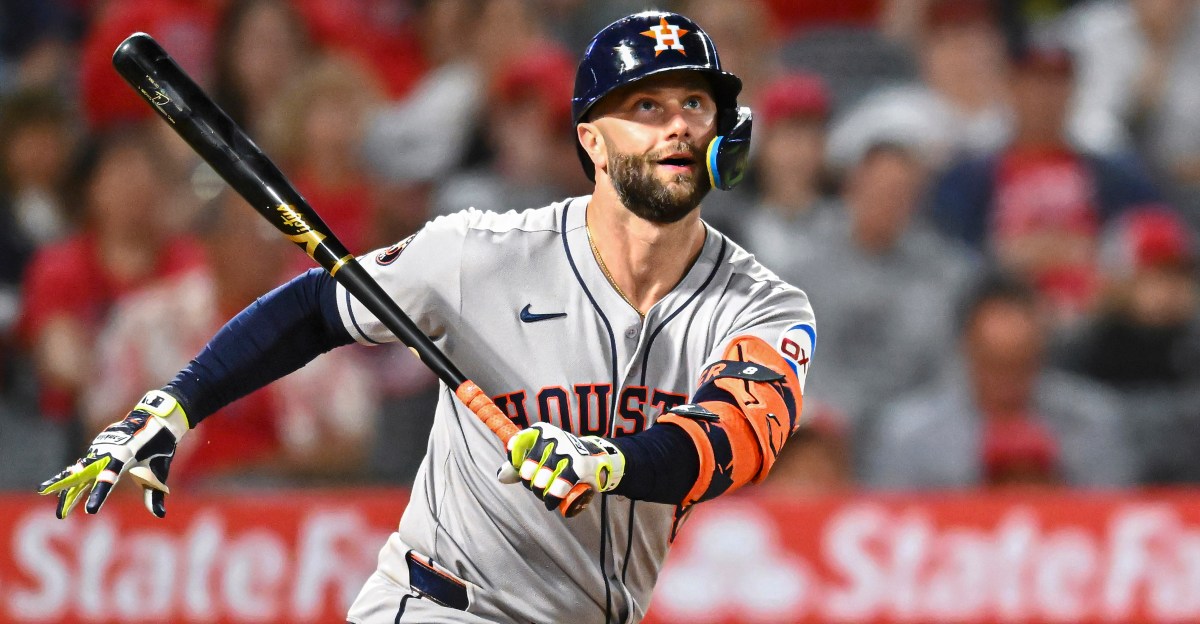
Bill James once said that numbers take on the property of language. I make my living as a school teacher. To be more specific, I support special education students in English classrooms. These two worlds are intersecting this week when it comes to Christian Walker. Words matter. Context matters. Numbers matter. When we put all of these things together we have to be precise in how we describe it.
There are two lazy narratives when it comes to Christian Walker and both of them are clearly wrong. In all fairness, more people are guilty of the second narrative than the first, but we might as well introduce both. The first narrative is that Walker led the Astros in home runs and RBI, so he therefore had a good season. Mind you, I know that most of you will laugh at that notion and I wouldn’t blame you. Clearly, it is a simplistic narrative that ignores numerous facts in evidence.
The second narrative is that he was a horrible player and a horrible signing just like Jose Abreu before him. He is an example of why you do not sign players entering their mid-thirties to multi-year contracts. The first narrative has kernels of truth in it. Walker did lead the team in home runs and RBI. That part is true. Similarly, Walker’s contract is not terrific. If history is our guide then we would surmise that he is likely to get worse and not better. These things are all true. However, calling him a horrible baseball player or saying he was horrible in 2025 is just not accurate or fair. Words matter and every situation is more nuanced than we want to make it. Let’s start by comparing Walker’s 2025 season with Jose Abreu’s 2023 season. I did not calculate the 2023 league average at first base or the league in general simply because it does not particularly matter for our conversation. We will assume Abreu exists in a 2025 universe.
BPOOutsMLB1BBPO+BPOP+Christian Walker.649461.678.6909694Jose Abreu.586435.678.6908685
So, calling Walker horrible is not merely offensive. Fans are allowed to say whatever they want to say, but as an analyst I have to do better. I need evidence to back up my labels. Therefore, I have to carefully consider the numbers before I throw out any adjectives describing a player like Walker. The Astros as a team had a .651 BPO. They were 19th out of 30 teams in BPO. If Walker was nearly at the team level then we could describe Walker the same way that we describe the Astros as a team. They were below average. That might seem like semantics, but below average and horrible are two very different things.
It also matters that Walker was considerably better than Abreu. The narrative that Walker was a failure just like Abreu is also a lazy narrative. Where the two intersect and where the negative narrative gains steam is what happens after the first year of their three year contract. Abreu finished 2023 strongly, so there was hope he would have a bounce back season in 2024. Obviously, the opposite happened. There is a similar thread around Walker and the hope for a bounce back season. Those same negative voices are predicting the same for Walker that befell Abreu. The rearview mirror is always clearer than the windshield. We don’t know what the future holds, but it would seem that a collapse is unlikely.
Essentially, the numbers above show that Walker was within approximately five percent of the league average amongst first basemen and the league at large. The odds of him suddenly becoming good are just as low as him falling off the map like Abreu did. The most likely result is a similar result. He will be in the average to below average range. That means that he is drastically overpaid, but it also means he is not horrible overall.
One of the things James did was come up with a concept called “similarity scores.” For him, that meant looking at who was most similar to a particular player when looking at all the counting numbers put together. We can do something similar with BPO. When we look at all of the profiled first basemen we can look at the player just above him and just below him to get an idea of where a guy stands without the emotional attachment.
BPOOutsMLB1BBPO+BPOP+Nathaniel Lowe.633428.678.6909392Christian Walker.649461.678.6909694Paul Goldschmidt.661366.678.6909796
Obviously Lowe and Goldschmidt’s personal situations do not help the Walker narrative. Lowe was cut by the Nationals and ended up landing with the Red Sox. Goldschmidt started as the Yankees first baseman, but did not finish that way. However, their particular situations highlight the Walker problem. The problem isn’t with Walker himself, but Walker’s contract. Both the Nationals and Yankees are able to move on. The Astros will need help to move on.
However, there are rumors that a few teams are in on those guys on a similar one year contract. Those contracts would be nowhere near the 20 million that Walker is getting. I would surmise that Walker would also have a job somewhere next year if he were a free agent. It would be a starting job. It would just be nowhere near what he is making now. So, it is fair to say the contract is awful. It is not fair to say Walker himself is awful. Before we leave today, let’s take a look at the defensive numbers and also include Jose Abreu just for fun.
DRSOAAFRVDRPChristian Walker-7+2+2+0.4Nathaniel Lowe-4-5-4-0.1Paul Goldschmidt-1-3-2-0.8Jose Abreu (2023)-2-3-2——
This is all alphabet soup to most of you and that is perfectly fair. Defensive runs saved (DRS) comes from what was originally called “The Fielding Bible.” It used video evidence to grade the difficulty of plays and the likelihood that an average fielder at that position would make the play. The number of runs below or above average are an indication of how many of those plays a fielder made or did not make over the course of a season.
Outs above average is a similar concept, but the methodology is obviously different. Usually, similar concepts should produce similar results, but we see that is not the case with Walker. Fielding run value (FRV) uses Statcast which is obviously more uniformed and less subjective because it removes the human element. Deserved runs prevented (DRP) is Baseballprospectus.com’s own fielding metric. Again, the concepts are fairly similar, but the results are different.
Keep in mind, I am a glorified English teacher. It makes little sense for me to seriously opine about the secret sauce behind these numbers. What I will say is that when three numbers say one thing and the other says something else entirely I become suspicious. We have to ask ourselves what is more likely. Is it more likely that Walker is an average to above average defensive first baseman and DRS is simply off-base or that DRS is right and the other three sources are all wrong?
Numbers like wins above replacement (WAR) are based partially on these numbers. This is why baseball-reference.com’s WAR (commonly called BWAR) is different than Fangraphs.com’s WAR (commonly called FWAR). There is nearly ten runs difference between DRS and FRV. Therefore, it should be no surprise that there is nearly a win’s difference between BWAR and FWAR.
All of this comes back to a nuanced view of Walker. What is more likely than not is that Walker is nearly average overall as a first baseman. Average or slightly below average players should not be paid 20 million dollars a season, so if the Astros could find a home for Walker this offseason it would likely benefit them in the long run. If they can’t (which is most likely) he isn’t exactly an albatross, but should find a less high profile place in the team’s lineup.
The chief problem with the Astros’ offense is that they had prominent players soaking up outs that weren’t helping. Both Christian Walker (second in outs) and Yainer Diaz (third in outs) were below the overall team average in BPO. Simply put, you want your better hitters getting the most plate appearances. Those would include Yordan Alvarez, Jeremy Pena, and Isaac Paredes. It would include Jose Altuve and Carlos Correa to a lesser extent. If Walker were sixth or seventh in outs it would be more appropriate.
This is part of the science behind batting orders and what the new coordinator for hitting is going to look at. Hitting coaches usually don’t fix hitters. They may refine some things. What is more impactful is how you deploy the hitters you actually have. Who do you want getting the bulk of the plate appearances? If he is on the team, Walker should be one of those nine guys. He probably shouldn’t be hitting nearly as high in the batting order.