
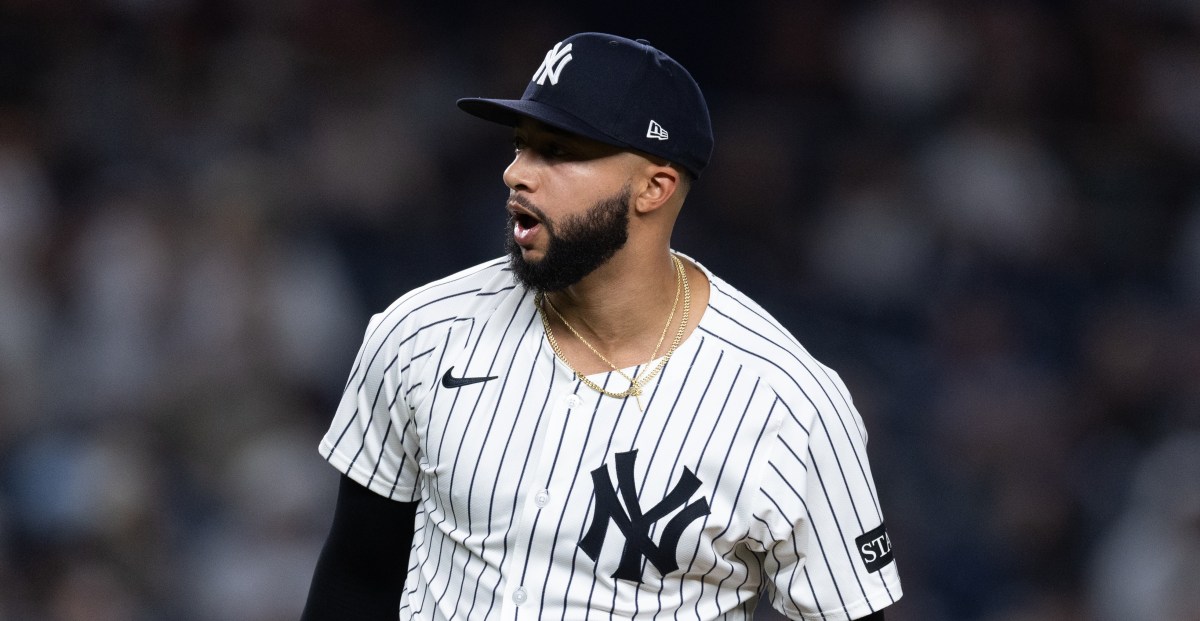
The Mets took the first step (unless you count bringing back Richard Lovelady) to rebuilding their bullpen this offseason, signing Devin Williams to a 3-year, $51M deal. The deal includes $5M deferred in each year, which knocks the effective AAV on the deal to just above $15M per Jon Becker.
Williams, a 30-year-old right hander, has spent the majority of his career in Milwaukee, where he was one of the best relievers in baseball. His changeup – dubbed the “airbender” given it’s mind-breaking movement – has consistently been one of the highest whiff-inducers in the league. Through his time as Brewer from 2020 – 2024, Williams was the second most valuable reliever in baseball, trailing only Emmanuel Clase.
A glowing resume, to be sure, but one that omits some key details. Williams’ tenure in Milwaukee ended after Pete Alonso’s wild card home run in 2024, with an offseason trade sending him to the Yankees. As you’re likely aware, it did not go well; multiple failed shots at the closer role, a career-worst 4.79 ERA, and another painful (though not nearly as back breaking) playoff moment.
Despite those ugly surface-level numbers and very visible blow ups, Williams remains an extremely good pitcher. His 25.1% K-BB% ranked 13th among relievers, and his 37.7% Whiff% ranked in the 99th percentile trailing only four other arms; Mason Miller, Brendon Little, Josh Hader, and Edwin Diaz. Williams didn’t bleed anything really in terms of velocity or stuff metrics either. The lone real slippage here was HardHit%, something that is fundamentally more noisy than stuff or whiff figures. Zooming out, it’s pretty clear that Williams’ career-worse season was more a product of a horrifically low LOB% at 55.2% – a metric that is almost entirely noise – rather than any sort of skill-based decline.
Now, the natural thought here is that Williams is Edwin Diaz’s replacement. While that might not be precisely true – reports emerged almost immediately indicating that a reunion with Diaz is still possible – this signing certainly reduces Diaz’s leverage as he looks for a 5-year deal in the $100M range. Unsurprisingly, plenty of fans / pundits / racing sausages are adamant that bringing is back Diaz is still something the Mets need to do if they want to be serious contenders. And on some level, you can understand the thinking. Diaz was definitely better than Williams last year:
PlayerIPERAFIPK-BB%Chase%Whiff%Williams, Devin62.04.792.6825.1%34.9%37.6%Díaz, Edwin66.11.632.2829.8%30.5%41.5%
But these are relievers after all, and that’s a pretty small sample. What about the last three years?
PlayerIPERAFIPK-BB%Chase%Whiff%Williams, Devin142.12.912.5826.1%33.1%39.5%Díaz, Edwin120.02.482.6129.7%30.6%39.9%PlayerIPERAFIPK-BB%Chase%Whiff%Williams, Devin257.02.592.4926.4%32.7%40.6%Díaz, Edwin244.22.432.1431.8%32.4%41.2%
Well then. If we look over a more comprehensive, representative, and predictive body of work, the gap between the two shrinks to near-negligible. Diaz might have the slightly better resume on the strength of this K-BB%, but we’re not talking about a significant difference here.
But remember, Diaz wants a 5-year deal. He’s a year older. He’s also bled two MPH from his fastball and one MPH from his slider since returning from this 2023 knee injury. Now, he’s still sitting 97+ so it’s perhaps not a blaring red warning light, but it’s at least an orange or yellow marker for an arm whose whole game is predicated on blowing people away with velocity and spin. Diaz is still excellent for now, of course, will he still be in three years? In five? I wouldn’t want to make that bet, and by giving Williams a three-year deal instead, the Mets have removed the need to cave to Diaz’s contract asks.
There is another caveat to be raised, and that’s our baseline philosophy on reliever contracts. Last season, one of the key takeaways from a retrospective look at offseason grades was that the Mets should, in general, shy away from paying relievers; they’re too volatile to be good investments (just look at Tanner Scott’s performance with the Dodgers last year), and David Stearns has a track record of conjuring up excellent bullpens seemingly out of nothing. Those ideas still hold true, and are a core reason of why I don’t think giving Edwin Diaz the deal he’s looking for is a good idea. Nor do I want the Mets to pay big for a second-tier closer like Brad Keller coming off a great platform year.
Williams’ contract would seem to violate this principle, but I don’t it’s actually totally relevant in this instance. This deal is more in line with what a 2nd or 3rd tier closer receives – effectively the Jeurys Familia contract plus inflation. But Williams isn’t a 2nd or 3rd tier closer, he’s one of if not the best reliever of the decade to this point and signed a deal $30 – 40M less expensive and 1 – 2 years shorter than those of comparable players (e.g., Edwin Diaz in 2022 – 23, Josh Hader in 2023 – 24) because he had an fluky-bad contract year. Is dolling out ~$45 to a reliever a great idea in a vacuum? No. Doing so for Devin Williams? Different story.
We’ll revisit the Edwin Diaz component later on in the offseason when he returns to the Mets or departs for another team. For the moment, the Williams’ signing looks like a prudent buy-low, locking in an arm that still maintains an elite base of skills at a below-market contract relative to historic peers. Couple that on-field impact with the additional leverage it buys the front office at this stage of the offseason and it’s an extremely savvy move. This deal receives an A.