
For a year or so, there have been rumors about the Washington Nationals trading left-handed starter MacKenzie Gore, one of the centerpieces of the trade that sent Juan Soto to the Padres three and a half years ago. Gore, who will turn 27 in February, has two years of team control remaining, and the quality of his stuff and sequencing suggest he’s worth over 25 runs per year, relative to an average starting pitcher. He’s a hot commodity, and naturally, the Cubs will be involved if he’s available. They had interest in him at the trade deadline in July.
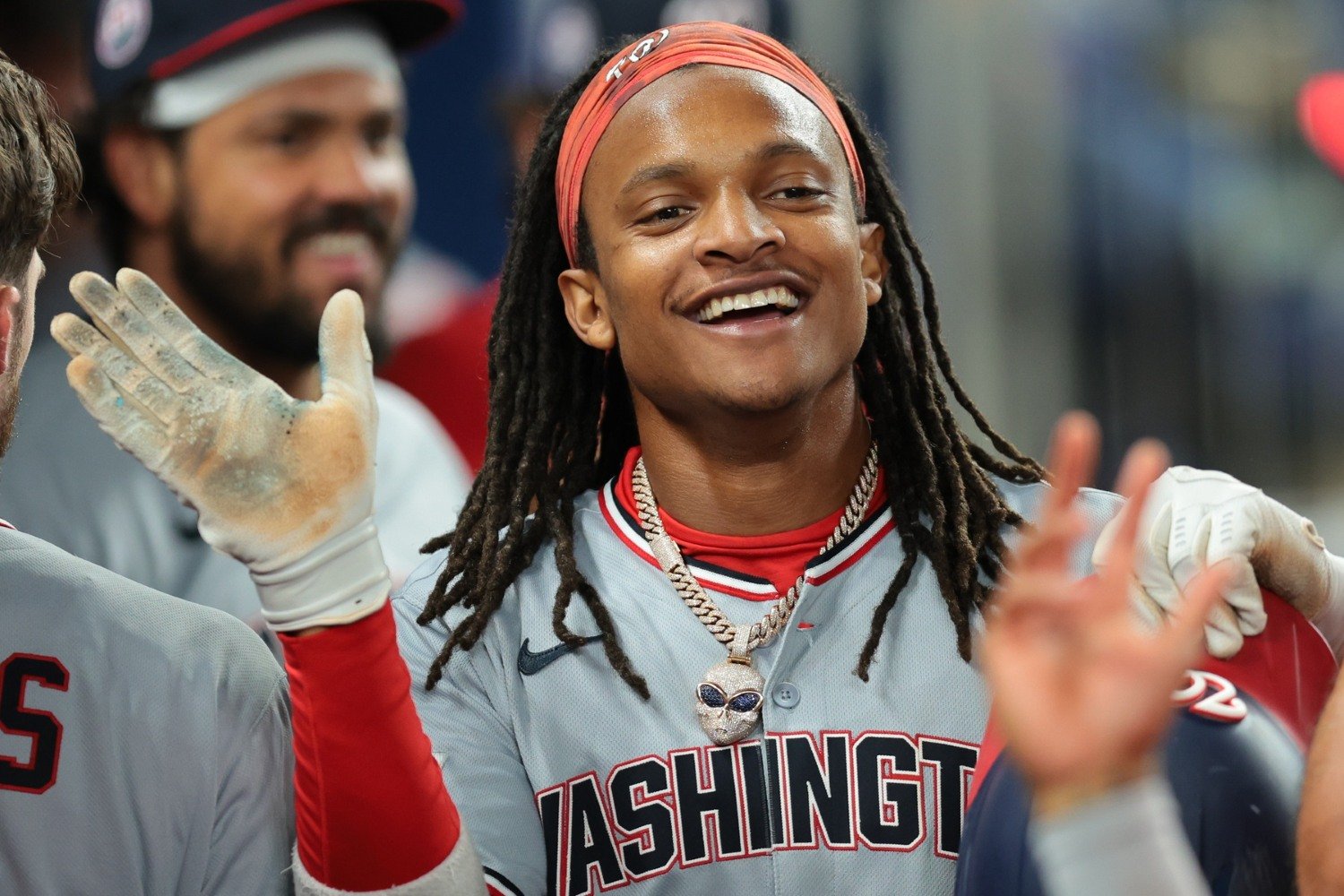
However, the other key player from the Soto deal appears to be on the block, too. CJ Abrams, 25, was an All-Star in 2024, and he’s coming off two straight seasons as an above-average, left-handed batter with a blend of power and speed. He has three years of team control remaining, and although his most famous connection to the Cubs is the unhappy incident in which he was demoted to the minors after the team discovered that he had gambled all night at a Chicago casino before a day game at Wrigley Field, he might be as good a fit for Chicago as Gore is.
There’s a lot to like about Abrams. The one thing not to like is his defense at shortstop, because he’s not good at that position. His arm doesn’t hold up on throws from deep in the hole, and despite his plus speed and good overall athleticism, he struggles to maximize his range. As a third baseman, though, he would be terrific. He’s lanky enough to cover the position well, and has quick feet for the hot corner. Most of his throws would come on the move toward his target, if he slid to third. He’d go from a defensive liability to an asset with a switch to the hot corner, and his bat plays at that spot, too.
There’s plenty to clean up with Abrams, in terms of approach. However, he has good feel for contact and slightly above-average bat speed. He’s young enough to make any of several more adjustments, but as a flat-swing lefty who hits line drives and can use his speed to generate extra bases, he’s a better fit for Wrigley Field than a more lofted-swing, power-dependent left-handed batter would be.
Abrams would infuse the Cubs lineup with dynamism and upside, on medium-term team control. He could fit as a complement to Matt Shaw, rather than a replacement, making him more similar as a target to Munetaka Murakami and Sung Mun Song than to Kazuma Okamoto, Eugenio Suárez or Alex Bregman. He’s younger, though, than any of those players—even Murakami. The Cubs would have to trade significant prospect capital to acquire him, but as a first-year arbitration-eligible player moving down the defensive spectrum, he’d be relatively cheap in a financial sense, for 2026 and beyond. He would provide the team with insurance against the departure of Nico Hoerner via free agency, and maybe even the opportunity to trade Hoerner if the right offer comes to them.
The real question, then, is what Abrams would cost. The Nationals would begin by demanding Shaw as the headliner of a deal for Abrams, and that shouldn’t be a dealbreaker from Chicago’s side. Though much cheaper and further from free agency, Shaw is only one year younger than Abrams. He doesn’t have Abrams’s tools or track record. For the moment, however, let’s consider what a deal without Shaw as the anchor might look like.
The Cubs’ top four prospects are catcher (or, perhaps designated hitter) Moisés Ballesteros, outfielder Owen Caissie, right-handed pitcher Jaxon Wiggins and shortstop Jefferson Rojas. The order of that quartet might depend on preference, but it’s hard to push any of the players in the tier below them (most notably, Kevin Alcántara and 2025 first-round pick Ethan Conrad) into the mix with those four. Washington is unlikely to accept any of the big four straight-up for Abrams, and after they traded reliever Jose A. Ferrer to the Mariners for catching prospect Harry Ford, perhaps they’re also a poor fit for Ballesteros. Caissie, Wiggins and Rojas would all appeal to Washington, though. Pairing either of the first two with Rojas would make an interesting package. Rojas, first baseman Jonathon Long and either Ben Brown or Javier Assad would form an interesting one, too.
Abrams is so young and so talented that, despite occasional (overblown, according to two league sources) questions about his makeup, he’s a huge upside play for any team who can pry him loose from the developmentally deficient Nationals. With three years of team control left and the chance to buy in before his production catches up to his tools, he presents a tantalizing opportunity to catalyze a lineup that already features a great blend of speed, power, and discipline. While the Cubs’ interest in Gore remains real and is growing increasingly urgent, they might do better to turn their attention to Abrams—and let the money they save by bolstering their lineup that way land with one of the top arms in free agency, instead.