
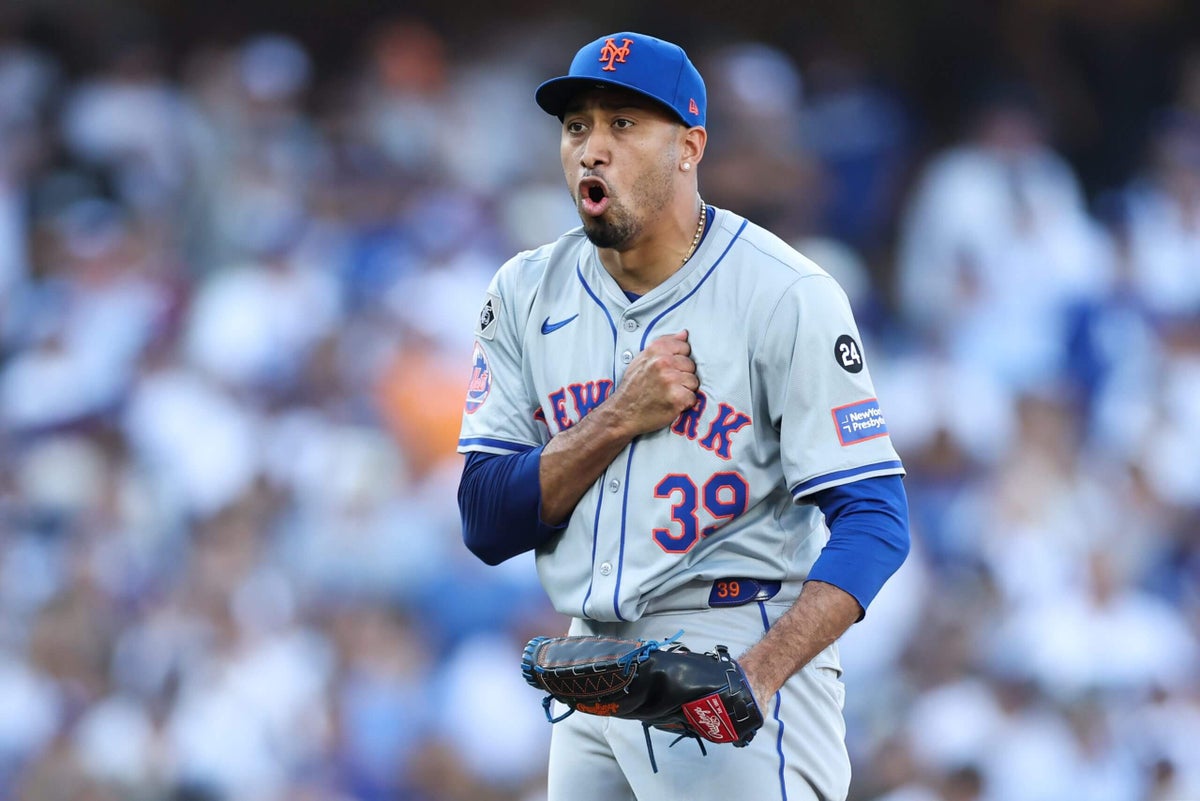
The Los Angeles Dodgers certainly have the money to pay a 65-inning-a-season reliever $23 million a year, and if you’re going to give a reliever that kind of contract, Edwin Díaz is probably the best guy on this market for that deal. It’s also hard to imagine him living up to the deal, given his age and the high attrition rate among even the best relievers in the game.
Díaz is coming off a good but not elite year, just by his own standards, in his final year with the New York Mets, a 3.0 bWAR/2.0 fWAR season that saw just about all of his underlying indicators drop slightly from 2024. His average fastball velocity was down, his batted-ball data was a little worse, his strikeout rate was the second-lowest of his career as a reliever, his walk rate crept up a little, and so on. You could hand-wave away any one of those points as insignificant in isolation, since they’re all within the range of what you might expect from random fluctuations year over year. You can also look at them all in total and worry that his overall direction is down, and another modest decline would make this deal a net negative for the Dodgers.
Of course, it’s the Dodgers, who are coming off two straight World Series wins and should have an infinite payroll. They’re going to enter 2026 as one of the favorites to win again, and they’re both trying to bolster their bullpen for the regular season and trying to construct the strongest set of relief arms for October, or at least trying to keep Dave Roberts from deploying Blake Treinen in every high-leverage situation from Labor Day until Thanksgiving.
Los Angeles has tried to throw money at its bullpen before. The team’s had mixed results at best, as their best relievers have been reclamation projects (Alex Vesia, Anthony Banda) or starter prospects they’ve moved to relief (Justin Wrobleski, Ben Casparius) — or Roki Sasaki, whose emergence in October was a combination of his struggles as a starter and the team’s desperation in the ninth innings. The Dodgers gave lefty Tanner Scott four years and $72 million last offseason, and he was a replacement-level pitcher for them last year, with a 4.74 ERA/4.70 FIP and eventually an injury that kept him off the World Series roster. The team’s re-signings of free agents Joe Kelly and Treinen yielded disastrous results for both guys, albeit just for one year apiece.
If Díaz “solves” the ninth inning for the Dodgers, allowing them to try to start Sasaki and maybe Wrobleski, or at least pushing names around so that Roberts uses the best relievers in the highest-leverage situations, it probably saves them a win or two during the regular season, and particularly makes them more dangerous in the postseason.
The signing leaves Robert Suarez as the best free-agent reliever still on the market. My No. 24 free agent this offseason, Suarez just had his best year since his return to the majors, cutting his walk rate while still sitting 98-100 mph with good extension that helped him keep hitters from pulling the ball. While I’m never a fan of spending big money or going three-plus years for relievers given the volatility of even the best pitchers in those roles, there are teams that clearly need help at the back ends of their bullpens. Teams like the Detroit Tigers, Baltimore Orioles and Chicago Cubs should at least be interested in Suarez at some price.