
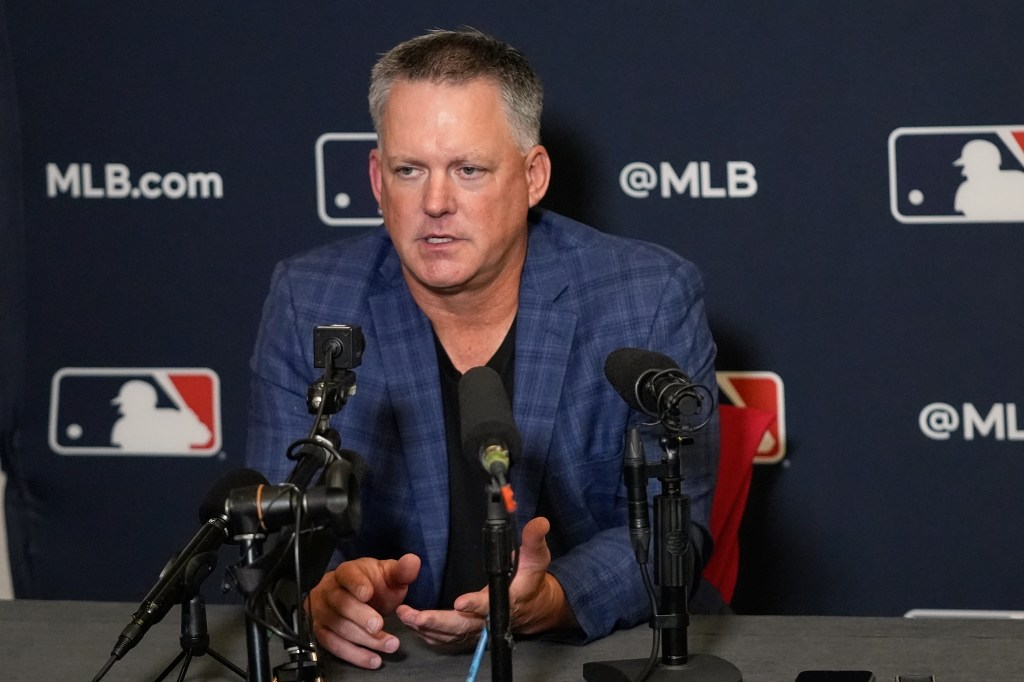
ORLANDO, Fla. – AJ Hinch didn’t even wait until the end of the question.
Speaking to the assembled media at the Winter Meetings Tuesday afternoon, the Tigers’ skipper was asked about Riley Greene. Specifically, how he reconciled and addressed a season of so much production and so much swing-and-miss, an All-Star season, a Silver Slugger award, but also a league-high strikeout total.
“Like, how do you have a three-peat All-Star season?” Hinch said. “He had one of the most remarkable seasons in Tigers history.”
That he did. Greene hit 36 homers and drove in 111 runs. The only other player in club history that did that at age 24 or younger was Hank Greenberg. But unlike Greenberg or any other player in club history, Greene struck out 201 times.
“There’s always room for improvement,” Hinch said. “He’s very aware of the things he’s going to try to do to be better.”
That was the basis of the initial question. Greene turned 25 in September. He’s played fewer the 500 games in the big leagues and despite the power surge, the hardware and All-Star berths, he’s not yet a finished product and that showed up both at the plate and in the field.
What might the next phase of his development look like? Certainly nobody expects a 30.7% strikeout rate and 31% chase and whiff rates to be part of the package going forward.
“Easier said than done, right?” Hinch said. “Hey, we want more contact. Hey, we want (better) at-bat quality. Of course. Everybody does. With Riley, getting his body in a good place to be able to endure what we ask of him is always the No. 1 priority.
“All the swing adjustments, the approach adjustments and the subtle little tweaks coming off a successful season soon follow.”
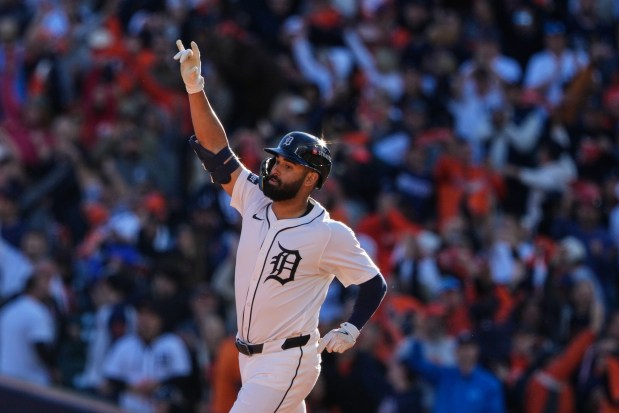 Detroit Tigers’ Riley Greene rounds the bases after hitting a solo home run during the sixth inning in Game 4 of baseball’s American League Division Series against the Seattle Mariners Wednesday, Oct. 8, 2025, in Detroit. (AP Photo/Ryan Sun)
Greene played a career-high 157 games with a career-high 600 plate appearances in the regular season and another eight games and 35 plate appearances in the postseason. The wear-down factor was real.
He hit .218 with a .694 OPS after the All-Star break, .195 and .618 in September. He hit .212 in the postseason (.621 OPS) with one homer and nine strikeouts.
“We haven’t had a full conversation about the strikeouts or the miss,” Hinch said. “It’s very obvious he wants to take the next step to be an even more elite player. But he’s spending the winter getting himself ready to play 150-plus games again.”
Greene’s winter conditioning regimen will include more speed-training than he’s done in the past. Per Statcast, his sprint speed, in terms of feet per second, was a full second slower (26.7 down from 27.7 in 2024). His time to first was 4.53 seconds, as opposed to 4.39 seconds in 2024.
The speed drop manifested in his outfield play, as well. His defensive run value in left field went from plus-2 to minus-3 and his outs above average fell from plus-4 to plus-2.
“It’s all a part of getting himself in position to play the outfield more,” Hinch said. “As the roster gets configured and the team gets formed closer to spring, you look at designated-hitter at-bats. You look at how can I get him off his feet more and maybe we can avoid some of the wear and tear that comes with the style of outfield he plays.”
There are also, Hinch said, subtle mechanical issues Greene can clean up defensively that will improve his metrics.
“We caught some things in his pre-pitch setup that were negatively impacting his defensive metrics,” Hinch said. “It’s things we’re not really concerned with but can get him in a better position to go both ways on balls.”
Greene had a more difficult time tracking balls hit into the left-centerfield gap. His outs above average chasing balls to his left was minus-3.
“The speed work he’s doing this winter will be key,” Hinch said. “He doesn’t have to be a burner. But we’re trying to get him to be an efficient runner and to be able to cover the ground we know he can.”