
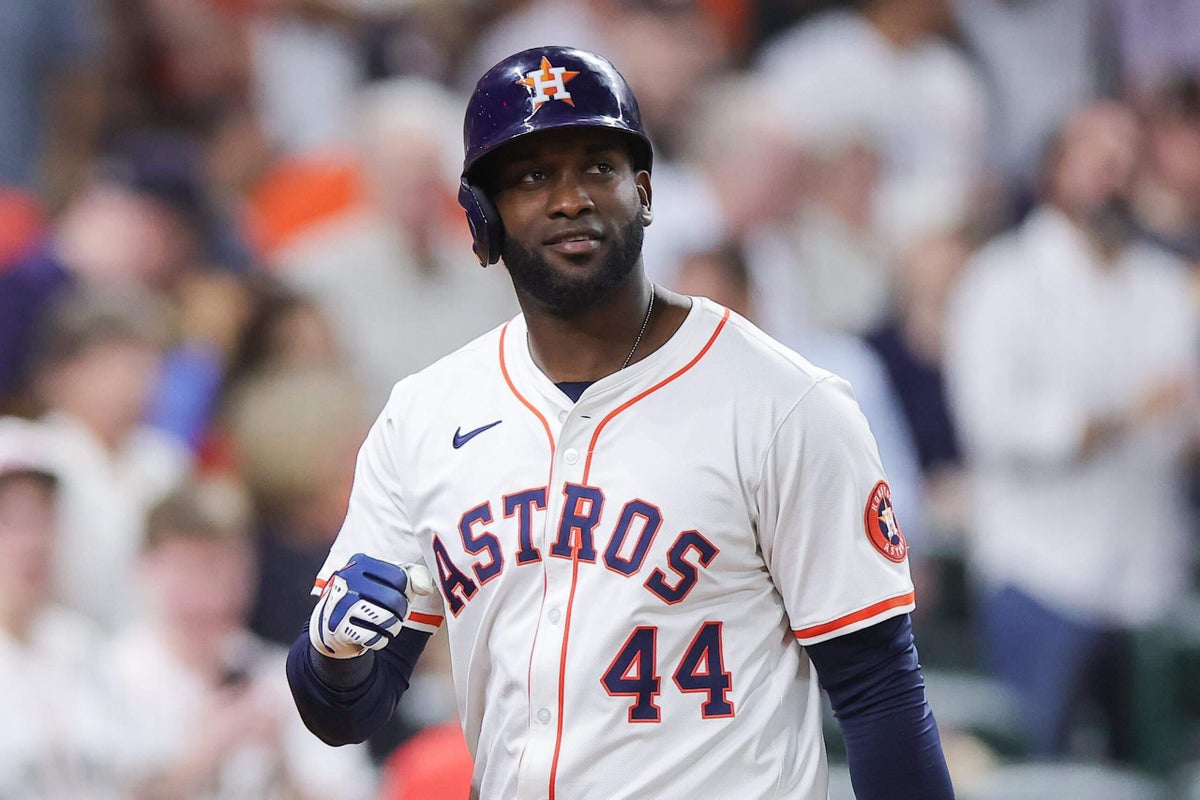
ORLANDO, Fla. — At full strength, Yordan Alvarez can ease any apprehension surrounding the Houston Astros. He is a one-man solution to slumps and the sort of presence Houston’s lineup sought throughout a star-crossed 2025 season. Instead, Alvarez’s 114-game absence staggered a club in constant search of continuity.
In response, the Astros have overhauled their coaching staff, instituted a hierarchy of hitting coaches and claimed a change in approach is coming. These measures may help, but still belie the biggest problem with Houston’s 2025 offense: Alvarez appeared in just 48 games, creating a chasm no changes in coaching or philosophy can even attempt to fix.
“One of our goals,” manager Joe Espada said on Monday, “is (deciding) how we keep Yordan Alvarez healthy.”
The Astros’ latest solution, according to Espada, is for Alvarez to “spend most of his season” at designated hitter. The manager did not divulge a specific division of playing time, but it stands to reason that Alvarez won’t match the 57 games he started in left field in 2022 or the 53 games he played there in 2024.
The benefits of shielding Alvarez from the outfield are obvious, even if it deepens a roster crunch that now appears untenable. Anointing Alvarez as the team’s primary designated hitter removes the only apparent avenue for the Astros to carry both Isaac Paredes and Christian Walker on their active roster, intensifying speculation that one of them will be traded before spring training.
According to The Athletic’s Ken Rosenthal, Paredes has drawn interest from the Boston Red Sox, who are amenable to moving some of their young, controllable starting pitchers in any trade. Houston’s entire offseason has been predicated on supplementing a starting rotation bracing for the loss of Framber Valdez.
Walker’s age, salary, six-team no-trade provision and subpar 2025 season won’t make him as valuable as Paredes. It’s unsurprising, then, that interest in Walker is minimal, according to multiple team sources, but it’s not as if he is unmovable. Even in a disappointing season, Walker still struck a team-high 27 home runs and sported a .799 OPS after the All-Star break.
Last month, general manager Dana Brown attempted to squash any idea of trading Walker or Paredes, saying that both would “hit somewhere between one and six” in Houston’s lineup. Brown added that Alvarez could “get a lot more games in left field” to free the DH spot for either of the two infielders to occupy.
Monday’s about-face makes this setup impossible. Declarations made in December aren’t final, but if Alvarez is indeed the Astros’ full-time designated hitter, flexibility to juggle Paredes and Walker will decrease. It also means Jose Altuve will be asked to play defense full-time during his age-36 season, making it even more difficult to find regular at-bats for both Paredes and Walker.
Before last season, Altuve accepted a position change to left field, but injuries around the roster altered the plan. Alvarez’s absence, specifically, allowed Altuve to start a career-high 49 games at designated hitter.
Ten months later, Espada acknowledged he is “considering” renaming Altuve as the team’s everyday second baseman. The skipper did not want to confirm anything until discussing it with Altuve, but during an interview on MLB Network, Espada said second base is Altuve’s “prime position” while adding, “I think we’re going to see him play there more this season.”
Astros manager Joe Espada breaks down his plans for the defensive configuration and talks about what it meant to have Carlos Correa back.
MLB Network + @SageUSAmerica pic.twitter.com/VezqgWOByt
— MLB Network (@MLBNetwork) December 9, 2025
“Altuve showed that he could play some left,” Espada said, “but also one of my goals is to keep Altuve in the lineup and keep Altuve healthy to play a big amount of games.”
Therein lies the crux of this conundrum. Alvarez and Altuve are the Astros’ two franchise cornerstones playing on the two largest contracts of Jim Crane’s ownership tenure. Barring injury, both of them will be in Espada’s everyday lineup. That neither man is a defensive difference-maker makes it more imperative for Espada to maximize their offensive value. In Alvarez’s case, it’s simply having him available.
In Altuve’s case, it could be limiting the energy he exerts on defense. Second base is a far less demanding position than left field, though it should be noted that Altuve received just 61 total chances in his 371 innings as a left fielder last season. For reference, Harrison Bader received 131 chances in 496 innings. Colton Cowser got 93 in 361 frames.
Unless Paredes is prepared to learn left field, keeping him and Walker on the roster would almost force Espada to play Paredes at second base on certain days. Perhaps there will be parts of the schedule where this is prudent. Getting Altuve off his feet or Alvarez an occasional start in left field would benefit both players while increasing roster flexibility. Doing that with any regularity, though, would weaken Houston’s offense.
If Altuve does make most of his defensive starts at second base, first base is the only position on Houston’s infield with any sort of fluidity. Walker is the incumbent starter and Paredes has extensive major-league playing time at the position.
Paredes also has experience at second base, but rival evaluators have long questioned his ability to handle the position on an everyday basis. Asked directly on Monday if Paredes is an option to play second base next season, Brown replied in part that “Paredes may get some games at third, DH, first, second.”
The feasibility of that plan is a legitimate question. Walker is owed $20 million next season. MLB Trade Rumors estimates Paredes will earn $9.3 million in arbitration. Is committing nearly $30 million to two part-time players a practical use of money for a team already concerned about its luxury tax positioning?
The left side of Houston’s infield is entrenched with third baseman Carlos Correa and shortstop Jeremy Peña. Both could get an occasional off day, but it’s difficult to envision Espada or any member of Houston’s coaching staff wanting to sit either player once a week. Peña, it should be noted, seemed on track to play 162 games last season before being hit in the ribs by a fastball.
Whether the players themselves would be amenable to such a fluid setup is another matter. Peña is two seasons away from a massive free-agent payday and, until then, is part of an arbitration process that rewards stat accumulation. Paredes has three more seasons of arbitration eligibility. Altuve is chasing 3,000 career hits. Communication and concrete plans could help soothe any possible discontent, but it’s worth wondering if such a hassle is worth it.
During the next two months, Brown and his baseball operations department must decide the answer.