
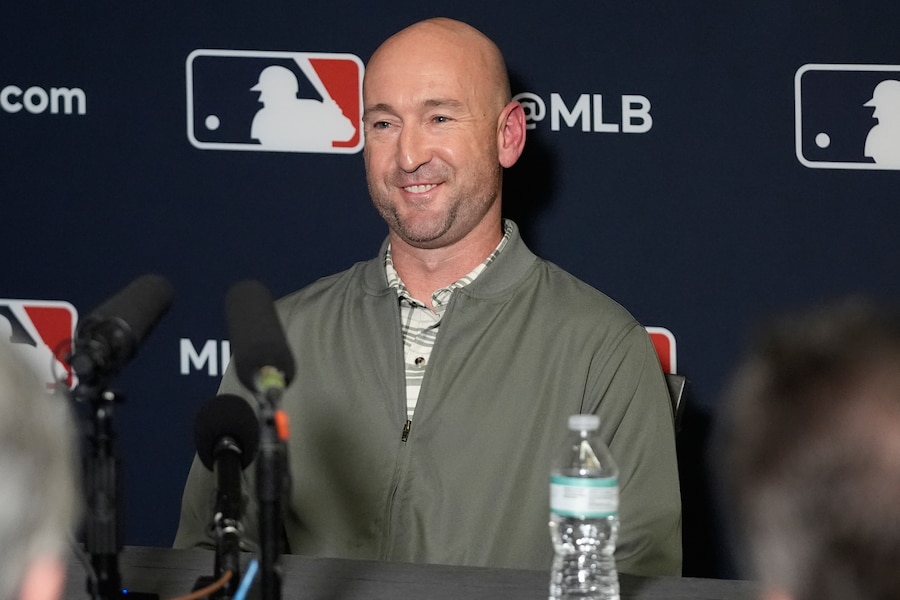
One of the most enduring questions about the 2025 Orioles now has an answer, thanks to new manager Craig Albernaz, the man whose job it is to turn things around.
We know the Orioles underperformed badly at the beginning of the season and things spiraled. We know the injuries, underperformance and roster decisions that led to the season going the way it did.
But this was a team whose talented homegrown core, and the close-knit nature of the group, was meant to gird against such a collapse. There was hardly any evidence of either — the talent or the spirit — as the year wore on. As Albernaz has made his introductory phone calls, he gained a fascinating sense of what his players thought of the team’s slide while also getting a glimpse at the unity and cohesion that was signature to this group in years past.
“They talked through what they need to do to get better and win games,” Albernaz said. “A lot of it has been just attacking the little things each day. That gets lost, especially with young players, but all baseball players. You kind of lose sight of what makes team baseball, a team-functioning aspect of the game. So for us, it’s just getting back to that point. That’s why our spring training is going to be like that, with a high focus on fundamentals and the little things, but as we move through the season, that’s a diverse team in my opinion. Like, we can go toe-to-toe and slug with teams, but we have to do the little things to do those close games as well, and those guys have identified that.”
Albernaz gave that answer in response to a question about expectations, which many in his lineup full of former top prospects have dealt with over the years. Earlier, he was asked about Adley Rutschman’s recent underperformance and flipped it to note that he was so impactful early in his career that he should be credited for the high expectations he’s built.
It felt like the same could be said about so many of Rutschman’s teammates: Gunnar Henderson, Jordan Westburg, Colton Cowser and Jackson Holliday, to name a few. None had the season he’d hoped for in 2025, for one reason or another. All were clearly impacted by what was surely the heftiest disappointment baseball has ever delivered to them, dragged out over six months.
The consequences of that are going to stick with these players. Even if the Orioles’ fortunes improve, the statistical regressions or lack of power production from the 2025 season will impact their own personal fortunes.
MLB’s salary arbitration system means players are paid for their production, and a year of poor performance can shave millions off a player’s earning potential before he reaches free agency. For a team comprised mostly of players who bet on themselves to make their riches in free agency rather than sign contract extensions, as everyone with the Orioles other than Samuel Basallo has, that can make a difference.
These individual struggles began in some cases before the team’s collapse overwhelmed everything, and unbraiding those threads feels pointless. But what seemed obvious as the team was flagging in April and May was that, in addition to injuries and rotation deficiencies, the Orioles were playing sloppy, unsound baseball and didn’t have the foundation to keep their season intact as those headwinds swirled.
At a certain point, there was much more the players could do about salvaging their own season — more homers, more counting stats and thus more money down the line — than there was to save the team’s season.
When that was suggested to me as the season wound down by someone close to the team, it felt counter to everything I knew about the players. I thought the opposite was true, and that their deep personal connections with each other were what made dealing with a season like this, where their friends were hurt or struggling to perform or both, kept the team’s stars from being at their best.
That was clearly misguided. The Orioles players feel that the approach they did take, for whatever reason and to whatever extent, was similarly flawed. If nothing else, Albernaz’s calls with them show the collective spirit that once made this team special hasn’t entirely gone away: Either they had a summit of sorts at the end of the season, or they all ended up in the same place about the season that had just ended.
“It was surprising, not the observations, but surprising to me how each player said the same,” Albernaz said. “It wasn’t like a mass call, it’s all these individual calls, and each individual was saying the same thing. It was really cool for me because, one, the self-reflection and self-awareness was off the charts, and no jaded views of the season either for them or the team. But it just speaks to the character of these guys and the culture that’s built here that these guys are all saying the same thing, and it’s nothing personal, about personal aspirations. It’s all about the team.”
That’s as good a place to start as any. I’d argue that for a manager who is leading with his authentic self in hopes of building authentic connections with his new players, organically uncovering the culture that his team is seeking to regain is a sign of good things to come.
More than their swing decisions or strikeout rates or anything else, it feels like restoring the advantage this team had when they were playing loose but crisp baseball and having a blast doing it will help the Orioles finally win in October.
Albernaz seems like the right combination of practical and cultural leadership to make it happen. And wittingly or not, his players gave him the roadmap to help restore it.