
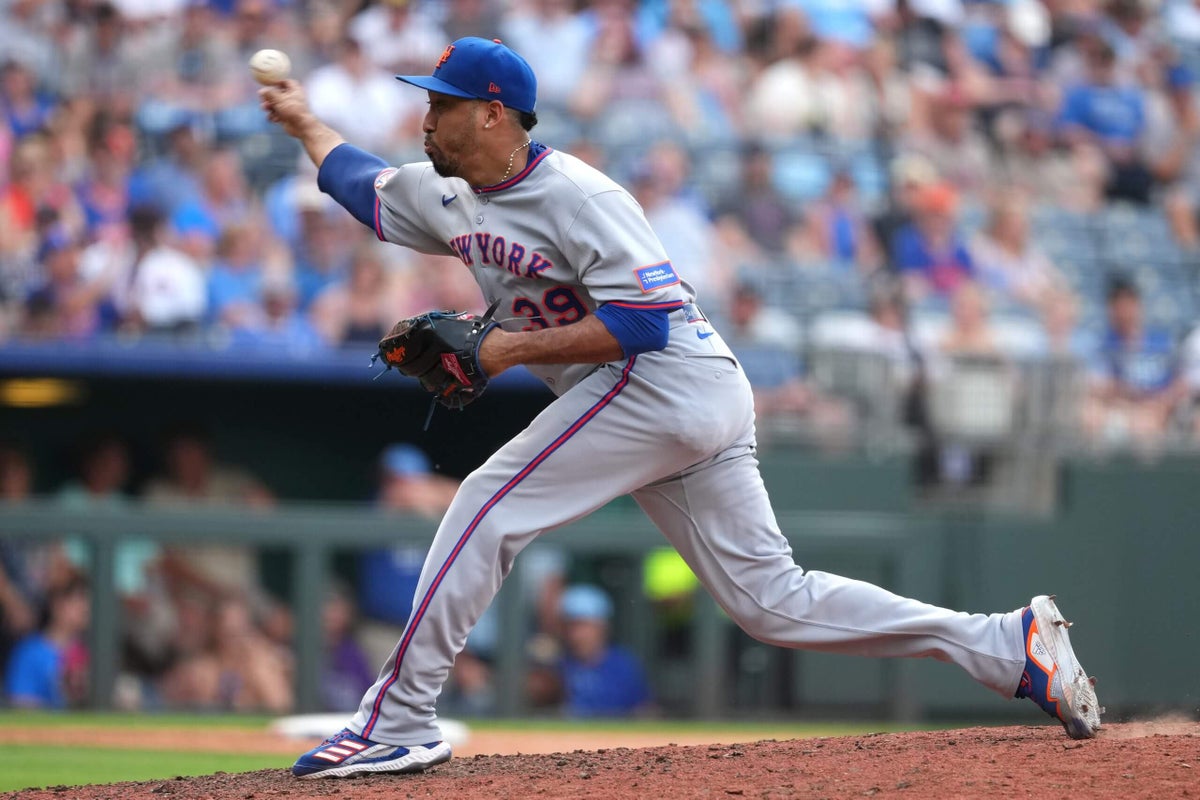
ORLANDO, Fla. — The Los Angeles Dodgers struck again on Tuesday, giving Edwin Díaz the highest average annual value ever for a relief pitcher, addressing their largest need and once again stunning a baseball world that cannot comprehend that the two-time reigning champions continue to dominate the market. They wooed Díaz from the New York Mets, one of the few clubs capable of the financial firepower the Dodgers possess, and again reset the expectations.
Here’s the thing, though: The Dodgers have spent two consecutive offseasons reframing what lengths people can imagine they’ll reach. They are one of one, with finances that have grown even from their previous gaudy levels. With that growth, their behaviors have shifted.
Nothing should be ruled out after Díaz’s three-year, $69 million deal (with reported deferrals to push the average annual value down to around $21.1 million) sent shockwaves through these Winter Meetings. Take last winter, when the Dodgers spent more on relievers than they ever really showed they were comfortable doing. The signings of Tanner Scott and Kirby Yates represented short-term disasters, with neither throwing a pitch in the postseason as the Dodgers repeated as champions.
Yet, rather than retreat to their typical logic and avoid the top of the relief market, the Dodgers doubled down. There’s a simple reason why.
“We are in a really strong position right now, financially,” said Dodgers president of baseball operations Andrew Friedman, who couldn’t discuss the Díaz signing directly since the move isn’t yet official. “If we were on a really tight budget, we probably wouldn’t allocate in the same way.”
Spend it if you got it, and the Dodgers sure seem like they got it.
.@FabianArdaya speaks with @kirsten_watson from Day 2 of Winter Meetings in Orlando about the reported signing of Edwin Diaz, moves being made quickly league-wide, and the need for an Outfielder. pic.twitter.com/sY6dUnki6o
— SportsNet LA (@SportsNetLA) December 10, 2025
The Dodgers came into the winter “wanting to focus on a shorter term,” Friedman said. They aggressively sought short-term pacts with Raisel Iglesias and Ryan Helsley before they each signed elsewhere. With the relief market moving quickest, they went to three years in their final offer to Devin Williams before he signed a three-year, $51 million contract with the Mets, according to a league source. Another source indicated that the Dodgers grew more willing to discuss a slightly longer-term deal with Robert Suarez in the days before Tuesday’s blockbuster.
Díaz’s deal came together quickly, a source said, and in a surprising fashion. The three-time All-Star had opted out of his record-setting deal with the Mets, hoping to get a five-year pact, which didn’t appear to align with what the Dodgers were seeking. While the Dodgers had expressed a willingness with relievers to go for a higher average annual value in exchange for fewer years, setting a new mark with Díaz still likely would’ve been at the high end of their desired threshold. Díaz also had the previous mark for highest AAV for a reliever at $20.4 million in his Mets deal.
Then there came an added wrinkle: Díaz, unlike his other relief counterparts, had a qualifying offer attached to him. The Dodgers, who will already suffer draft pick and international bonus pool penalties due to their spending for the foreseeable future, will have to surrender their second and fifth picks in the 2026 MLB Draft, along with $1 million in international bonus pool space for signing Díaz.
Those penalties are “a real cost,” Friedman said, “so (you) try to bake it in and factor it into the decision.”
“You never want to be flippant about this,” he continued, “but we have a really strong and deep farm system. And so it at least helps mitigate it some.”
The calculus is obviously different than what it once was. The Dodgers’ projected competitive balance tax figure for 2026 is already at around $347 million, according to Cot’s Contracts. Their farm system is regarded as one of the best in the sport. They’ve gone this far and could keep going. Players are treating Los Angeles like a destination. Díaz wound up signing for a three-year deal for only slightly more per year than the three-year, $66 million offer with deferrals the Mets sent out and were willing to increase.
A Dodgers front office that has at times groaned at the acquisition cost of relief pitching has now spent a combined $141 million on closers over the last two winters in Scott and Díaz. Circumstances have changed. The most expensive back end of the bullpen in baseball is in Los Angeles now, as stunning as that may be to those who have seen how this organization typically operates.
It’s a gamble for a team that has more chips to play than anyone else. Playing in the free-agent market, and especially the relief market, means you’ll bust more frequently. The Dodgers certainly did last winter, as Yates, Scott and Blake Treinen turned a $107 million commitment into a 5.04 ERA in a combined 143 appearances. Los Angeles’s bullpen ERA in 2025 was 4.27, tied for 20th in the majors. Adding a relief pitcher did not represent a luxury but a real need.
“Every spring training, the question is, ‘What keeps you up at night? What are you thinking about?” Friedman said. “It’s always the bullpen.”
It was a bust last year. Scott, in particular, represented a concern. Only this week did manager Dave Roberts and general manager Brandon Gomes say that his troubles could be linked to elbow discomfort that he pitched through long before hitting the injured list last July. Scott won’t be asked to take down as many ninth-inning opportunities with Díaz in the fold, lowering the stakes on what they’re hoping is a big turnaround for several of their internal options. Díaz, perhaps the best closer in the sport, solves several bullpen problems with one issue.
That’s the thing about the Dodgers these days. They always seem to have another hand to play.
— The Athletic’s Katie Woo contributed to this story.