
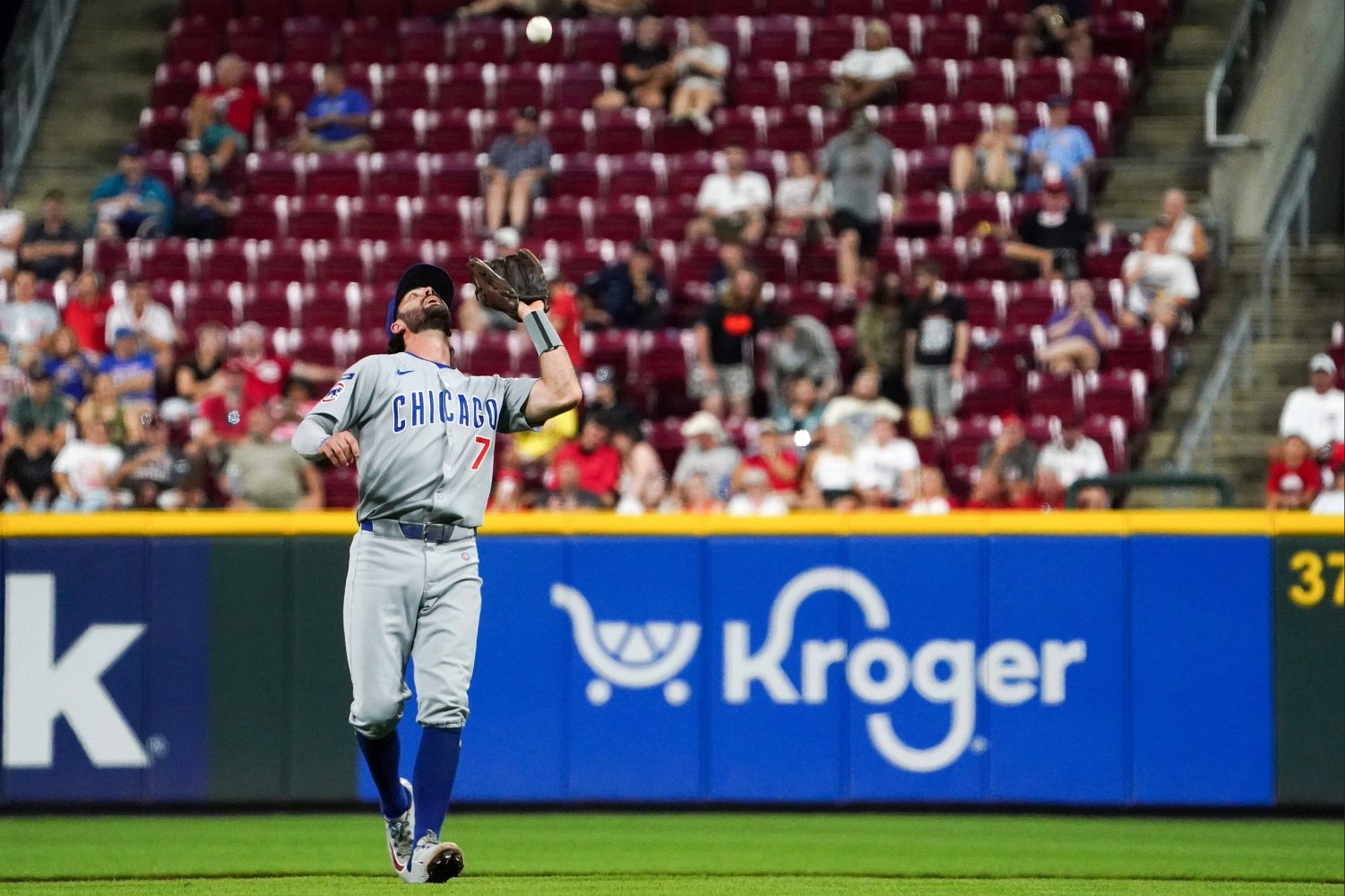
I want the 2026 Chicago Cubs pitching staff to become “King of the Pop-Up”. I admit, it sounds a little less sexy than becoming “King of the Strikeouts” (or for any Tim Robinson fans out there, Rog, the “King of the Slams“) and frankly, a pop-up is just less exciting. There is a reason that, in the movie Major League in the penultimate scene, Ricky “Wild Thing” Vaughn gets Clu Heywood to strike out on a 99-mph fastball instead of inducing a weak can-of-corn to the first baseman; it’d be hard for audiences to go crazy about that. And yet, I’m here to tell you that, in a baseball-sense, it would have made no difference, and that getting a “Texas Leaguer” is basically the same as a powerful punchout.
First, we should look just how devastating a pop-up actually is. Using MLB’s Baseball Savant, there were 8,716 balls-in-play during the 2025 season that were classified as pop-ups fielded by an infielder. Of those 8,716 pop-ups, just 71 landed for a hit. What this means is that if you hit a pop-up on the in-field, it is the most guaranteed form of out one can imagine, at least from balls put in play. It may not look devastating — a baseball flying just 50 feet in distance, landing safely in the second baseman’s webbed glove is kind of boring in real time — but in terms of getting an out? It’s absolutely devious.
Now, I can already hear the counterargument, “but a player can make an error.” So, I’m going to push my (non-existent) glasses up on my nose and give you my best “uhm, actually” to point out this: There were only 20 errors in the league on those 8,716 balls in play. This means just 91 hitters found any way to reach base on an infield pop-up last season. This gives teams a 99% chance of recording an out on a pop-up — it’s a near-guarantee. As I said: it’s truly a fatal to a hitter.
Further comparing it to a strikeout, lest us not forget about dumbest of all rules: the dreaded dropped-third-strike. That rule proves that not even a strikeout is immune to a player getting on base. In an article by Sam Miller, he outlines how many dropped-third-strikes happen on a year-to-year-basis; a strikeout is not a guaranteed out either, and by July of 2025, there were already 29 instances of a player reaching first on a K. In 2024, this number was 50, which is not many more than the pop-up. It’s true, that there are far more instances of strikeouts, but in total, hitting a pop-up is just shy of a guaranteed out in a very similar way the strikeout is.
Enter the Chicago Cubs. In 2025, the Cubs were second in baseball (behind the Minnesota Twins), inducing 345 infield pop-ups on the season. This included the seventh-best pop-up inducer in Matthew Boyd, the 13th-best in Shota Imanaga, the 19th-best in Colin Rea, and the 29th-best in Jameson Taillon. You’ll note that two of these three were new additions to the team, and Taillon worked extensively on his pitch repertoire last year. The Cubs, as a team, use cutting motions on their fastballs, almost more than any other organization, which likely leads to the extensive pop-up heavy approach; they just have that added movement which misses barrels.
The Cubs should improve on their pop-up-generation in 2026 simply by having their stalwart, Justin Steele, healthy. The left-handed pitcher has been a very reliable pop-up getter, ranking 70th of 361 pitchers between 2022 and 2024. While Steele may not be the master of his craft as much as Matthew Boyd of Shota Imanaga are, he uses a cut-ride fastball that is useful in this area.
Why are pop-ups important? Well, our advanced metrics don’t take them into account currently. Fielding Independent Pitching (FIP), which has become the basis of a lot of our advanced data on pitching, does not take batted ball data (such as pop-ups or ground balls) into it’s equation, focusing heavily on strikeouts, walks and home runs. As FIP has become more popular, “FIP-beater” profiles, or pitchers who routinely post lower ERAs than their FIPs would suggest them capable of, have become an undervalued property at times. Kyle Hendricks is a great example of a FIP-beater; someone who threw a slew of strikes, generated abundant groundballs, and didn’t walk hitters proved that this combination was effective here. Guys who induce a lot of pop-ups just may be the next “FIP-beater” out there.
Last year, the Cubs were one of the biggest “FIP-beaters” as a team in the league, finishing ninth in baseball with a 3.81 ERA but just 20th (4.16) in FIP and 18th (4.16) in xFIP. Part of this is that the Cubs have a great defense, ranking among the top three in almost any category you can think of. But the team is just 25th in ground-ball rate, and this is generally a part of the “FIP-beater” profile. How do they achieve this? Well, in part, due to their innate ability to get hitters to get under the ball and hit weak pop flies.
Getting even more Texas Leaguers is a way the Cubs can close the strikeout gap they currently face. Last year, the Cubs ranked just 27th in total strikeouts (1,271) and 21st in strikeout rate. Compare that to, say, the Yankees, who were fourth in total strikeouts (1,440) and seventh in K%. When we include the near-guaranteed out of a popup into the “easy out” equation, the Cubs close the gap from a difference of 281 to 205 — a healthy reduction. This isn’t to say the Cubs don’t still need to find swing-and-miss, but finding more pop-outs can also help to close the gap in terms of “guaranteed outs”.
This may be a way to figure out which pitchers on the current market appeal to the team. Michael King, in his healthy 2024 campaign, induced the 25th most pop-ups in baseball. He’s been routinely connected to the Chicago Cubs this offseason, and while it’s unlikely that the primary reason is his ability to generate pop-ups, that almost assuredly appeals to the team. Another starting pitcher who induces a lot of pop-ups? The Minnesota Twins’ Joe Ryan, who is rumored to be among those who could be traded this offseason.
Using the same properties, relievers Kenley Jansen and Ryne Stanek (of whom we reported recently that the Cubs do have interest in) have history of creating a lot of pop-ups and could interest the team. Caleb Thielbar as well could be a candidate for a reunion, based on his history with the team and his history with the pop-out. This obviously won’t be the only factor a team like the Cubs will taken into account, but as we look for under-the-radar pickups, it’s clear that this can matter in player evaluation.
Ultimately, the pop-out is a boring version of an out; a hitter meekly hits a ball in the air a relatively short-distance and a defender camps out under it and catches it with ease. It doesn’t have the same panache as an overbearing 99-mph heater, and a defensive player isn’t tasked with doing some amazing. It’s a play that literally results in an out at the major-league level 99% of the time, but one we generally have ignored as a viable way of limiting base runners. The Cubs cannot just get pop-outs, but they can look to add more of them coupled with swing-and-miss options. For a team who has a bunch of pitching to add, finding a few cheap pop-out getters is a way the team can continue to defeat its FIP reliably.
What do you think of the pop-out? Do you think more teams need to embrace it as a legitimate way to get outs? Sound off in the comment section below!