
ORLANDO, Fla. — A week spent setting foundations ended without any Winter Meetings transactions for the Houston Astros, a club focused on trading for starting pitching and navigating its overcrowded infield.
“It’s always good when you get something done at the meetings, make an announcement, that’s all cool,” general manager Dana Brown said. “But it’s not reality all the time. A lot of times, you get to these winter meetings, you set the foundation for a deal and then by the time you get back to your respective cities, that’s when you get the deal done.”
Perhaps, then, the next week will produce some meaningful movement. In an otherwise quiet week at the Signia by Hilton Bonnet Creek & Waldorf Astoria, here are seven things we learned about the Astros:
Though both men intend to “retire here,” the future of Brown and manager Joe Espada beyond this season is murky. Both members of Houston’s braintrust are in the final year of their contracts, and neither appears close to an extension. On Tuesday, the same day Rob Thomson received a one-year contract extension from the Philadelphia Phillies, Brown evaded a question about whether Espada has warranted one of his own. It should be noted, too, that Espada sat nearby, listening to Brown’s interview and answer to this question.
“Joe and I have had the conversations that we both want to retire here. That’s our goal,” Brown said Tuesday. “The way we’re going to be able to do that is to put a good team together, win, get deep into the postseason and then our contracts will take care of itself. I like the way we both put the time in to get to where we are. We take pride in that, and we (will) work our tails off to get back to the postseason, and we’re going to work our tails off to get deep into the postseason.”
Whether extending Espada is even Brown’s decision is a legitimate question, especially given the general manager’s own uncertain status. Owner Jim Crane does have precedent for allowing his manager and general manager to operate as lame ducks, with Dusty Baker doing so twice and James Click once.
At least one other head of baseball operations, the San Diego Padres’ AJ Preller, is also in the final year of his contract, but he has engaged in extension negotiations with Padres ownership. It’s unclear if Crane, who hasn’t held a news conference since Opening Day, has the appetite to do so with his employees.
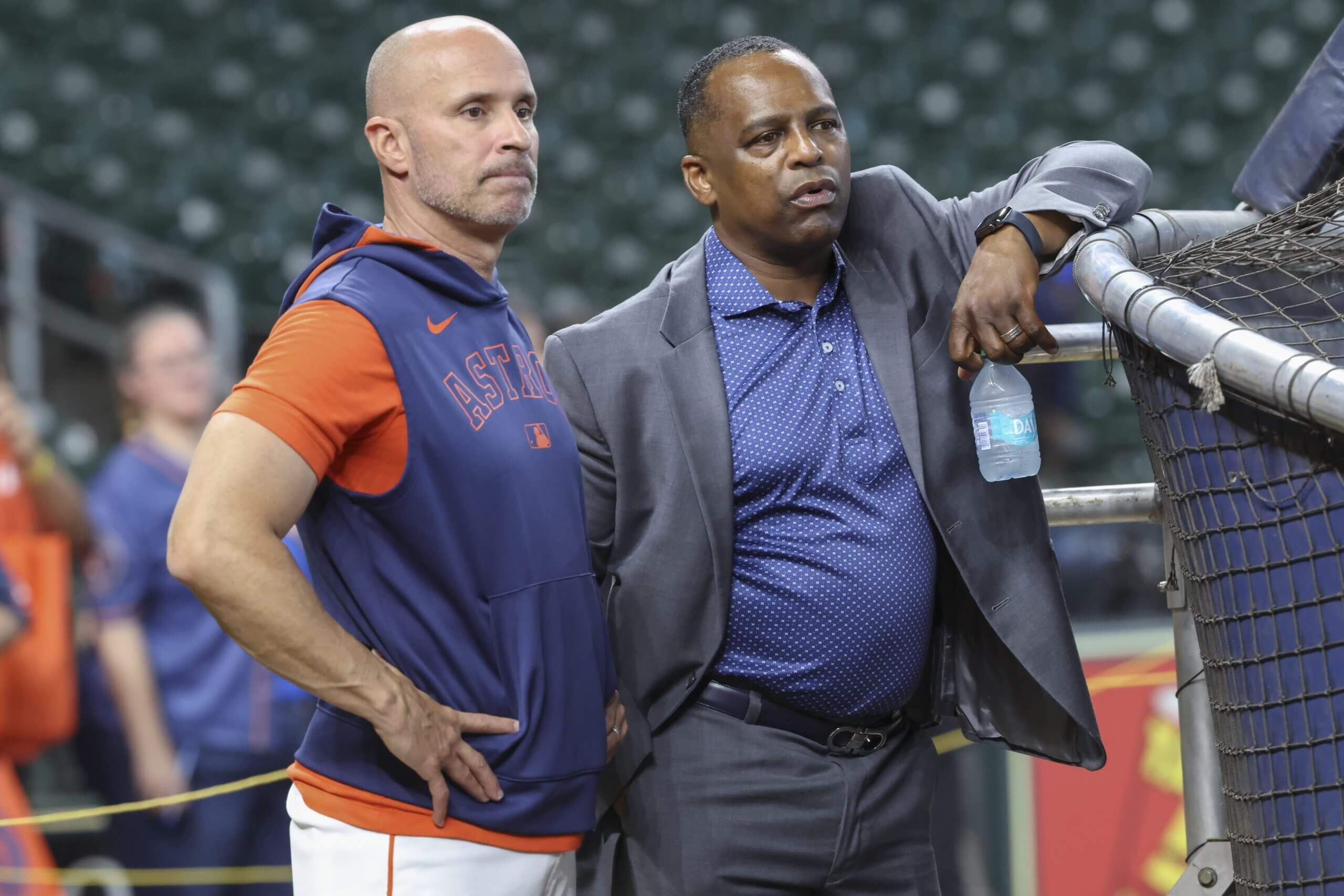
Joe Espada and Dana Brown are not guaranteed another leap of faith from Astros ownership, but history could be on their side. (Troy Taormina / Imagn Images)
Trading Kyle Tucker last December set a precedent. As a result, each subsequent offseason will feature speculation about a similar deal involving a homegrown superstar whom Houston has failed to extend. Brown shut down one possibility Tuesday, revealing that teams have not inquired about shortstop Jeremy Peña’s availability.
“I think teams understand if you’re a winning team and you’re trying to go back to the postseason, there’s no way you can trade your starting shortstop,” Brown said.
The revelation itself is unsurprising. Peña has two more seasons of club control remaining. Tucker had one when the Astros traded him last winter.
Still, Houston’s overcrowded infield and its constant search for farm system upgrades made it at least feasible to consider listening to ideas for Peña. The prospect haul in a potential Peña trade would do wonders for the Astros, but would also signal the sort of organizational step back that runs counter to Crane’s claim of a championship window never closing during his ownership tenure.
So, for now, Peña remains entrenched in Houston. Perhaps that will change if the Astros underperform before the trade deadline and decide to sell. If they don’t, expect this same conversation to occur next winter, when moving Peña will feel far more realistic and align with the precedent Tucker set.
Despite the presence of clubhouse favorite César Salazar, the Astros are pursuing a more experienced catcher to back up starter Yainer Diaz. Salazar, who will be out of minor-league options this season, has long been lauded for his game calling and pregame preparation, but there is concern about overexposing him at the major-league level. Bear in mind, too, that Victor Caratini became a critical part of Espada’s roster flexibility, contributing as a designated hitter, occasional first baseman and as one of the team’s most trusted pinch hitters.
The Astros have interest in a reunion with Caratini, but clubs in search of everyday catchers have identified Caratini as a target and could make him more lucrative offers. It stands to reason, too, that Caratini would prefer more regular playing time after two successful seasons in Houston.
After a late-season shoulder strain, Josh Hader’s days as a multi-inning reliever may be over. Might set up man Bryan Abreu also see a decrease in those duties? Espada acknowledged Monday that he is “looking for ways to take that fourth out of Abreu’s hands early in the season” in an effort to maintain health for one of baseball’s most underrated relievers.
Ten of Abreu’s 70 appearances last season featured more than three outs. Four of them occurred before June 2. Previously unheralded middle relievers such as Bryan King, Steven Okert, Kaleb Ort and Bennett Sousa became more reliable throughout the season, lessening Espada’s urgency to deploy Abreu earlier than the eighth inning.
Similar seasons from those relievers, and maybe other surprise contributions, will allow Houston to preserve Abreu and Hader early in the season. Espada said he will be “focused on” pitching young relievers early in spring training to determine if any could contribute in high-leverage roles. Rule 5 pick Roddery Muñoz will be among them.
Bear in mind, too, that this is Abreu’s final season before free agency, which will make his usage fascinating to follow. He’s made at least 70 appearances in each of the past three seasons. That durability will increase his value on the open market, but must also be monitored before he enters it.
Other than announcing Eric Velazquez’s promotion from assistant athletic trainer to head athletic trainer, Brown declined to reveal much about the changes Houston made this winter to its much-maligned return-to-play procedure.
“I won’t get into our policies, but make no mistake, we’ve definitely taken a deep look at it and talked at length about return to play,” Brown said. “We definitely have a plan in place. I won’t talk publicly about it, but it’s something we’re taking a lot of pride in this year.”
Houston didn’t renew the contract of long-time head athletic trainer Jeremiah Randall after an injury-marred season filled with setbacks.
Brown said the team is “still working through details” of some assistant athletic trainers, but the team’s official website, which reflects Velazquez’s promotion, lists Taylor Witczak as an assistant athletic trainer. Witczak was listed as the major-league physical therapist in last season’s media guide.
John Gregorich, who served as an assistant athletic trainer last season, is no longer listed on the team’s website. Both of the team’s strength coaches, Hazael Wessin and Stephanie Mock Grubbs, remain listed in their same positions from last season.
After authoring a career renaissance in Korea, right-hander Ryan Weiss will compete for a spot “in the back-end” of Houston’s starting rotation, Brown said. Ditto for Nate Pearson and AJ Blubaugh, both of whom Brown confirmed will be stretched out as starters in spring training.
Neither Blubaugh nor Pearson has Weiss’s track record of durability, which is important for a team that returns only one pitcher who threw more than 100 major-league innings last season. Weiss threw 178 2/3 innings in KBO last season and, in 2024, logged 146 1/3 frames between independent ball and Korea.
Weiss’ deal, which the Astros made official Tuesday, contains a $5 million club option for 2027 that contains a $500,000 buyout, according to a league source. He will make a $2.5 million base salary in 2026, but can earn an extra $250,000 if he pitches 100 innings and another $150,000 if he throws 130 frames.
According to Brown, Lance McCullers Jr. is “locked in” before the final season of his five-year, $85 million contract extension. The Astros could benefit from any type of bounce-back he can make.
Injuries and setbacks have limited McCullers to 103 innings pitched since 2021. He returned last season from flexor tendon surgery, but struggled to a 6.51 ERA across 55 1/3 innings and finished the season as a long reliever.
Getting anything close to McCullers’ previous form would be a boon to a starting rotation with so much uncertainty.
“He’s got something to prove to the baseball world that he’s still Lance McCullers and he can get after it,” Brown said. “ … I’m kind of excited about seeing him in spring training, to be honest.”