
 Listen to this article
THE BLUEPRINT:
Study shows $70 million to $800 million in potential development near American Family Field.
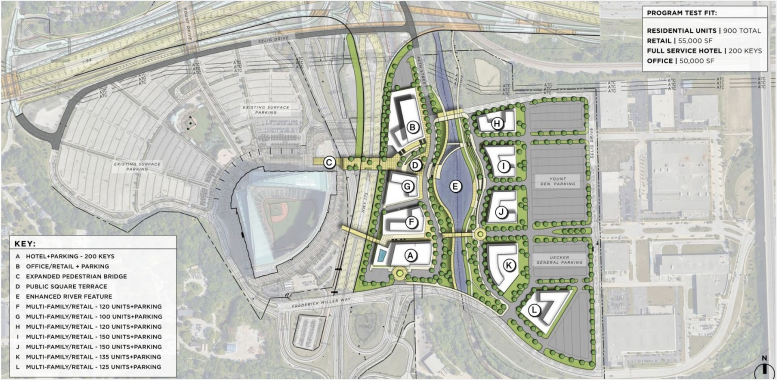
Concepts include 600 to 1,000 housing units, hotels, offices and retail space.
Plans could displace 2,000 to 3,000 parking stalls. The stadium has around 12,000 stalls currently.
Site challenges include floodplain issues, contaminated fill and utility relocation.
A report on development next to land near American Family Field showed vertical construction with housing, hotels and offices could be worth between $700 million $800 million.
In November, the Wisconsin Professional Baseball Park District board reviewed a study for development on parking lots south of Interstate 94 and west of Wisconsin Highway 175 in Milwaukee County. Board members reviewed three scenarios where mixed-use development would stretch from left field to the Menomonee River. However, each option could take thousands of parking stalls from the stadium’s 12,000 existing stalls.
The district hired Washington-based consultant Brailsford and Dunlavey, Missouri-based architecture firm Populous and Glendale-based Kapur to create the report. Key stakeholders listed were the Wisconsin Professional Baseball Stadium District, the Milwaukee Brewers, the City of Milwaukee and Milwaukee County.
Plans could include 600-1,000 multifamily units, hotels with 150 to 200 keys, 38,000 to 52,000 square feet of retail space and between 20,000 and 50,000 square feet of office space.
The presentation also addressed a handful of factors for site development, including environmental, flood management, utilities, parking and lease terms. Redevelopment could also displace around 2,000 to 3,000 parking spaces in most scenarios.
Environmental, utility and floodplain management are factors
Much of the study area has historic fill and contaminants tracked by the Wisconsin Department of Natural Resources. New development must consider capped surfaces, limited excavation, elevated foundations and vapor mitigation on the site.
Part of the area falls within 100-year and 500-year flood zones, which will require elevated structures and improved drainage, the study showed. Developers would coordinate with the Federal Emergency Management, DNR, the Southeastern Wisconsin Regional Planning Commission and local agencies to modify the floodplain.
There are also high-voltage transmission lines and some utilities such as water, sewer, electric, gas and fire lines might have to be extended or relocated, the study showed.
Utilities: Redevelopment must account for relocated high voltage transmission lines and will require targeted utility extensions or relocations for sewer, water, electric, gas, and fiber.
The Milwaukee Brewers‘ lease also expires in 2050, which is shorter than private developers’ ground leases for 50 to 99 years for mixed-use developments.
Early construction costs estimated around $800 million
If a plan is created and approved by the district, vertical construction costs for mixed-use development at the stadium would range $732 million to $791 million. That number is based on 2025 pricing for typical mid-rise construction.
The estimate is based on multifamily and retail developments designed with two levels of parking, retail space on the bottom floor and five levels of residential floors above. Offices would be designed with three levels of parking and two levels of office above, and hotels would be designed with two levels of parking with a lobby on the ground floor and five levels of hotel rooms above.
Site improvement costs would land around $27-$30 million to address civil, environmental and public infrastructure requirements, the study showed.
The estimate includes utilities, stormwater systems, streets, sidewalks, lighting, plazas and landscaping, the study showed. A developer would have to raise surfaces onto pads to address floodplain requirements.
Some environmental mitigation and soil remediation would have to be conducted due to previous developments, but those costs will depend on testing and planning to come up with a refined cost.