
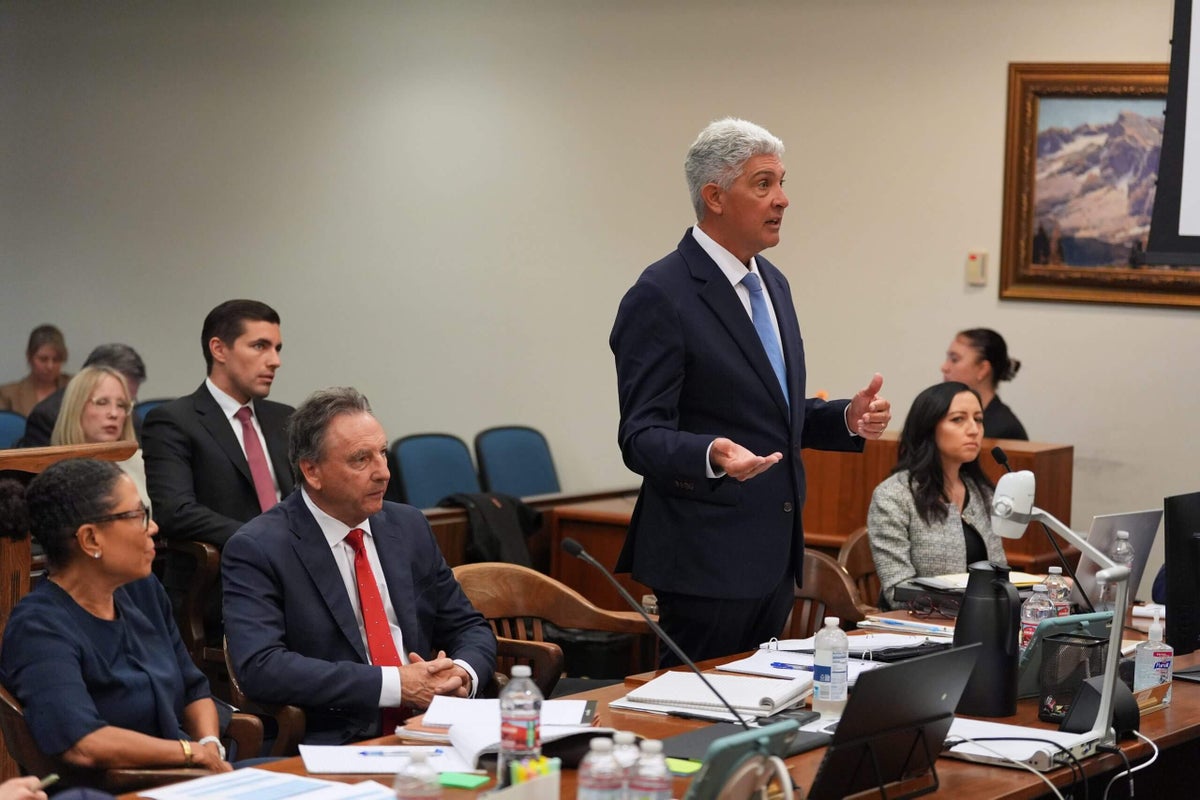
SANTA ANA, Calif. — Testimony in the wrongful death civil trial brought by the family of pitcher Tyler Skaggs concluded on Friday with brief but contentious testimony from Angels president John Carpino.
Carpino acknowledged that the Angels declined to pay out the remainder of Skaggs’ 2019 contract after his death. He also testified that the team was still paying for Eric Kay’s legal defense.
“Tyler Skaggs was a drug addict and a drug dealer,” Carpino said. “And Eric Kay was a drug addict and drug dealer.”
Kay is serving a 22-year federal prison sentence for providing the fentanyl-laced pill that Skaggs ingested, leading to his death on July 1, 2019. The family’s suit is based on a belief that the Angels knew, or should have known, that Kay was providing pills to Skaggs.
Closing arguments will begin on Monday, with deliberations ensuing immediately after. Testimony in the trial began more than two months ago, and the proceedings overall have gone on for nearly three months.
Carpino, on direct examination by Angels lawyer Todd Theodora, said he wished that ex-Angels vice president for communications Tim Mead had provided him with information about Kay’s drug issues. He also highlighted the team’s actions in calling law enforcement on July 18, 2019, immediately after Carpino was notified of Kay’s potential involvement.
The Angels president said he spent time with Skaggs’ family in the aftermath of Tyler’s death, and that he helped arrange for a game to memorialize the pitcher, when the team played its first home game following Skaggs’ passing.
“It affected me deeply,” Carpino said. “He was part of our family.”
On cross examination, Carpino declined to say whether or not he thought Kay had actually provided the lethal pill to Skaggs, and said “I don’t believe that Eric Kay had proper representation” in his criminal trial.
Court proceedings were delayed on Friday due to a fire drill in the court house. The lawyers and judge ended up arguing issues related to jury instructions in an adjacent outdoor courtyard.
The judge said I could tweet this. https://t.co/6ThcnALA7p pic.twitter.com/sYvzwW2P77
— Sam Blum (@SamBlum3) December 12, 2025
When testimony began, nearly two hours late, two Angels-hired experts argued — in the context of potential future earnings — that Skaggs was a pitcher in decline, with a significant injury history and a record of poor performance. The Angels also called another senior executive, Molly Jolly.
The Angels utilized longtime MLB general manager Dan Duquette to make the argument on potential future earnings. The Angels, through Duquette and sports economist Stephen Walters, have said Skaggs would have earned between $0 and $30 million throughout the rest of his career.
Duquette’s comments, at times, focused on statistics that didn’t align with Skaggs’ overall performance. One of his presentation slides was titled, “Tyler Skaggs was in Decline” — citing year-over-year dips in curveball spin rate and fastball velocity from 2016 through his death.
“The quality eroded significantly,” Duquette said, due to his “unreliability” and “unavailability” stemming from injuries.
However, in nearly every statistical metric, Skaggs performance was improving at the time of his death. He’d posted a career-best 1.8 WAR and 4.02 ERA in 2018. In 2019, through exactly half a season, Skaggs had a 1.1 WAR, on pace for a career-best year. He led the team in strikeouts and innings pitched, and past testimony from other Angels witnesses referred to him as the club’s “ace” that year.
Duquette was asked by Skaggs lawyer Daniel Dutko if 2019, when Skaggs started 15 games, was on pace to be his healthiest season. Duquette said no, offering that 2016 was actually Skaggs’ healthiest season. However, in 2016, Skaggs made only 10 starts, and missed more than half the year recovering from Tommy John surgery.
Before Duquette testified, the Angels called Walters, the sports economist, who testified that he used Baseball-Reference.com’s similar players’ tool to find the best comparisons to Skaggs.
On cross examination, Walters was asked why the list included numerous relievers, when Skaggs was a starter. The list also included several pitchers whose careers ended at age 27, and several more who were born in the 1940s, and pitched before the mound was lowered in 1969. Dutko noted language on Baseball-Reference’s website saying their similar players comparison tool can be unreliable.
Walters also argued that Skaggs was not a good comp for lefty starter Patrick Corbin, who ultimately made more than $100 million in free agency, even though Walters’ initial list of comparable players included Corbin.
The Angels expert criticized the Skaggs side’s projected future earnings estimate. Ex-MLB Players Association attorney Jeff Fannell testified that Skaggs would have earned more than $100 million over his career. “Tyler’s performance was substantially worse than Fannell’s comps,” read the header of one of Walters’ slides.
Duquette then testified that a player abusing and distributing drugs would “disqualify them from future employment.” It was a point that another Angels expert, ex-MLB lawyer and Pirates president Frank Coonelly, testified to earlier this week, arguing that Skaggs would have been banned from the sport for abusing and providing drugs.
The first question Dutko asked Duquette on cross-examination was about 2010 MVP Josh Hamilton, who previously signed with the Angels for $125 million in 2012, despite a previous two-year suspension for drug use. He also asked about C.J. Cron, who the Angels traded for in 2023, after he testified in Kay’s 2022 criminal trial about purchasing pills from Kay.
When asked by Dutko if Cron was another player that Kay had sold drugs to, Duquette’s response was consistent with the approach of the side that hired him as an expert: “CJ Cron was on the list of players that received drugs from Tyler Skaggs, yes.”
The Angels’ penultimate witness was Jolly, who has been at the defense table throughout the trial.
On direct examination by Theodora, she explained that the Angels initiated a separation agreement with Kay, as opposed to unilaterally firing him, over concerns about potential litigation. At the time of Kay being placed on paid administrative leave, Jolly said, the team didn’t have all the facts because he was under criminal investigation.
She also addressed October testimony from Camela Kay, Eric’s wife. Camela had testified that Jolly drove to their family’s home on July 18, 2019 — the night authorities were alerted to Kay’s possible involvement.
Camela testified that Jolly didn’t seem interested in her or her husband, who was entering rehabilitation. Instead, she was asking details about Eric’s legal representation.
“I knew he had a lawyer, I wanted to get the information,” Jolly said.
Jolly testified that she had no knowledge of Kay’s drug use, and downplayed the authority of Mead and traveling secretary Tom Taylor, both key witnesses alleged to have known about Kay’s drug use.
Cross examination by Skaggs attorney Leah Graham began with her reading back Jolly’s deposition, in which she said that Mead was on the Angels’ executive leadership team.
Graham also worked to poke holes in Jolly’s timeline of Kay’s administrative leave turning into an unpaid suspension in October 2019. Jolly said Kay’s suspension began when he returned from medical leave, but Graham noted that a doctor’s note about his leave ending has never been produced.
Lastly, Graham asked if there’s anything Jolly would do differently, knowing all that she knows. Jolly admitted she’s not a perfect person, but defended the organization and its transparency.
Answering the question, Jolly said, “I’ve taken notes on the policy manual.”