
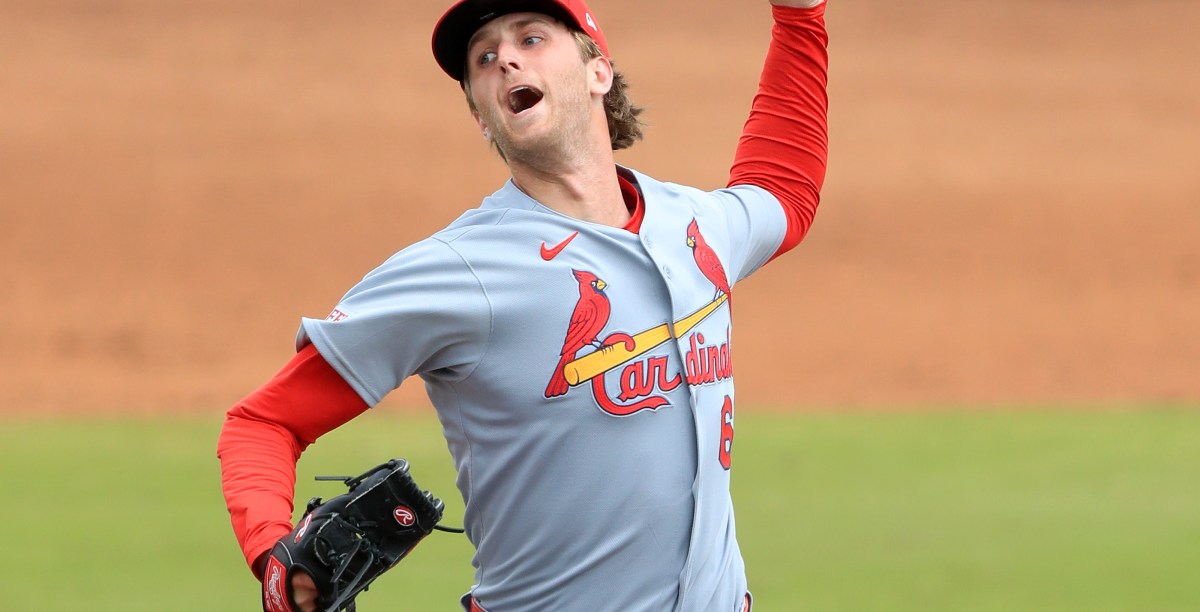
How likely is a prospect to go from an unknown non-prospect to a top prospect in one season? Rainiel Rodriguez went from unranked by Fangraphs to hitting the Top 100 prospect list last year. That’s a little unfair though because Rodriguez was a relatively unheralded international signing that only had one professional season under his belt. Quinn Mathews is a better recent example. He went from the 31st ranked prospect in the system to the 58th in all of baseball between 2023 and 2024. Looking outside the Cardinals organization, James Wood went from the 10th ranked prospect in the Padres organization to the 9th ranked in all of baseball between 2021 and 2022. Bo Bichette had a similar trajectory back in 2017 and 2018 with the Blue Jays.
There has been extensive research over the years on how players perform at the major league level relative to their prospect ranking. This research is trying to answer questions like “How much WAR should we expect from a pitcher given a 50 FV ranking over the first six years of their big league career?” I would like to dig into this data more in the future, but today I am going to focus on the year-over-year change in a player’s grade prior to making a major league debut and exhausting their rookie eligibility. How often does a player make a jump like Wood or Bichette? How many Quinn Matthews would we need in our system to expect to have one breakout every year?
Thanks to the great work by the Fangraphs prospect writers over the years, we have a ton of prospect data at our fingertips. From 2017 to 2025, Fangraphs has ranked and graded over four thousand prospects and over 10 thousand prospect seasons. Fangraphs assigns a future value (FV) score with players receiving a 50 or greater typically being Top 100 prospects in a given season. Without going too far into the weeds, a quick reference on what FV score correlates to:
40: Bench player or up-and-down starter
45: Platoon player or back of the rotation starter
50: Average everyday player or 4th starter
55: Above average regular or mid rotation starter
60: All-Star player or No.3 starter
70: Top ten player in baseball or No. 2 starter
80: Top five player in baseball or Ace pitcher
Below we will walk through the historical ranking trends of prospects by FV bucket. I am including the graduation rate for reference, but a prospect graduating is not included in the table summary. The FV ranking in the table is for the next season only, not their final prospect grade before graduating. One final note, I do not necessarily agree with all of the Fangraphs grades, but to stay consistent, I am showing how Fangraphs has the current crop of Cardinals prospects ranked. If it were my grades, we would be creating a new tier for Rainiel Rodriguez!
Prospects: JJ Wetherholt, Liam Doyle

34.5% of the total 200 prospects given a FV 55 since 2017 have made their major league debut and exhausted their prospect eligibility the following season. Unless something goes wrong, we can expect Wetherholt to join this group before next season’s prospect lists are published. Liam Doyle might have a good year and make a major league debut while still remaining a prospect. Based on this data, we can say that he has roughly an 80% chance to maintain a Top 100 ranking and an 18% chance of improving on his grade. Only one player has made the jump from the 55 to the 70 tier in one season, which Vlad Guerrero Jr. did back in 2018.
Prospects: Leonardo Bernal, Rainiel Rodriguez, Jimmy Crooks, Quinn Mathews, Tink Hence, Brandon Clarke

Fangraphs gives the Cardinals a huge cohort of six players with a 50 FV. Crooks and Mathews will hopefully graduate. Hence will likely graduate or drop and see his stock plummet. Two of the Cardinals’ highest upsides prospects, Rodriguez and Clarke, will look to defy the odds and take another step up the ranking hierarchy. Only 3% of players make the jump from 50 FV to 60 FV, but if Rodriguez hits in Springfield next year, that will be on the table.

To me, this is where it starts to get interesting. Regardless of what you think of him, Padilla is one of the highest upside players in the system. If he can get the ball in the air and keep improving on his already solid exit velocity numbers, he is a prime candidate to move up. Konnor Griffin made the jump from this tier to mega prospect just last year.
Prospects: Hansen, Hjerpe, Roby

We will just have to wait and see on Roby and Hjerpe when they get back from their injuries. I personally would not have Hansen this highly ranked.
Prospects: Henderson, Je. Baez, Gurevich, Mitchell, Jo. Baez, Robberse

Some more fun prospects in this tier. Joshua Baez has already started showing up on some Top 100 prospect lists, but Eric Longenhagen is not buying his improved strikeout rate.
Prospects: Hancel Rincon, Jose Davila, Blaze Jordan, Andre Granillo, Austin Love, Brycen Mautz, Cade Crossland, Matt Koperniak, Chase Davis, Cesar Prieto, Royelny Strop, Skylar Hales, Yordy Herrera, Leonel Sequera, Cade McGee

The jump from this tier to a top 100 prospect list isn’t unprecedented (2%) and having 15 players in this tier certainly helps the odds.
This analysis is not perfect as it is based on the subjective rankings of one outlet (but their data is too good not to use!), it doesn’t consider draft pedigree, pitcher vs. hitter, prospect age, or any other number of factors that could be useful. However, I think this will help frame what we can view as a successful season for the farmhands next year. Much of the attention will be on Wetherholt and the upper minors players, but some of the lower ranked prospects outperforming expectations will be a great sign for the future big league club and validation that the new regime can outcompete on player development.