
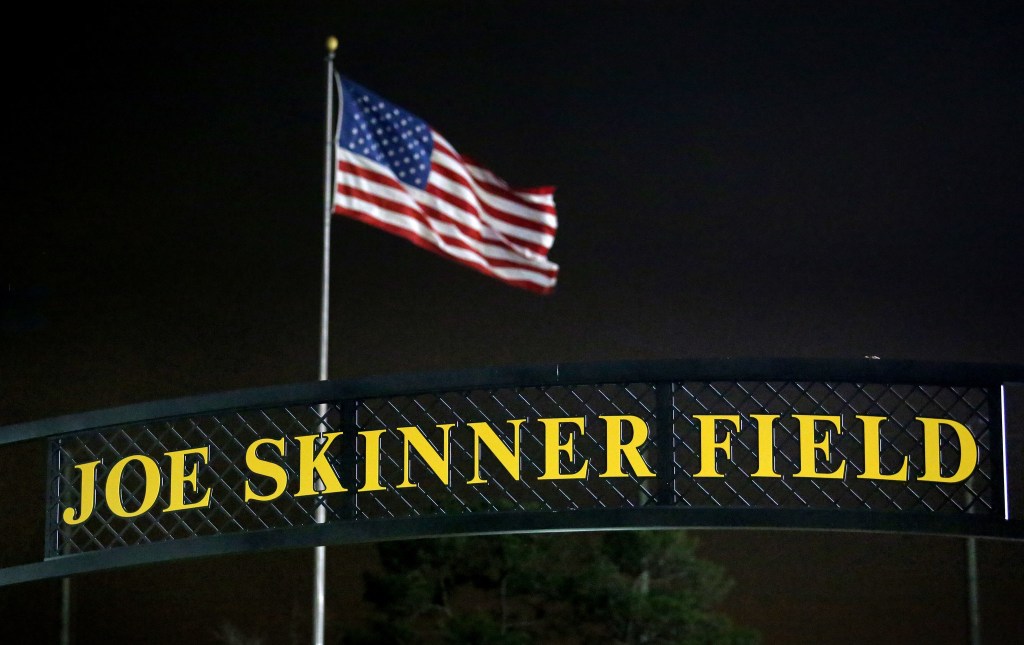
It’s been a long time.
Long enough for a decade to pass, for long lost summers to blur into fall and back again, for baseball fields to be mowed and re-mowed a thousand times, for kids to grow up and for grief, somehow, to learn how to breathe.
And yet, for Judy and Scott Skinner, 10 years can also feel impossibly short.
“It doesn’t feel like 10 years,” Judy Skinner says. “It feels like yesterday. You never get over when one of your children dies.”
This Friday, Dec. 19, at Shingle Creek Golf Club in Orlando, the Skinners will host the 10th annual SkinnerStrong Charity Golf Tournament, a milestone event that exists because their son Joe once lived — fully, joyfully, generously — and because even death could not erase him. Nearly a decade after Joe Skinner died from a rare form of leukemia at age 17, his memory remains active, purposeful and alive through his parents, through the SkinnerStrong Foundation, and through the money raised to help other families fighting the same merciless disease. (To play in the golf tournament or to donate, go to skinnerstrong.org/events-registration.)
But this is not a story about a golf tournament. It’s a story about a kid.
A good kid.
A great kid.
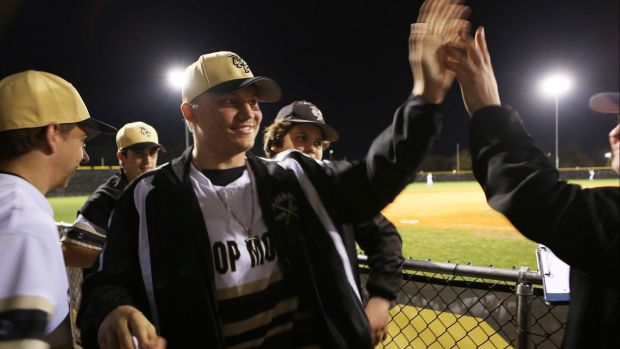
Ricardo Ramirez Buxeda / Orlando Sentinel
Joe Skinner high fives teammates during a 2016 Bishop Moore baseball game. Skinner, who was committed to play at UCF, died after battling leukemia nearly a decade ago.
Joe Skinner was the kind of kid we all wish our kids could be. He was driven without being entitled, competitive without being cruel, gifted without being aloof. Baseball was his passion — the diamond his sanctuary — but it never defined the entirety of who he was. He was an honor student. A teammate. A friend who crossed social boundaries with ease.
“He was a light,” Judy says. “He had friends who were athletes and friends who were non-athletes and he somehow brought them all together. He treated everybody like they were his best friend.”
At Bishop Moore High School, Joe was a standout third baseman and team leader, a player whose talent and work ethic attracted college coaches before he could drive. As a freshman, he committed to play baseball at the University of Central Florida — his hometown school, his dream — and when he finally got a scholarship offer, the smile never left his face. MLB scouts were scheduled to visit the Skinner home. The future was unfolding exactly as promised.
Then came the weekend that changed everything.
Joe was supposed to be on his official visit to UCF. Earlier in the week, he had a fever. He felt tired. He missed school, which was unusual for him. On Friday night, out to dinner with UCF coaches and staff, Joe had to excuse himself and go home because he felt sick. Two or three days later, he was diagnosed with hypodiploid acute lymphoblastic leukemia, one of the rarest and most aggressive forms of the disease.
The timeline feels cruel in its efficiency. Diagnosis in December. Death in April. Just a few months between everything he was supposed to become and everything he endured instead.
What Joe endured would have broken most of us.
The cancer rapidly ravaged his body but never dimmed his spirit. He wanted desperately to remain part of his team. He showed up to practice when he could. Once, his body — hollowed by chemo — betrayed him so completely that he fell down on the field as he tried to run.
Still, he kept coming back.
“He had one last at-bat during a game,” Judy recalls. “It was hard and inspirational at the same time.”
That at-bat — taken to a standing ovation — wasn’t about baseball anymore. It was about dignity. About normalcy. About joy in the midst of sadness. Joe understood, perhaps better than most, that life is measured not only by how long it lasts, but by how fully it’s lived.
Even as his world narrowed to hospital rooms and treatment schedules, Joe’s faith expanded. While he lay in the hospital before he died, Bishop Moore handed out its senior awards. A young man of immense faith, Joe won the Religion Award. It fit. His favorite Bible verse — the one he had scrawled on the whiteboard in his bedroom — came from Micah 5:8: “… Like a lion among the beasts of the forest.”
That’s a reminder to stay strong and faithful no matter what the world throws at you.
In a fragile, uncertain world filled with noise, outrage and division, Micah’s words — and Joe’s life — feel almost radical. Joe brought people together and moved through life with a humble but fearless outlook. He included and encouraged.
UCF, to its eternal credit, told Joe that his scholarship would be there whenever he wanted it. It was a promise rooted in hope, one that acknowledged the fight he was facing. Joe never got to use it. But that promise mattered. It told him he was more than a statistic. More than a diagnosis.
Joe died on April 30, 2016, in Dallas, awaiting an experimental treatment he never received because the cancer moved faster than the medicine could keep up. He died in the arms of his parents and his sister, Molly. A few weeks later, Bishop Moore named its baseball field after him: Joe Skinner Field. A place where teenagers still chase dreams, where the crack of the bat still echoes, where his presence lingers without saying a word.
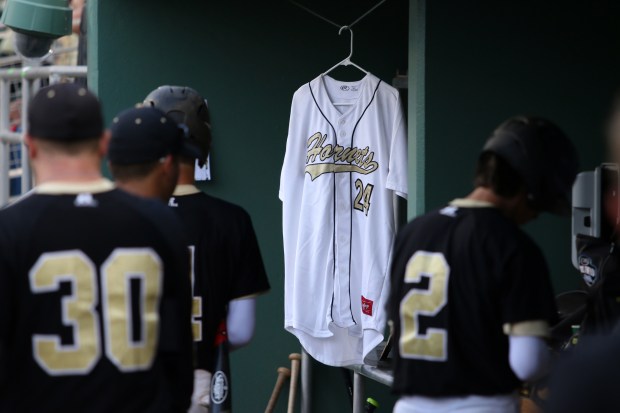
Kelli Krebs, Special to the Sentinel
Joe Skinner’s jersey hung in the Bishop Moore dugout after he passed away in 2016. (Kelli Krebs / Correspondent)
There is a famous passage from A.E. Housman’s poem “An Athlete Dying Young” that often surfaces in stories like Joe Skinner’s — stories about young men whose talent and promise once lifted an entire town.
“The time you won your town the race
We chaired you through the market-place.
Today, the road all runners come,
Shoulder-high we bring you home,
And set you at your threshold down,
Townsmen of a stiller town.”
The poem is often read as an ending, as a somber farewell for something lost too soon. But Joe Skinner’s story refuses to stop there. Because nearly a decade later, Joe is still being carried — not in silence, not in sorrow, but in action. He is carried in every scholarship funded, in every research dollar raised, in every child who benefits from the work his parents began in the darkest moment of their lives.
Joe Skinner’s story did not end with his death. It doesn’t rest quietly at a threshold.
Because 10 years later, his parents and Bishop Moore are still carrying him forward.
“Joe’s legacy is about more than baseball. It’s about character, resilience and love,” says Scott Skinner, Joe’s father. “Every swing, every laugh, every reunion at this golf tournament is a reminder that his light continues to shine.”
The SkinnerStrong Foundation has raised critical funds for childhood leukemia research. It has supported families who suddenly find themselves in hospital rooms they never imagined entering. It has given back to Bishop Moore, ensuring future students benefit from Joe’s legacy. Every dollar raised, every golfer who tees it up, and every drive down the middle or shank into the trees at the tournament is an act of defiance against despair.
Joe Skinner’s memory lives not in sorrow, but in service.
And maybe that’s the greatest lesson he still offers us. In a world desperate for reasons to believe, Joe represents the greatest commodity our country still has:
A good kid with a bright future.
A kid who did things the right way.
A kid who mattered — and still does.
Ten years later, Joe Skinner is still bringing people together. Still reminding us what grace looks like under pressure.
Still teaching us that a light, once given, never really goes out.
Email me at mbianchi@orlandosentinel.com. Hit me up on social media @BianchiWrites and listen to my new radio show “Game On” every weekday from 3 to 6 p.m. on FM 96.9, AM 740 and 969TheGame.com/listen