
In many ways, we know what shape the 2026 Chicago Cubs will take on the positional side. While there’s still a bench to sort, the catchers, the infield, and two-thirds of the outfield are settled. That’s seven spots in the lineup that are largely set in December, barring an impact addition or subtraction (which would be a shock given how Jed Hoyer & co. typically operate).
There’s still the matter of right field to be sorted, and how things shake out between Seiya Suzuki and Owen Caissie should have some bearing on the designated hitter spot. It’s this portion of the equation where we start to wonder about what role Moisés Ballesteros will serve for next year’s group. Given the departure of Kyle Tucker and Ballesteros’ performance down the stretch for the 2025 Cubs, there’s an assumption that exists that he’ll factor in heavily as the team’s designated hitter. On paper, there’s plenty of logic to it.
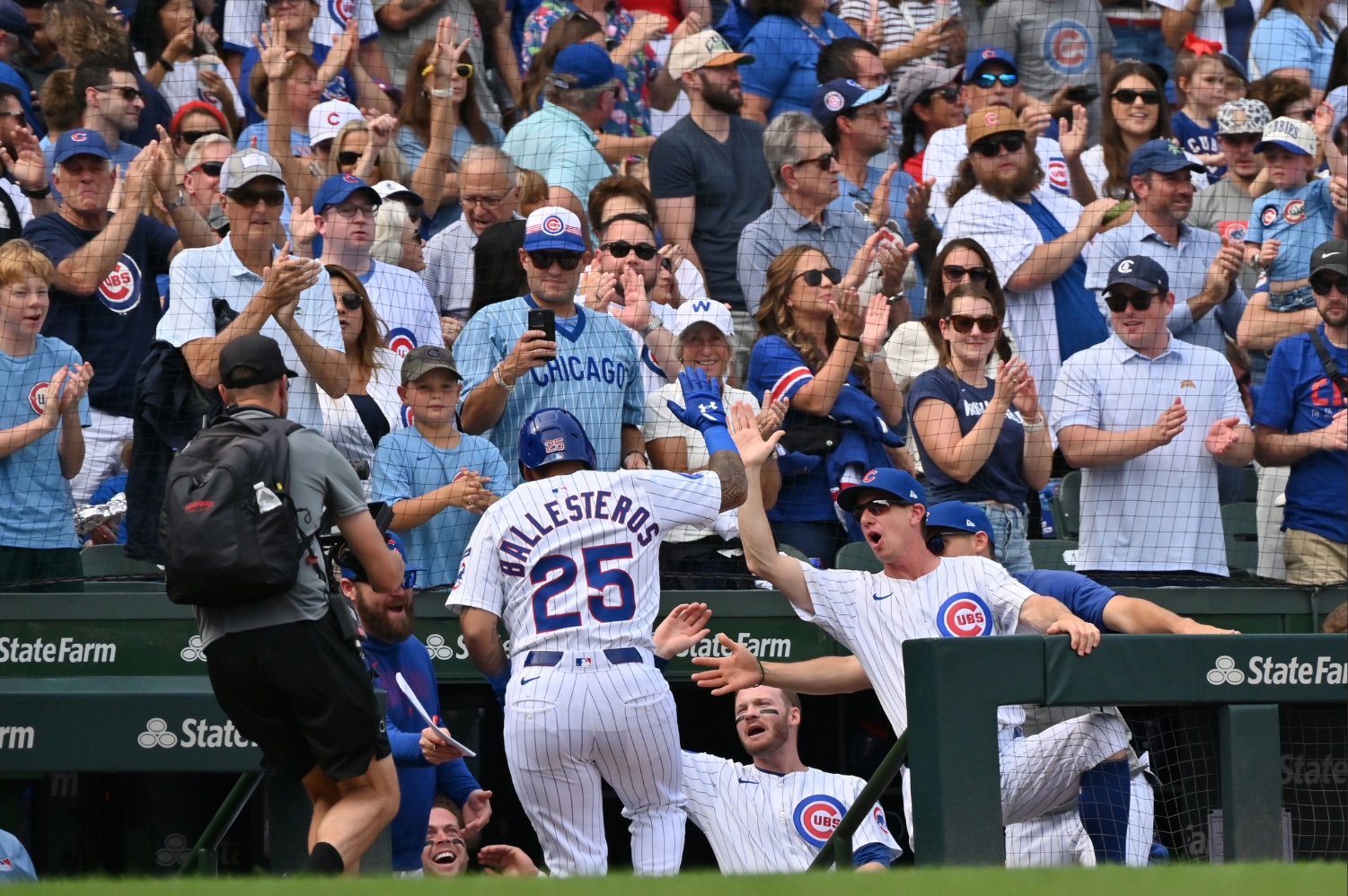
After carrying a .316/.385/.473 line and 121 wRC+ in Iowa, Ballesteros was called up permanently in September, appearing in 14 games and landing as an extra bat on the postseason roster. He finished his first 20 big league games (which also included five games in May and one in July) with a .298/.394/.474 line, a 143 wRC+, and strikeout (18.2 K%) and walk rates (13.6 BB%) that matched up well with one another. His approach and contact ability were on full display, leaving the Cubs with an admirable skill set in a lineup that needs every bit of consistency it can find. The aforementioned departure of Tucker lends itself to a roster shuffle that should, in theory, land Ballesteros the gig as the top option at DH. But theory will get you only so far.
Craig Counsell likes a bit of flexibility out of his DH. Suzuki might’ve been the team’s primary option in that role last year, but injuries necessitated plenty of time for him all across the outfield grass. He was hardly a full-time DH in the way that one might have expected through the combination of Tucker’s arrival and Pete Crow-Armstrong‘s breakout. Ballesteros assuming the role would change the calculus in that spot entirely.
At present, Moisés Ballesteros is a man without a position. The Cubs are not inclined to let him catch, with questions long persisting about his ability to handle the defensive nuance of the position. With Carson Kelly and Miguel Amaya each set to return, it’s likely that the team goes the Reese McGuire route and stashes a defensive catcher as depth in Iowa until needed. If they had any intention of letting Ballesteros catch, we likely would’ve seen it for more than six innings of a single game throughout his stretch on the roster in September.
And while the Cubs got him a bit of time at first base at the very end, it’s unlikely he’ll assume a role there (other than a legitimate off day or injury to Michael Busch). In Busch, the Cubs employ a full-time first baseman with upper-tier offensive upside. The only supplement he’ll see if of the right-handed variety, though it stands to reason that he’ll also see additional time against southpaws in 2026. That Ballesteros is also a lefty essentially eliminates any shot there.
Which means that the outcome in right field is going to directly correspond with the space with which Ballesteros will have to operate.
Let’s assume, for a moment, that Suzuki gets his time back on the grass as the full-time right fielder. In that case, are the Cubs going to be content to rotate Owen Caissie through left, right, and the DH spot depending on the day? Or would that not offer up enough of a timeshare to justify his place on the roster in favor of a yet-to-be-signed veteran backup? Such a scenario lands Caissie back in Iowa (operating under the safe assumption that he’s not included in a trade for an upper-tier starting pitcher before then). In that case, then you likely have the ability to let Ballesteros ply his trade as the everyday designated hitter.
But what if Caissie forces the collective hand of the brass with a strong showing in the spring? His presence on the roster would unlock far more flexibility in both providing breaks for the other outfielders and ensuring you don’t have to rely on Suzuki’s glove on a daily basis. On paper, having Caissie on the roster serves the group more effectively than Ballesteros might considering the more dynamic opportunities available via his presence.
Of course, the possibility exists that both are on the roster. It’s a tough sell, however; a pair of left-handed bats, one pinned exclusively to the outfield and another without a firm position, really tamp down on Counsell’s job to operate as effectively as he may prefer.
If there’s any indication of where things may stand at present, perhaps we can turn to a couple of key outlets for some insight. FanGraphs currently projects Caissie to occupy seven percent of the timeshare in left field, 20 percent in right, and 20 percent as the designated hitter. Ballesteros, meanwhile, projects for 44 percent of the time as the DH, four percent behind the plate, and nine percent at first base. In terms of playing time, the score is 1-0 Ballesteros, it would seem.
Baseball Prospectus has something similar on their depth charts. Caissie is projected for 10 percent of the time in left, 25 percent of the time in right, and 20 percent as the DH. Ballesteros is projected for five percent of the plate appearances at each of catcher and first base, with 40 percent of the time sent his way as the DH. Prospectus lines up a bit more favorably for Caissie than it does for Ballesteros.
Which means that even the roster prognosticators are working within the same muddled framework alongside the general public. The wide assumption from both is that Suzuki will grab the majority of the time in right field, with the other two factoring in in a more supplemental fashion as far as playing time distribution goes. While neither FanGraphs or Prospectus are particularly revealing of how things could shake out, it does speak to the idea that there may only be room on the roster for one at a time.
The good news is that it’s only December and there’s time for the roster to be sorted. We don’t yet know how that’ll transpire, but there should be at least one notable positional addition to the roster for some extra depth. That addition should go a long way toward indicating whether it’ll be Ballesteros or Caissie with the first crack at a regular role for the Cubs in 2026.