
Christmas is a week away and the Red Sox still haven’t handed out a single MLB free-agent contract this offseason. The only other club in the same boat? The Rockies.
Boston hasn’t been idle — far from it. Craig Breslow has already swung six trades, bringing 11 new players into the organization. The headline moves were the acquisitions of right-handers Sonny Gray and Johan Oviedo, giving the rotation much-needed structure and innings. On paper, the pitching looks more stable. The depth looks real.
And yet, the silence in free agency is loud.
This is not how Red Sox offseasons usually feel. No splash. No December press conference. No “statement signing” meant to signal intent. Last winter, Breslow added Garrett Crochet, Aroldis Chapman, and Carlos Narváez — all three of whom proved to be legitimate impact pieces for the big-league roster.
This winter was supposed to be different in another way. Breslow publicly preached the need to add power bats to a lineup that too often stalled in key moments. Instead, Kyle Schwarber and Pete Alonso signed elsewhere, with reports suggesting Boston never made a serious, aggressive push for either slugger.
So what exactly is Breslow doing when it comes to finding the offense his lineup desperately needs?
Thus far, Breslow appears committed to patience — perhaps to a fault. He’s reshaping the roster through value plays, flexibility, and controllable assets, prioritizing optionality over optics. It’s sound roster theory. It’s also a risky posture in a market that expects clarity.
Which raises the real question: what exactly is Breslow building toward?
Alex Bregman has long been viewed as the cleanest fit for Boston’s infield and the most obvious “statement” bat still on the board. But the financial picture is coming into focus. Bregman is believed to be seeking a five-year deal that could exceed the contracts signed last week by Pete Alonso ($155 million) and Kyle Schwarber ($150 million). Bregman turns 32 in March — one year younger than Schwarber and only nine months younger than Alonso — making both the price and the length of that commitment significant.
With Arizona emerging as a serious suitor, the Red Sox may soon be forced to pivot.
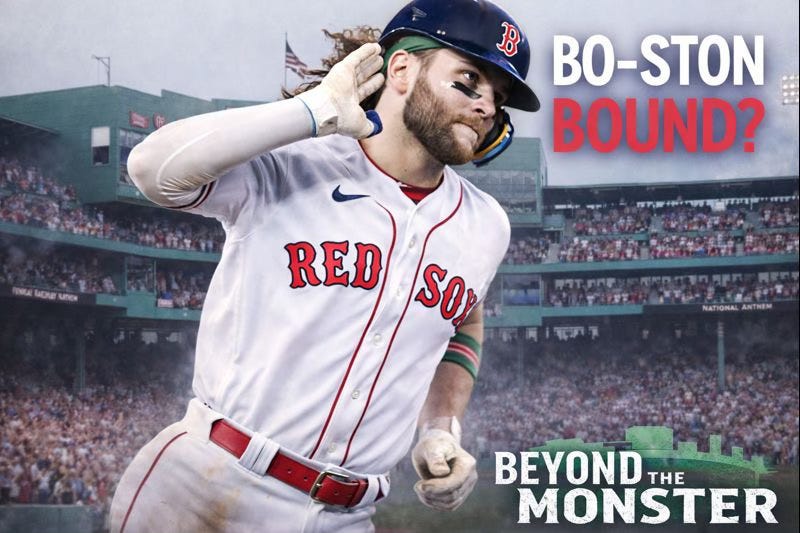
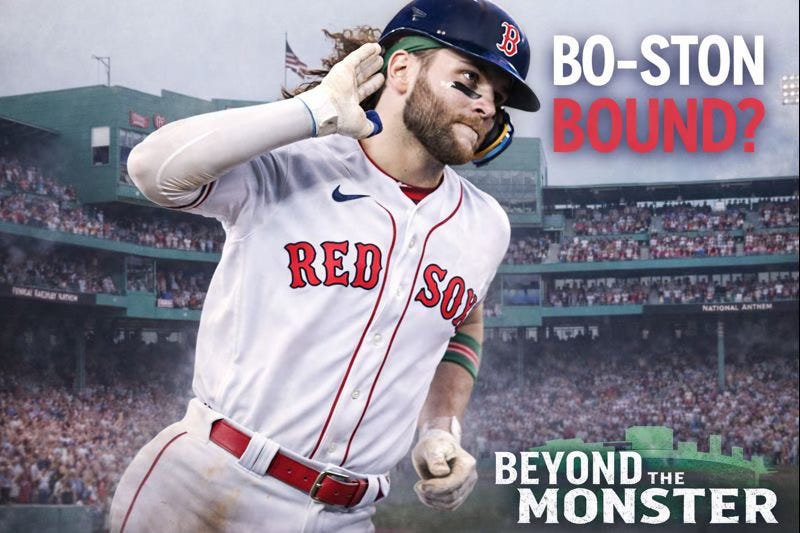
That pivot could be Bo Bichette — and not as a consolation prize.
Bichette isn’t just a theoretical Fenway fit. He’s already punished the park. In 35 career games at Fenway Park, Bichette owns a .329/.382/.524 slash line with a .907 OPS, slugging six home runs, 10 doubles, and driving in 30 runs across 157 plate appearances. That production translates to a 149 wRC+ and a .386 wOBA — numbers that don’t lie and don’t require projection.
The underlying data only strengthens the case. Statcast paints a hitter who thrives on contact quality: 99th percentile expected batting average and 79th percentile expected slugging. This is exactly the type of offensive profile that plays in Boston — hard contact, an all-fields approach, and damage without selling out.
Just as importantly, Bichette appears willing to make the fit work defensively. According to MLB.com’s Mark Feinsand, Bichette has begun telling teams he’s willing to move off shortstop and play second base. “The shortstop market has been terrible, but people are not necessarily looking at Bichette as a shortstop,” Feinsand said. “He is starting to tell teams he’s willing to move to second base.”
That flexibility matters. Sliding to second base would allow Bichette to focus on what actually drives his value — the bat — while easing the nightly strain that comes with playing shortstop. For Boston, it isn’t a concession or a workaround; it’s a practical solution that maximizes offensive impact while maintaining long-term infield flexibility as Marcelo Mayer continues to develop.
At 27, Bichette also aligns with Boston’s competitive timeline. He fits alongside Roman Anthony, Mayer, Ceddanne Rafaela, Crochet, and the rest of the emerging core without blocking development or forcing a short-term window. He raises the offensive floor immediately while preserving the optionality Breslow has quietly prioritized all winter.
Not that this matters much, but fans love a sentimental story; the Bichette family has roots in Boston. His parents, Dante and Mariana, met at Gold’s Gym on Landsdowne Street. His father also played one season for the Red Sox. He appeared in 107 games and hit .286 with 12 homers and knocked in 49 runs. The elder Bichette retired from baseball after the 2001 season after spending 14 years in the big leagues; the majority of his career was spent with the Rockies.
Which brings the conversation back to where it started.
With Christmas approaching and the roster still missing a true middle-of-the-order presence, the Red Sox are running out of time to convince fans this isn’t another offseason of half-measures. If Bregman’s price climbs beyond comfort, Bichette represents a cleaner blend of age, fit, performance, and flexibility — a move that aligns with both the present and the future.
Breslow has done plenty of work already. Now comes the moment where he has to tell everyone what it’s all been building toward.
One way or another, something has to give.