
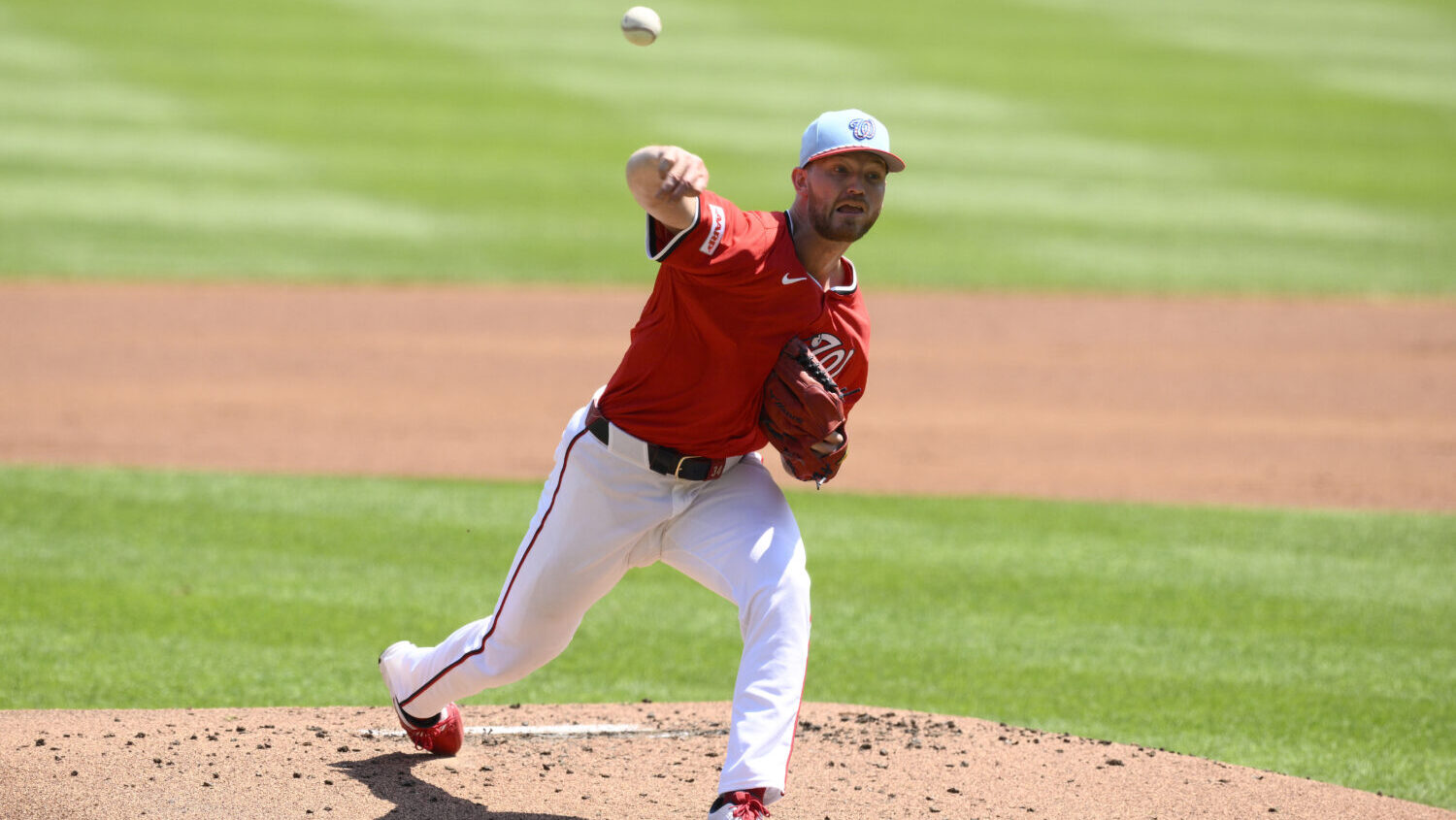
PHOENIX — Michael Soroka is looking forward to learning what he can from his new Diamondbacks teammate Merrill Kelly.
Soroka called Kelly one of, if not the very best, in the league at commanding the baseball.
The two are going to play pivotal roles for the Diamondbacks in 2026, but bringing up Kelly as someone to look up to was noteworthy.
Sure, Kelly is nine years older and has had a way more productive career over the past half-decade as one of the most consistent starters in baseball. But rewind to 2019.
Kelly was a 30-year-old rookie finally getting his chance in Major League Baseball after pitching in Korea. Soroka was a 21-year-old phenom who made the All-Star team and finished sixth in the Cy Young vote, surely starting a fruitful career with the Atlanta Braves. Baseball can be cruel, as Soroka’s career changed drastically as he suffered Achilles tears in consecutive years in 2020 and 2021. He pitched sparingly between 2020-23, and shoulder issues have limited his innings in the two seasons since.
Like Kelly in 2019 in certain ways, Soroka is looking to prove himself with the Diamondbacks, who took a flier on the potential he brings to the rotation.
Soroka is a different pitcher than he was in 2019, and he recently made changes to his delivery and arsenal. Pairing these changes with solutions to undisclosed, underlying health issues that have impacted his ability to stay on the field he believes will set him up for a resurgence.
“There were some things as far as internal health that I think we’d kind of figured out that I’d rather not completely dive into, but we’d had some things I’ve been dealing with for a long time that I didn’t really understand until this past year,” Soroka said.
“I think that’s gonna be one really big key is just being able to actually recover and not deal with a ton of inflammation at all times. Ultimately that’s where injuries have added up for me is just chronic inflammation and the ability to clear that. … Obviously working on delivery, you change things, you work on new ways to do things efficiently. I think that all kind of started to come into place and this was kind of the last key. Moving forward, I really feel confident.”
General manager Mike Hazen said the club felt “very comfortable” with where Soroka was at physically when he signed the deal.
Soroka is coming off his most productive season since his 2019 breakout campaign, pitching 89.2 innings with a 4.52 ERA. He still spent two stints on the injured list, including with a right shoulder strain in the second half.
The Cubs traded for him from the Nationals at the trade deadline, after which he landed on the IL and returned in September as a reliever.
Toward the end of the season with Chicago and moving into the offseason, Soroka looked at deepening his arsenal. He has found success balancing the fastball with his slurve, but the right-hander wanted to find more answers to get deeper into games and better manage a full-season workload. Opponents hit .193 against him the first time through the lineup, .220 the second time and .304 the third time last season.
Michael Soroka, Filthy Slurves. 😷 pic.twitter.com/WowRRRD9FU
— Rob Friedman (@PitchingNinja) August 5, 2025
This happened against the Diamondbacks in May, as Soroka threw three perfect innings before allowing a two-run home run to Josh Naylor in the fourth inning and being tagged with two more runs in the sixth.
Soroka credited Cubs vice president of pitching Tyler Zombro with some of the adjustments.
“It’s gonna be traditional cutter,” Soroka said. “I’d already at times tended to cut the ball a little bit just naturally being a little bit supinated* through release. … Tyler Zombro was able to kind of show me some things with just the way I was able to stay supinated with certain pitches and throw the cutter, as well as a sweeper. It’s thrown the same way as my slurve or curveball, just with a different grip and it kind of stays on that straight horizontal axis. It’s gonna be useful for giving guys a different look.
“Then the last one’s a traditional gyro slider.** It is basically the curveball grip thrown like a fastball. So, that was the key with all three of these, is that I really didn’t need to do too much. I didn’t need to manipulate anything. I was already set up right to throw it. Tyler was able to show me exactly how all that worked.”
Soroka said he’s already connected with Diamondbacks pitching coach Brian Kaplan to go over all of this, as the two have prior familiarity.
Kaplan worked with Soroka from 2018-20 at Cressey Sports Performance, where Kaplan coached pitchers before taking as assistant role with the Philadelphia Phillies.
While Soroka’s numbers don’t jump off the page from 2025, his peripherals suggest he was moving in the right direction. He struck out a quarter of the hitters he faced and walked only 7.7%, the latter of which was a huge improvement from his 2024 season with the Chicago White Sox.
He drew more ground balls and missed way more barrels than he had. His FIP (fielding-independent pitching) was 4.23, and his expected ERA via Statcast (based on contact quality and how many balls put in play) was 3.46, indicators that his ERA was on the higher side of the spectrum compared to how he pitched.
“We felt like Mike had the combination of stuff, bounce-back potential and the upside to make it a good fit for us,” Hazen said.
Arizona was an ideal spot for Soroka to attempt this, beyond his connection to Kaplan.
First of all, he has lived in the Valley for a year-and-a-half, but he was familiar with the area from his upbringing. Soroka grew up in Calgary, Canada, but his family like many others would come down to Arizona during the winter, in many cases for baseball tournaments.
The Diamondbacks had a need for starting pitching, and the marriage provided Arizona an economical fit in the rotation for one year and $7.5 million with a mutual option and gave Soroka the runway to keep pushing as a starter.
Soroka told the Foul Territory podcast that he had more lucrative offers on the table, but he would have joined a club to be their swingman.
Betting on himself to stick as a starter and set up the rest of his career led him to Arizona.
“Anybody can say that they’re taking a bit of a gamble on the injury stuff, and I understand that,” Soroka said. “I want nothing more than to prove them right.”
*Supination is the opposite of pronation, where pitchers leave their wrists open when releasing the baseball.
**A gyro slider has low spin, comes in harder and looks like a fastball until it breaks late.
