
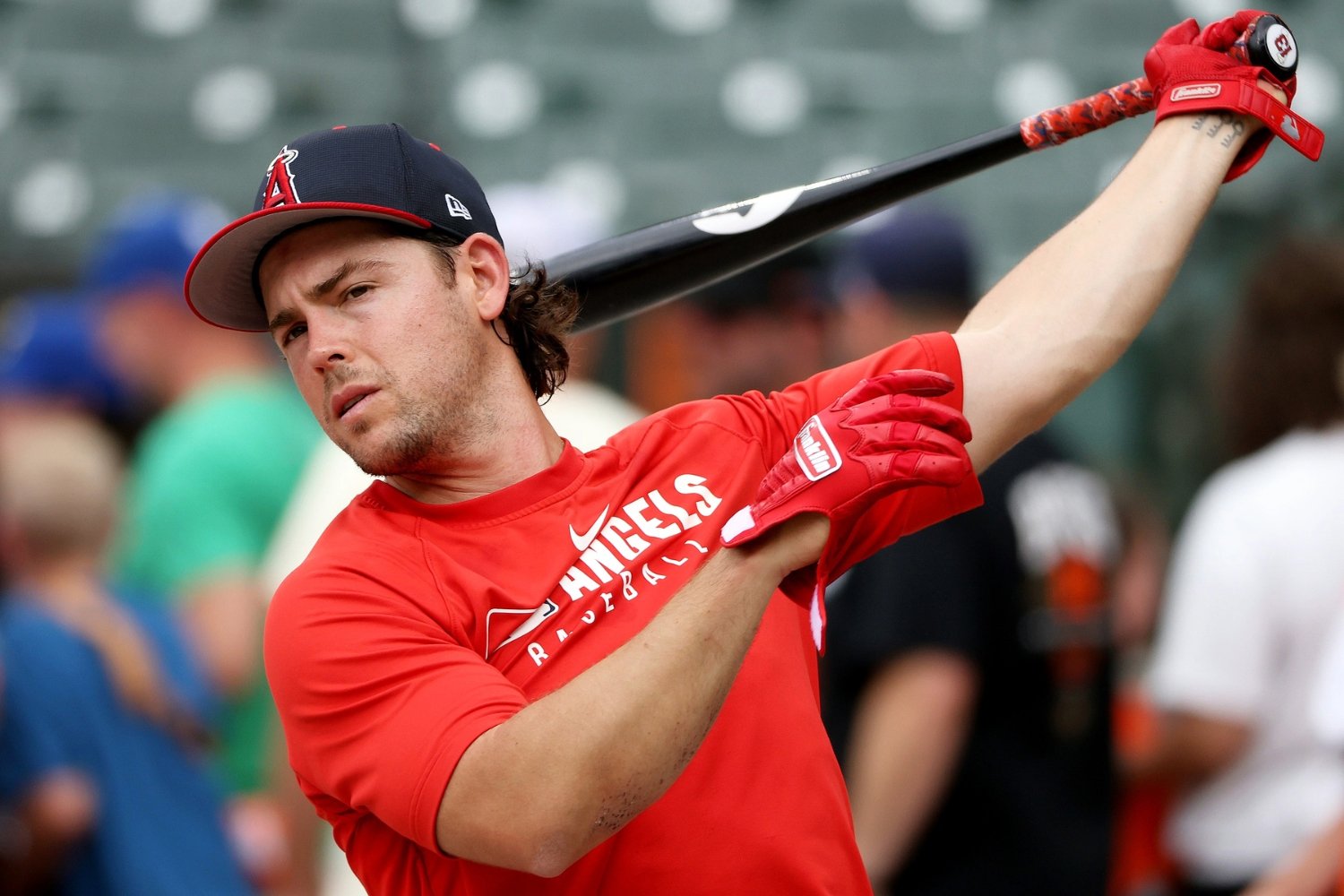
There was a time (roughly the spring of 2018) when Scott Kingery represented one of the more intriguing names across the baseball landscape. Had the Chicago Cubs brought him into their organization at any point around that particular moment, then his involvement in a potential roster would’ve had a bit of juice to it. We’re far removed from such a time, however.
Kingery signed a pre-debut extension as a top prospect with the Philadelphia Phillies in March of 2018. The contract carried club options for 2024 through 2026. Unlike many of his counterparts that have signed that type of deal, there wasn’t really a point where the contract looked like a win for the Phillies. Kingery posted a wRC+ of just 61 across 484 plate appearances in 2018. He improved to 100 in 500 PA the following season and showed a bit of pop (.216 ISO), but flamed out entirely during the COVID sprint of 2020 (36 wRC+).
After toiling largely in Triple-A for the next four seasons — the final two of which he never appeared at the major-league level — Kingery was sent to the Los Angeles Angels for cash last November. After an uninspiring 29 plate appearances, he was outrighted off the 40-man roster and elected free agency. That’s where the Cubs enter the picture.
Kingery signed a minor-league deal with the Cubs earlier this month. It’s entirely possible that his initial signing on December 2 is the last we hear of him as a noteworthy member of the organization. With the way his career has transpired, one would really have to stretch to see this as a signing anything beyond its literal significance: depth. There’s no logical reason to expect him to ply his trade at Wrigley Field outside of injury to one of the team’s current position players.
With that said, there’s been almost no activity to speak of on the part of the Cubs in building up their positional depth this winter (let alone adding a legitimate component to their lineup), save for their very cheap acquisition of Tyler Austin. They’ve made signings to build up their bullpen again, but outside of the odd Alex Bregman whispers, there’s been nothing even speculated. Such is the nature of a tight-lipped franchise like the Cubs, compounded with their relative inactivity in making outside additions.
That context does add a least a little bit of uncertainty as to whether the Cubs will seek additional roster depth or give Kingery a legitimate shot to win a bench job in the spring. Even if it’s unwise to award a roster spot to a player who hasn’t posted a positive fWAR at the top level since 2019, it’s also not an impossible image to project.
Kingery’s value at this point lies almost exclusively in his versatility. He logged time in the Angels organization last year at second base, third base, shortstop, and all three outfield spots. He was perfectly adequate at each, with his worst Outs Above Average in small samples unfolding at second (-1 in 53 innings) and shortstop (also -1 in 13 innings) while with the big-league club.
Of course, the caveat to that is that you’re not getting anything with the bat. Kingery’s wRC+ in his 19 games with the Angels was just nine, and it was only 58 while in Triple-A. Factor in a career strikeout rate over 28 percent that is hardly compensated for with a walk rate under seven percent, and there’s very little to speak of in terms of offensive value.
At the same time, the Cubs just spent a season rolling out the likes of Jon Berti, Vidal Bruján, Gage Workman, Nicky Lopez, and a post-deadline Willi Castro among their reserves last year. It’s not entirely unreasonable to think they’d give Kingery a little bit of run as a versatile bench piece if they’re unable to fill such a role elsewhere. At least with his presence, you have coverage for Nico Hoerner and Dansby Swanson and a late-game insertion option in the event that you need to deploy a pinch hitter whose defensive chops aren’t completely trustworthy (like Moisés Ballesteros).
In an ideal world, the Cubs are thinking bigger for their lineup than Scott Kingery. While the versatility will play, the absence of any offensive value is something we saw become a major issue for Chicago out of their depth last year. If lessons were learned, then perhaps they shoot higher as the offseason wears on. But it’s also not entirely unreasonable to imagine a path to playing time considering the lack of movement for the Cubs thus far.