
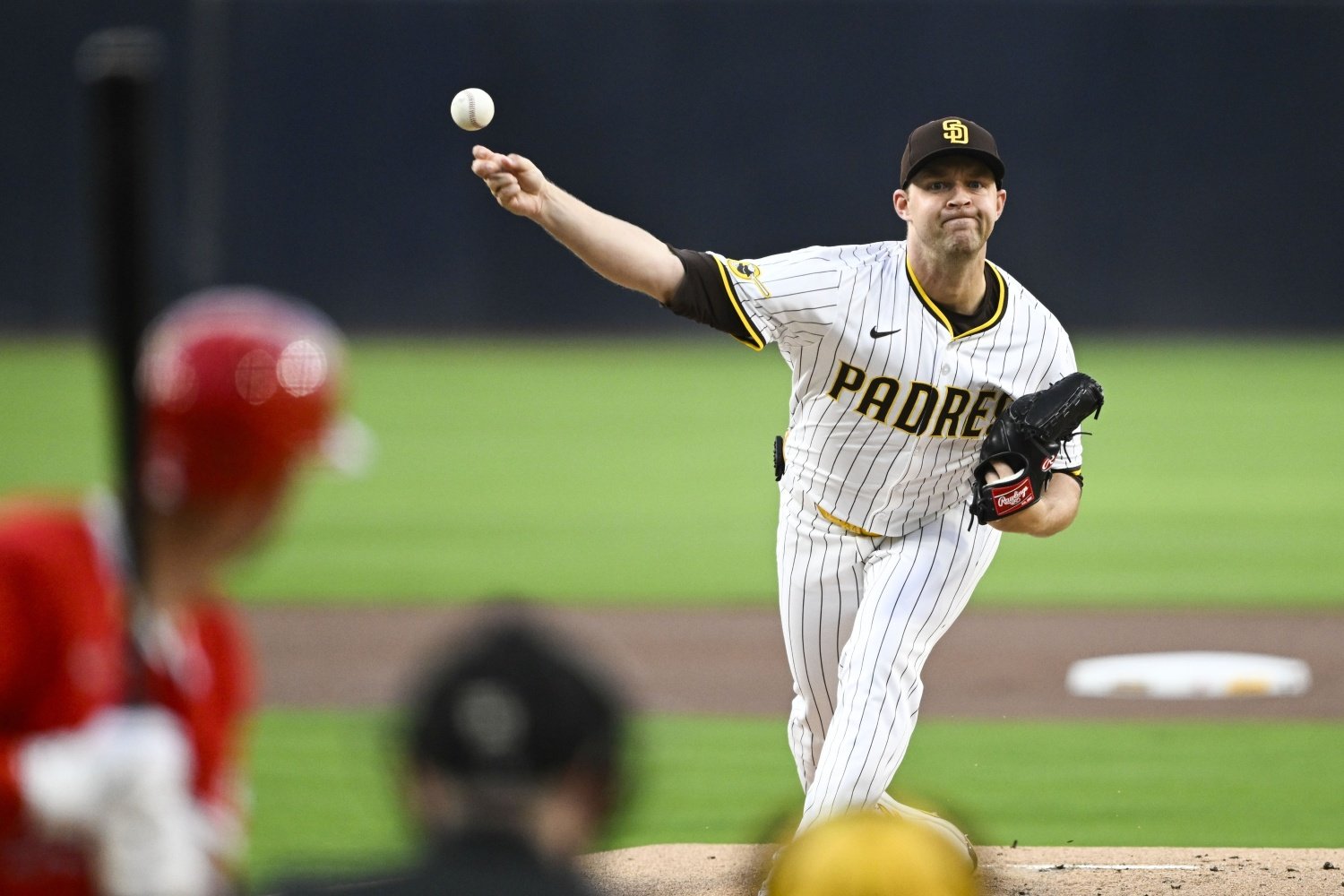
The Cubs were interested in Michael King at the outset of this offseason. After they got a sense of his initial asking price (approaching $100 million on a four-year deal, according to one source), they backed away, but once it was clear that King wouldn’t net quite that rich a contract, they circled back to him. Ultimately, King re-signed with the Padres Thursday night, on a remarkably player-friendly deal that guarantees him up to $75 million over three years and gives him the right to opt out after either of the first two.
A source familiar with the team’s thinking said they were open to signing King on a short-term deal, but were unwilling to offer him both that high an annual average value and the pair of opt-outs that enticed him to return to San Diego. That’s a sensible stance. King is coming off a season disrupted by injury, and his health history is spotty. He passed a physical to finalize his deal with the Padres, but the risk the team is assuming on that deal is a bit unwieldy, from the Cubs’ perspective.
This is the luxury the team has afforded itself, with the holidays looming and big names coming off the board but some desirable options left. By signing relievers Phil Maton, Caleb Thielbar and Hoby Milner and right-handed slugger Tyler Austin on low-cost deals, Jed Hoyer has set a floor that allows him to eschew further additions to the bullpen or the bench until he resolves more pressing business. He has roughly $40 million in 2026 salary available to him, if the right opportunities are there, but he’s bought the ability to be patient and take a strong negotiating position.
Before he signed with the Phillies for $22 million over two years, Brad Keller came to the Cubs and expressed a willingness to sign for less, according to two sources with knowledge of the conversation. The Cubs passed. They were not serious suitors for Luke Weaver, either, as he signed a similar deal with the Mets. Though they would still welcome improvements to their relief corps, the club now has its sights set on upgrading the lineup and the front half of the starting rotation, and they believe their current depth allows them to keep their focus there until they get resolution of situations just like the one that transpired with King.
Among players still on the market, Zac Gallen and Tatsuya Imai are highest on the Cubs’ radar as starters; they prefer those players (at their expected prices) to Ranger Suárez or Framber Valdez. They’re also staying in the mix for four position players of note, sources said.
It’s down to the last three days of Munetaka Murakami‘s posting period, and the offers the left-handed slugger hoped would materialize are not forthcoming. Initially looking for $200 million or more on a long-term deal, Murakami is increasingly open to shorter-term deals that could include opt-outs and/or club options to convert an initial contract worth under $100 million into something more lucrative. The Cubs have been in contact with Murakami’s agent, Casey Close, about the possibility of such a deal. They’re also keeping tabs on the market for fellow impending Japanese import Kazuma Okamoto, whose market has developed slowly but who is expected to get a robust offer once Murakami signs and the picture crystallizes for teams still seeking a right-handed bat.
The other two players the team has shown interest in, according to a league source, are extremely familiar names to Cubs fans: Alex Bregman and Cody Bellinger. Agent Scott Boras has been dissatisfied with the offers for both hitters thus far, though Bellinger is expected to wait out the market and sign sometime in January, anyway. The arguments for and against signing either player are well-documented, by now, but the Cubs are taking an opportunistic stance on each—as well as on Gallen, Imai, Murakami and Okamoto.
In all likelihood, the team will only sign one of those six players. They would be stretching their budget near its breaking point to land more than one, and they generally prefer to keep some powder dry into mid-January. No matter which of their targets they sign, though, they should be left with some surplus talent on their roster, and Hoyer could then try to land a second difference-making player via trade. Signing Bregman, Murakami or Okamoto could beget a trade sending Matt Shaw elsewhere for pitching help. Signing Bellinger could free up Owen Caissie or Moisés Ballesteros to be dealt.
One way or another, the Cubs will land a big fish, and they’re likely to do it soon. They’ve passed on some opportunities already, believing a better one is waiting for them and that their small, early moves this winter have given them the leverage to hold out. That’s a bit of a tightrope act, but by now (for better or worse), Hoyer is comfortable on that wire.