
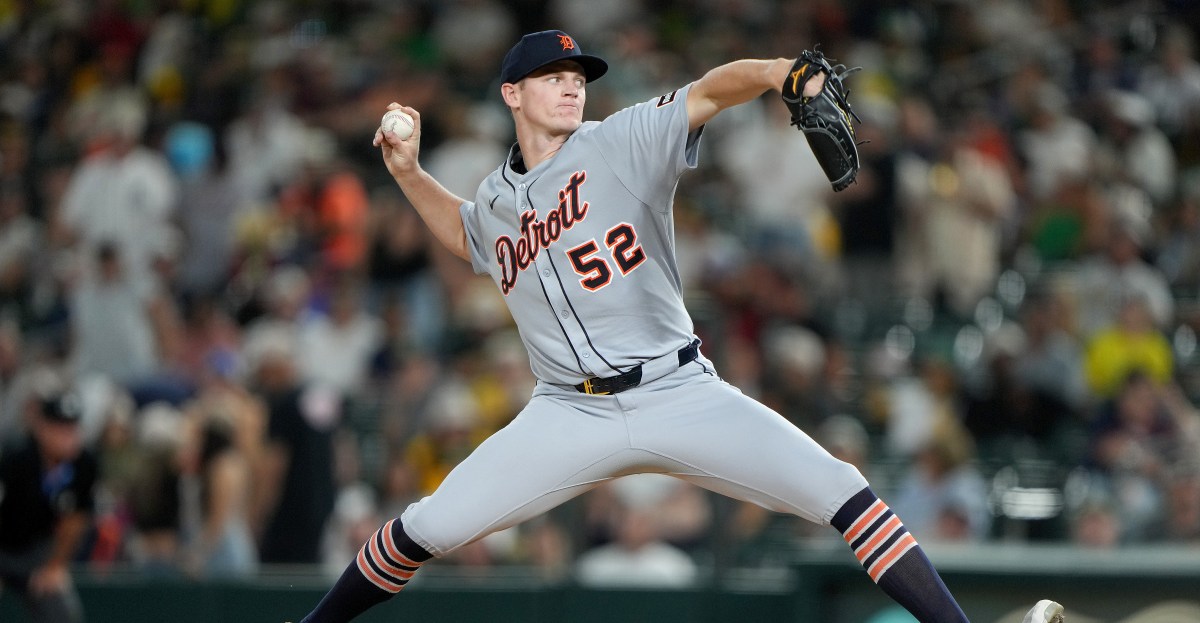
The 2025 breakout of rookie right-hander Troy Melton helped salvage a struggling bullpen and pitching staff in general after the All-Star break this year. Even more impressive was his rebound from a rough postseason debut against Cleveland in the Wild Card round. He shook that off and put together three huge appearances against the Mariners in the ALDS, giving up just one earned run over eight innings of work under the pressure cooker of the postseason. There are still some issues to clean up, but Melton showed the stuff, the presence, and the command to develop into a very good starting pitcher, or an ace reliever. Let’s unpack what the Tigers should do with him in 2026, and what Melton still has to work on to reach his full potential.
Troy Melton threw 45 2/3 innings for the Tigers, making four starts and 12 relief apperances. His 2.76 ERA was outstanding, and a good example of his upside. However, after posting excellent strikeout rates in the minor leagues, he struggled at times to put hitters away. That resulted in a pretty meager 20 percent strikeout rate, which has to improve for him to continue to post ERA marks under 4.00. He also gave up a few too many home runs. These are all pretty small samples, and Melton had to be flexible as AJ Hinch used him in a lot of different roles. It was pretty far from an example of putting a young rookie in the best position to succeed, but even so his 4.60 FIP makes it plain that he’s got to do better to reach his potential.
The recently turned 25-year-old certainly has a lot going for him. Even in his five starts, including his Game 1 performance against the Mariners in which he tossed four innings of one-run ball, Melton showed off a premium fastball. He averaged 97.1 mph with his fourseam fastball in 2025, and there wasn’t that much separation in average velo between his starts and his relief appearances. He uses his wiry, six-foot-four frame really well to generate power, and gets down the mound a long way with excellent extension. His compact, short-armed delivery also gives him a little bit of deception against lefties as he’s able to hide the ball behind his head on their sight line until he’s deep into his stride.
The fastball quality was no surprise, as his fastball has been his calling card since his 2023 breakout in the minor leagues. The major league average whiff rate for fourseamers was 21.7 percent in 2025. Melton averaged an excellent 29.7 percent whiff rate on his heater. Even better, hitters posted a meager .123 isolated power mark against the gas, with minimal difference in his splits. A dominant fastball is still the best pitch in the game, particularly for a starter pitcher, and Melton absolutely has a good one. If the Tigers decide to use him in the starting rotation full-time in 2026, hitters may do a little better against the heat in seeing him multiple times in a star, but not much.
Beyond the fourseamer, Melton also packs a deep set of pitches that are all average or better pitches. He mainly relies on his slider, particularly in relief appearances, but he mixed in splitters, cutters, sinkers, and curveballs throughout his 11 weeks as a major leaguer. Right now he’s a fourseam-slider pitchers who is still working to figure out how to use the rest of his repertoire, and at times he was trying to do too many different things. Melton threw the fourseamer 40.2 percent of the time, and the slider 23.5 percent. He only used the curveball a little bit, though it’s good enough to become a quality pitch for him if he can throw it a little harder without sacrificing its movement, while the sinker, cutter, and splitter all checked in at roughly 10 percent of his pitches.
The slider was his most effective secondary pitch and a major catalyst for his breakout. In 2024, the slider had good shape, he just wasn’t nearly as consistent with it. His developing ability to locate it down in the zone and then break off a bigger version for chase translated reasonably well to the big leagues. His 29.3 whiff rate was a little less than the major league average of 33 percent, but hitters could not lift the slider at all and Melton got a lot better about avoiding the dreaded hanger in 2025. The result was an outstanding .024 isolated power mark against the slider. When hitters made contact, that put in on the ground or were caught cheating for the fastball and lifted it into pop-ups and routine fly balls.
Melton can mix in the sinker to jam right-handers, although he’s probably never going to be a big sinker guy. It’s a good option for him to mix fastball types a bit, better certainly than the cutter. The curveball has pretty good depth and gives him that vertical breaking ball to pair off the riding fourseamer, but at 78.8 mph it’s just not the type of power curve that is going to be more than a change of pace pitch It performs better when he’s really ripping it above 80 mph.
Of all these offerings, his attempts to jam left-handers with the cutter fared the worst. Not only did he struggle at times to locate it, but the shape just wasn’t consistent and he threw a few that backed up over the plate rather than getting to his gloveside. Those got crushed. Melton only threw the cutter 10.8 percent of the time, yet it accounted for four of the seven home runs he allowed.
The cutter just needs to be ditched. He doesn’t need it, and even the better ones occupy a middle ground between his fourseam and slider that functions as just a bad version of them both. If he can spot the fourseamer inside to lefties and limit the run on the pitch, there’s just no place for the cutter, and Melton wouldn’t be the first pitcher whose cutter negatively impacted the consistency of both fourseamer and slider. That in-between pitch sometimes just impacts the feel of the other two as all three are slight variations in grip and wrist position at release. You’ll recall that the Tigers immediately had Jack Flaherty ditch his cutter in 2024, with big gains in the effectiveness of his fourseamer and slider as the result.
The split between rotation and bullpen work
What this all comes down to is Melton’s splitter. If it improves, Melton can thrive as a starter using his fourseamer, slider, and the splitter, with some sinkers mixed in against right-handed hitters as a change of pace to try and jam them. There’s no reason to clutter things up with the cutter and curveball. Melton appeared to start working on the splitter in 2024, and it became a little more consistent pitch for him this season, then regressed somewhat at the major league level as he bounced between roles and just didn’t need it much in relief. His command and conviction with it comes and goes, and he only threw it 8 percent of the time overall. To reach his full potential as a frontline starting pitcher, the split needs to develop into a real moneymaker instead of side hustle.
The reason I emphasize conviction with the splitter, is that big league hitters couldn’t touch it, and yet he still only threw it occasionally. Part of that reflects the fact that he struggled with it and wasted pitches away from lefties too often. Even so, hitters posted a hilariously weak .059 wOBA against it. There’s enough potential there for a really dominant pitch that could turn him into top shelf starting pitcher. He just needs to show more consistent feel and confidence in it.
So the key going forward is to simplify the arsenal to fourseam, slider, splitter, with a little bit of the sinker and perhaps the curveball mixed in. Melton needs to punch more tickets, and better consistency in the secondary pitches, particularly the split, is still the key for him to do that. Streamlining things should help, but he’s probably going to peak as an average to slightly above average strikeout pitcher who has the stuff to manage contact as well. Last offseason, those were still wide open questions, leading to a lot of relief risk. He’s put the reliever concerns to rest, but to really take the next step, getting rid of the cutter and focusing on tuning up the slider and splitter a little further are the key to reaching his full potential.
AJ Hinch said after the season that the Tigers view Troy Melton as a starting pitcher in the long run, and let’s hope they follow through on that. Troy Melton is currently a better pitcher than Jackson Jobe, and the big difference in fastball quality is the reason why. While Jobe’s fastball is pretty average except in his peak velocity band, Melton’s heater is a plus pitch and better when he’s reaching back into the high 90’s. He’s also been very durable, topping 100 innings in 2024 and throwing 126 innings in 2025. Jobe has the spin and a better split-change right now, but Melton has made enough strides with his slider and split this year to equal Jobe as the Tigers best hope for their next topline starting pitcher. Of course, Melton is 25, while Jobe is still 23, though still injured. There’s still plenty of time for Jobe to come back strong and keep developing into a very good starting pitcher, but that’s all on the back burner until 2027.
As the Tigers start to look ahead to a probable Skubal-less future, developing Troy Melton into the starting pitcher he’s capable of becoming needs to be a priority. If he can refine command of his slider and splitter a little further, he’ll become the Tigers number two starting pitcher in 2026. If, by some miracle, Tarik Skubal, Flaherty, Casey Mize, Reese Olson, Keider Montero, and recent signing Drew Anderson all come through spring camp healthy, Melton should still be in the rotation with a good camp. That would be a great “problem” for the Tigers to face headed into the 2026 season.