
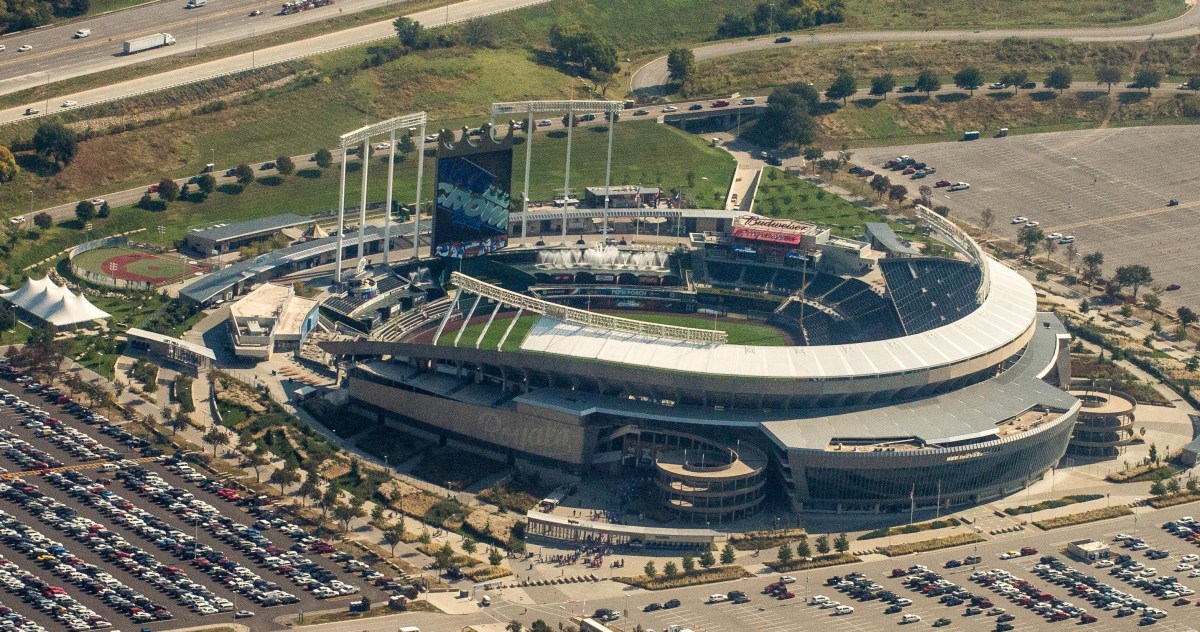
Four score and seven years ago, the Kansas City Royals told the world that they’d be looking to construct a new stadium. Technically, that official statement is only three years old, but it feels like an eternity considering how so much and yet how so little has happened in the Royals stadium timeline.
Every so often, there’s a new piece of information that bubbles to the surface and prompts some additional speculation or discussion. In October, the North Kansas City site was the focus. As the calendar has turned the page from Thanksgiving, the Overland Park site at the Aspiria campus has become the source of some chatter.
If you’ve got stadium fatigue, I don’t blame you whatsoever. Nothing has really changed in months; we know that there are three main sites the Royals are looking at, we know that Kansas and Missouri have put together incentive packages to keep the teams, and we haven’t heard anything from the Chiefs, either.
But this is a good opportunity to point out that an Overland Park Royals stadium is just about the worst possible outcome and would be, frankly, pretty terrible. Let’s dive into why.
It doesn’t fit with the Royals’ stated goals
When the Royals first announced their new stadium push, principal owner John Sherman penned a letter where he outlined what the Royals were thinking and what they were looking for. This is the clearest “mission statement” of sorts that the Royals have made about the project.
There are, I think, three clear takeaways here:
In downtown or near downtown, opening the possibility for North Kansas City, the West Bottoms, or varying places in downtown or midtownA new Ballpark district, with “residential, commercial, and community components” alongside a stadiumCommunity impact and economic growth, with an “enhanced quality of life for the citizens of our region” and “emphasis on historically under-represented members of our community”
Putting a new baseball stadium at the Aspiria campus at 119th and Nall accomplishes, impressively, none of those things. It’s obviously not in or near downtown, and is a 20-mile drive from the urban core. It’s not big enough to construct a substantive ballpark district, as it’s a relatively landlocked area. And that area of Overland Park is well-off suburbia with extensive commercial development that’s already there.
It doesn’t fix the downsides of Kauffman Stadium
Drilling down a bit into why the Royals are looking for what they’re looking for, you’ll find that it’s mostly in response to Kauffman Stadium’s warts.
While the stadium itself may be nice, Kauffman Stadium is surrounded by a load of, well, nothing. There isn’t any developable land. There aren’t any real hotel options. You can’t walk to the stadium, at least not really. And it lacks reliable public transportation; a downtown stadium or an urban stadium would be less reliant on auto transportation.
Putting a stadium in Overland Park wouldn’t do anything to fix those issues. It would be similarly unwalkable (although the site could be an improvement, if only because the current Truman Sports Complex walkability is so awful). Public transit still isn’t much of a thing, and the result would be a stadium nearly everyone would drive through–but if you’ve driven at 435 and Nall recently, you know how gnarly the traffic can get even without a stadium.
The locals don’t want the stadium
MLB franchise owners often tout how much economic benefit professional stadiums bring to their surrounding areas. But the reality of the matter is that a baseball stadium only brings economic value to very specific types of businesses, is closed three quarters of the year, and on the other 81 days brings annoying crowds and increased traffic for everyone else.
The negative effects of a stadium tend to impact urban areas less because those areas are generally better equipped to handle crowds and have a denser population from which to draw workers from nearby. In suburban areas, especially more affluent suburban areas, the types of people who benefit from a new stadium are not always the type of people who live and work near the stadium.
Sure enough, the affluent residents of the area are not pleased at the prospect of an Overland Park stadium. Recently, there was a meeting at the Leawood Community Center that was organized by residents who are opposed to the Royals moving in nearby. The Kansas City Star story quotes folks who are frustrated with the Royals’ communication and who have serious reservations on the impact of traffic.
And while a collection of NIMBYs opposing a big public project may be predictable, local resident angst is only part of the pushback. Located right next to the Aspiria site is The J, or the Jewish Community Center of Greater Kansas City. It occupies land that could be built out or utilized by Royals ownership, but The J has already stated that they aren’t moving.
Additionally, the Jewish Community Center Association of North America penned a letter to Kansas state leadership stating that they are “deeply concerned” with the prospect of an MLB stadium next to The J. The association’s letter outlined concerns with traffic congestion, security risks, parking challenges, and environmental concerns, among other items.
If that weren’t enough, the most recent piece of news about the Overland Park location came from the mayor of Leawood, who came out in opposition of the stadium’s Aspiria campus potential location.
“Based on media reports and direct feedback from our residents, we share serious concerns about the potential impacts on Leawood and its citizens should a stadium be built on this property. These concerns include traffic congestion, noise and lighting, public safety and emergency access, parking in residential neighborhoods, infrastructure capacity, and impacts on nearby schools, medical facilities, senior living communities and established single-family residential areas.”
The Royals responded, saying that the team was “Deeply committed to building a stadium environment that prioritizes the health, safety, and traffic concerns of our neighbors.” But while the team can do work to alleviate the first two, there’s no way around the traffic mess that an Overland Park stadium would bring. The only thing that can alleviate that is public transit, housing density, and walkability, which are all incompatible with the broad idea of American suburbia in general and Overland Park/Leawood in particular. No streetcar or train solution is on the horizon there–at least not this century.
So why are the Royals interested in Overland Park?
The Royals are interested in Overland Park because it’s their best site in Kansas, and Kansas is prepared to provide the biggest incentive package.
I’m not going to go too deeply into the why here, because the nuance gets complicated quickly, but it all comes down to total monetary compensation. Missouri’s stadium funding bill signed this summer provides funding for up to 50% of the cost of a new stadium. Meanwhile, Kansas’ turbocharged STAR Bonds would finance up to 70% of the cost of a new stadium. While funding mechanisms differ, both state funding sources apply to the “total costs of the project,” a word-for-word phrase found in both documents.
In other words, the same $1 billion stadium would be $200 million cheaper for the Royals to construct in Kansas versus Missouri.
That money has to come from somewhere, and the money comes from the public. Technically speaking, STAR Bonds are paid for by the sales tax revenue generated by the project itself within its district–tickets, restaurants, hotels, what have you. But there’s no such thing as a free lunch; until those bonds get repaid, that tax revenue doesn’t go where it would otherwise go, like roads and schools and libraries and other government-funded public goods. And while you might assume that this tax revenue wouldn’t exist at all if the stadium didn’t exist, there’s a large body of research that shows stadium-related spending is mostly redistributed spending away from other local sources—local sources where tax revenue does go to roads, schools, and libraries.
In other words, somebody has to pay back those $700 million (or more!) worth of state bonds. It’s not the team. It’s not the government. You do the math on who’s left.
With both Missouri and Kansas assembling significant funding mechanisms that don’t require voter approval, it seems inevitable that the Royals and Chiefs will get handouts to the tune of hundreds of millions of dollars. Kansas offering 70% is a worse deal for the public than Missouri offering 50%. And it’s just one more reason why it’s the worst spot for a stadium.