
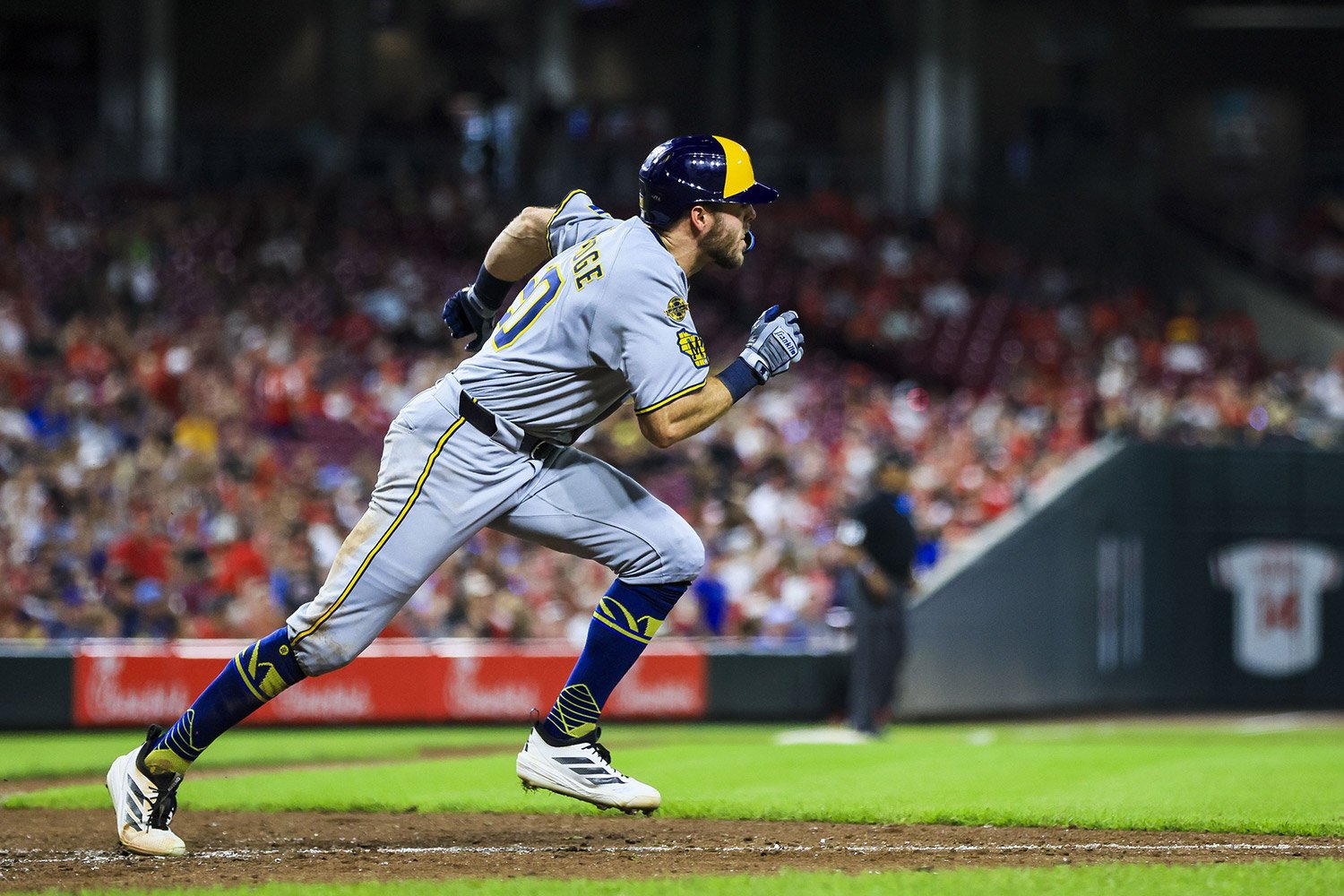
It was easy to see that the Brewers valued Brandon Lockridge’s speed and defense the moment they acquired him at the 2025 trade deadline. The 28-year-old’s sprint speed of 30.1 feet per second ranked seventh among all baserunners, and he has accrued 5 Defensive Runs Saved in just 394 ⅔ career big-league innings in the outfield. That profile fit in nicely with Milwaukee’s existing team identity.
Lockridge’s approach has been geared toward maximizing the havoc he can wreak on the bases rather than hitting for power. In 196 games across the 2023 and 2024 minor-league seasons, he reached base at a .396 clip and stole 86 bases while hitting just five home runs. That offensive profile has yet to translate into success in the majors, where Lockridge has hit .226/.268/.308 for a 62 wRC+ in 160 plate appearances, but his defensive value has kept him slightly above replacement level in 79 games.
Like Blake Perkins, Lockridge doesn’t need to do much offensively to be a productive fourth outfielder. However, the Brewers are high on him to an extent that suggests they see more potential in his bat. They acquired him for veteran starter Nestor Cortes in a deal that also saw them pay down the remainder of Cortes’s salary. Milwaukee also shipped Isaac Collins to Kansas City last week, a move that opens up more playing time for Lockridge next season.
A fifth-round pick of the New York Yankees in 2018, Lockridge was scouted during his early prospect days as a power-speed threat who regularly pulled the ball in the air. He popped a combined 39 home runs over his first three full years in the system. Serious swing-and-miss issues stalled Lockridge’s progression, though, with a 68.5% contact rate and 26.9% strikeout rate holding him to a .230/.300/.379 line (90 wRC+) in Double-A in 2022.
By 2025, Lockridge’s contact rate improved to 80.6% in Triple-A, but the home runs have evaporated because he’s stopped pulling balls in the air. His 50.1% hard-hit rate ranked in the 92nd percentile of Triple-A hitters this year, but his 8.1% pull air rate ranked in the 11th percentile. In the big leagues, Lockridge hit 36.9% of his batted balls to the opposite field, the fifth-highest rate among hitters with at least 100 plate appearances.
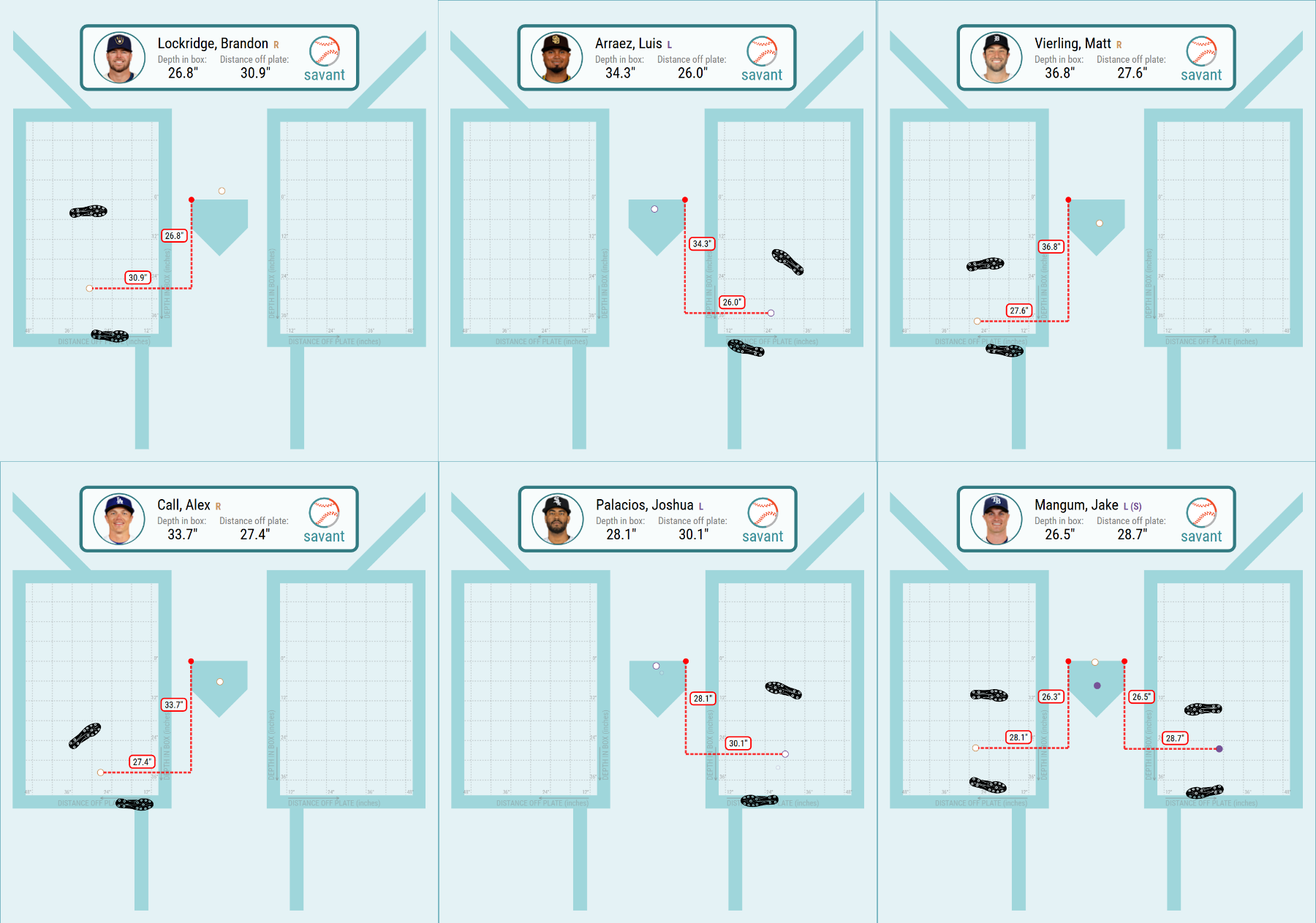
Many hitters who typically prioritize going to the opposite field stand further back in the batter’s box. This gives them time to let the ball get deep over the plate and still make decent contact, rather than meeting the ball before their hands and barrel have a chance to work through it. Lockridge, however, doesn’t set up like a hitter with an extreme opposite-field approach. He stands a few inches closer to the pitcher in a much wider stance than most of his oppo-minded contemporaries, meaning he typically makes contact in front of the plate.
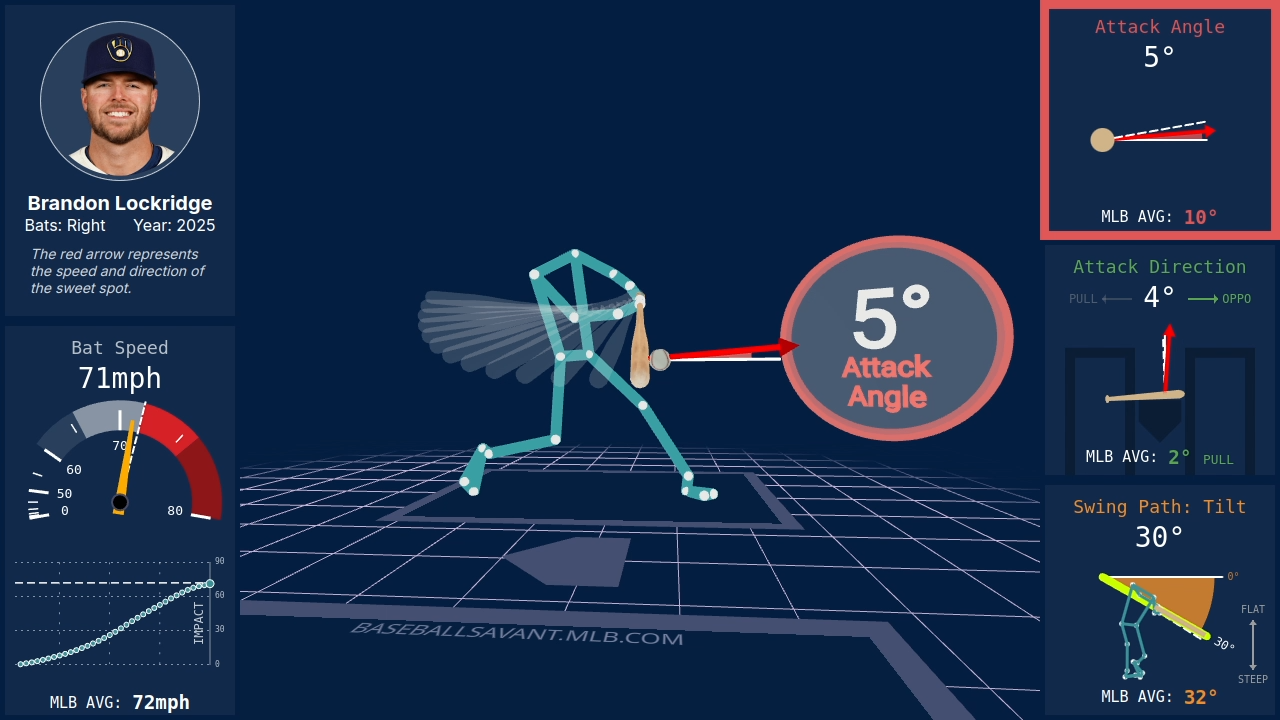
The biggest reason Lockridge rarely pulls the ball in the air is not where in a pitch’s flight he makes contact; it’s his swing path. Despite making contact in front with decent tilt, Lockridge’s average attack angle of 5 degrees was only half the league average, meaning his barrel doesn’t switch to much of an upward trajectory by the time it reaches the ball. In other words, he’s often chopping at it – swinging down and leveling out, instead of swinging down to lead into a slight uppercut as his hands work through the pitch.
That choppiness was immediately on display in his Brewers debut, initially in a productive fashion. He notched his first hit with a 104.4-mph grounder through the right side.
VndNNndfV0ZRVkV3dEdEUT09X0JnTllVbEpRVjFFQVdRTlFBQUFIQkFCU0FGa0NWVmdBQmwxWFZBWUFWUVJWQndjRg==.mp4
He later smoked a 102.1-mph liner to right on a hanging breaking ball.
VndNNndfV0ZRVkV3dEdEUT09X1Z3TlpBRkZTQUFZQUNGWUZBd0FIQ1FkV0FGaFhVRkVBVVZJQkFRWlhWQUlHVkFGUw==.mp4
That’s not a fundamentally bad swing – it can produce worm-burner and line-drive singles, just like those two hits – but it may not be the best utilization of Lockridge’s athleticism in the box. Despite posting a solid 40.5% hard-hit rate during his small sample as a Brewer, he slugged just .370 with an 86 wRC+.
Lockridge may be capable of a more balanced profile, and Pat Murphy prefers the versatility of a more vertical bat path for the right hitters. He and the Brewers shouldn’t try to turn him into a power hitter – his speed is his greatest asset – but some small tweaks to get him meeting the ball at a better angle could yield a valuable payoff.