
Should the Royals move to Aspiria in Overland Park?
Most respondents to the Post’s reader poll we put out late last week think not.
Nearly 60% of the more than 5,000 responses we got said the Royals should go somewhere else other than 119th and Nall.
The Post’s informal poll comes ahead of a key meeting of legislative leaders, the Legislative Coordinating Council, in Topeka Monday, at which the committee is expected to take up a deal to lure the Chiefs to Kansas.
Notably, some legislators participating in the meeting have said a Royals deal is not on the agenda.
Overland Park one of 3 sites the Royals are weighing
Still, speculation has heated up in recent weeks about where in the metro Kansas City’s Major League Baseball franchise could land its new stadium.
Hundreds of residents turned out for a town hall largely meant to express opposition to a stadium, T-Mobile said it will likely have to move if a stadium comes to Aspiria and a national association representing Jewish community centers said a stadium would have a “devastating” impact on The J.
With all these developments swirling, the Post wanted to gauge Johnson Countians’ sentiment.
Overland Park, specifically the Aspiria campus, is one of at least three sites the team is considering as its future home once its lease at the Truman Sports Complex in Jackson County runs out in 2030. (The other two are in downtown Kansas City and in the Northland in Clay County.)
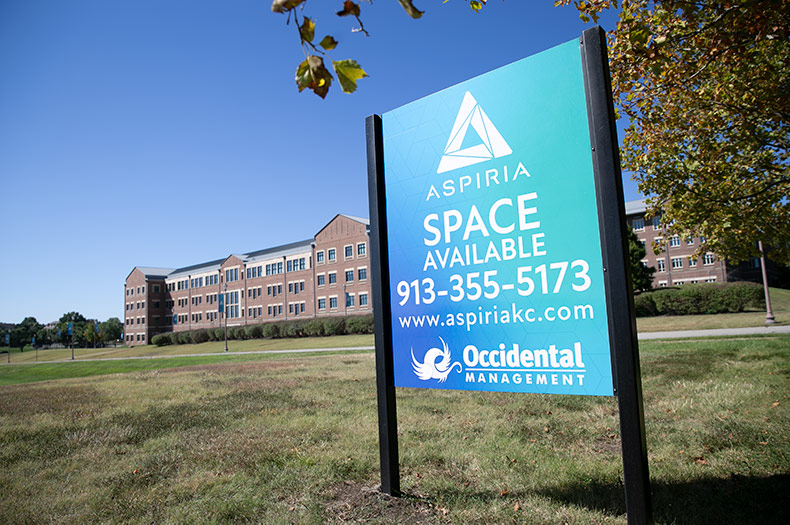 An Aspiria leasing sign near 119th and Nall. File photo.
More than 5,000 responded to our poll
Our poll is an admittedly non-scientific effort, meant to be more of a point-in-time gut check rather than a rigorous public opinion exercise.
We asked readers, “Do you like the idea of a Royals stadium at Aspiria (119th and Nall)?,” with four possible responses.
More than 5,000 people responded, and a clear majority (58%, or more than 3,000 respondents) said they did not want the Royals to end up at Aspiria.
Here’s a breakdown of the results:
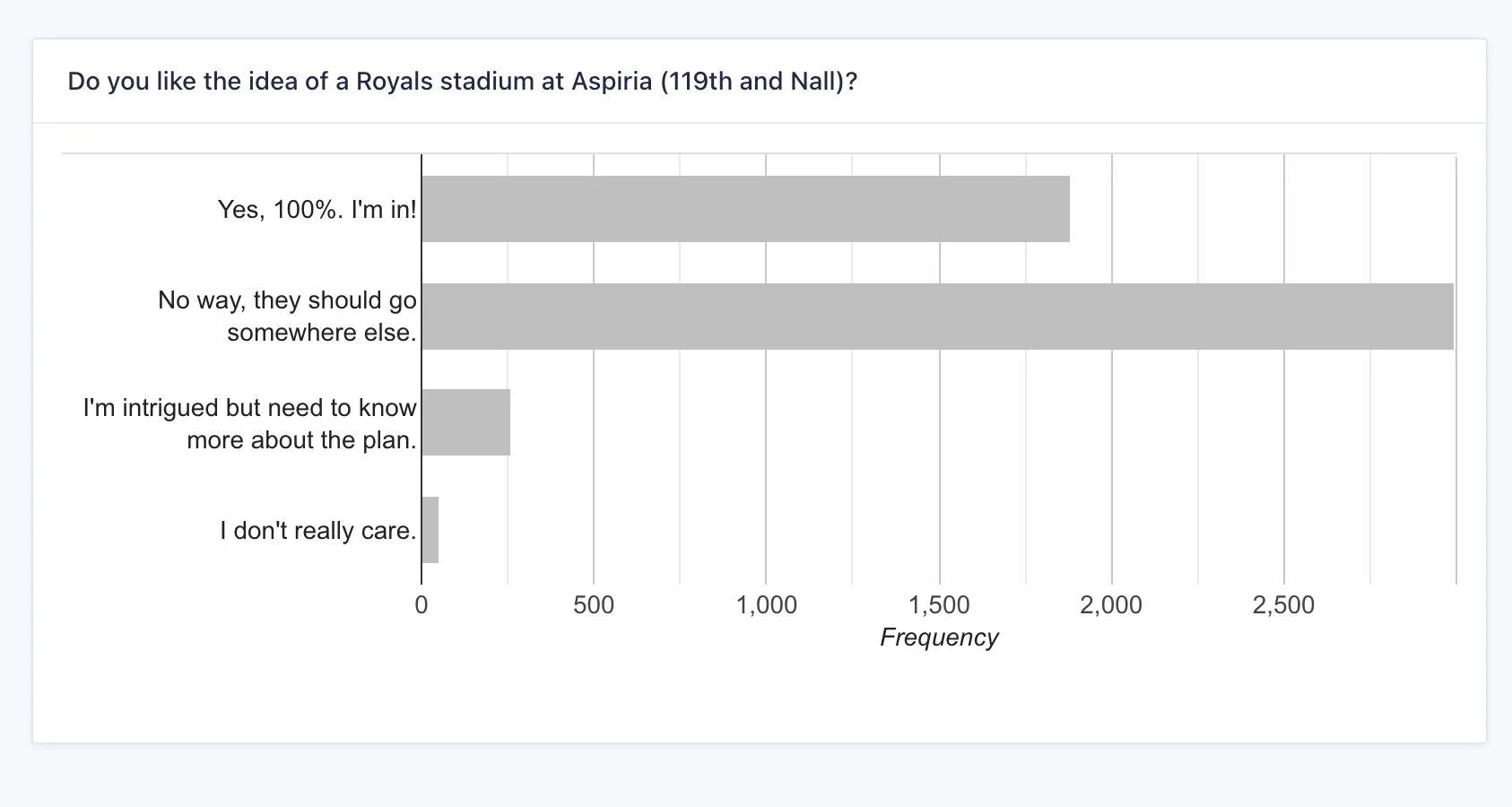
About 36% (or 1,890 respondents) selected, “Yes, 100! I’m in,” to the idea of the Royals at Aspiria.
It seems there’s little middle ground or ambivalence on the topic. Just 5% of respondents said, “I’m intrigued but need to know more about the plan,” and even fewer (about 1%) said, “I don’t really care.”
This is an issue that seems to have strong feelings, either way.
Open-ended responses: ‘Glass slipper’ v. opportunity
In addition to the multiple choice question, we also allowed readers to leave an open-ended response to the prompt, “Tell us any more thoughts you have about the Royals possibly coming to Johnson County. Do you support the idea? Why or why not?”
We asked readers to include the name of the city in which they live and at least their first name. (We thought requiring both first and last names might discourage people from responding.)
We ended up getting more than 800 open-ended responses.
These mirrored the poll results, with most comments opposed to the idea.
Many arguments against a stadium at Aspiria centered on fears about traffic and local roadways in that area not being able to handle an influx of thousands of fans who would come to Overland Park more than 80 times during the year for home games.
Other readers noted the possibly disruptive impacts of noise and lights on surrounding neighborhoods. And some also expressed philosophical opposition to the idea of public tax incentives (in this case, state-level STAR bonds) being used to finance a billionaire sports team owner’s project.
Many commenters offered alternative locations, including the other two sites apparently under consideration by the team — Washington Square in downtown KCMO and a site in Clay County. The Legends area of Wyandotte County also came up frequently as a better option than Aspiria. (That’s where many think the Chiefs are eying a new stadium.)
In all, the arguments against a stadium can best be summed up in one particularly potent metaphor left by an anonymous respondent, who said, “This would be like Cinderella’s ugly stepsisters trying to squeeze their big feet in the glass slipper. It just doesn’t fit.”
On the other hand, there were plenty of people who expressed support and even excitement for the idea of the Royals calling Overland Park home.
Many of these people see the stadium as a major opportunity for Overland Park and Johnson County more broadly, lauding the possibility of unprecedented economic development and a boost in tax revenues such a venue could bring.
A few respondents suggested a stadium in the heart of Johnson County suburbia could actually spur the growth of something else: useable and reliable public transit to get fans to and from the games without overloading local streets.
Some respondents warned that if Overland Park also rejects the Royals (like Jackson County voters did at the ballot box last year), then the team may ultimately be persuaded to leave the metro entirely.
There were a few respondents who hadn’t made up their mind. These people said they might have their opinion swayed if the team, city or state were to lay out an Overland Park stadium plan in more detail or at least begin articulating a clearer vision for how a stadium could impact the area and what benefit the area would derive from it.
Here are some comments from readers who responded to our poll that caught our eye. Some comments have been edited for length:
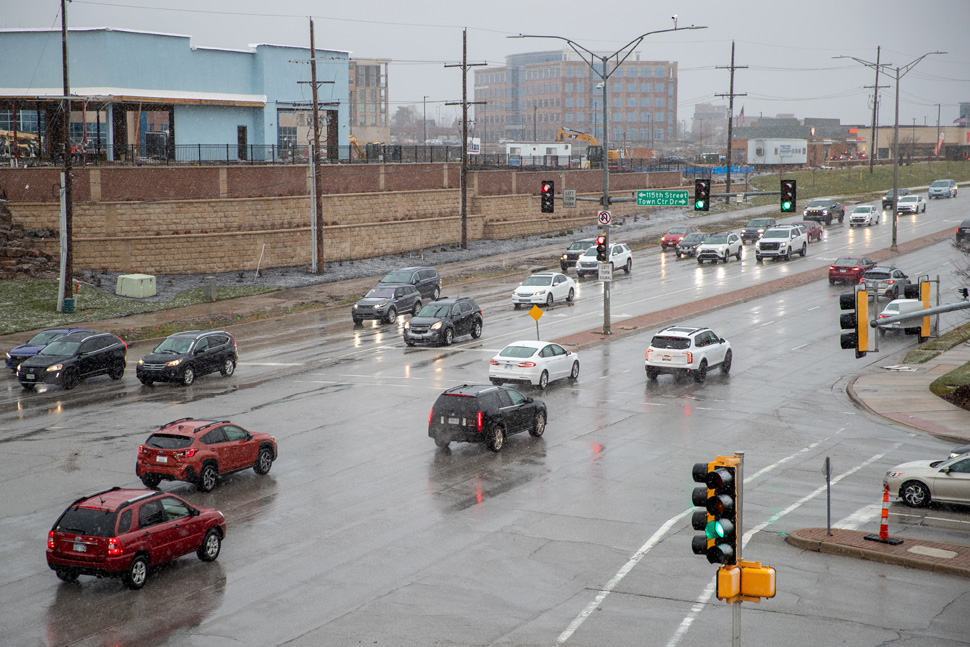 Cars navigate the intersection at Nall and 117th in Overland Park Monday afternoon as flurries picked up. Photo credit Kylie Graham.
Opposed to an Overland Park stadium
“A major negative for home values” — Tom Stevens
A MLB stadium would be a major negative for home values in the area. Traffic, noise and lights from the stadium would also be an unwanted intrusion to the lifestyles of many within a radius of the stadium. To make room for the stadium, existing structures would have to be destroyed, grading and preparation of the site would be monumental and disruptive to the residential and commercial development that surrounds the area. Also, why the inexplicable delay in coming to a decision? Do the Royals management enjoy creating anxiety by remaining silent on this issue, which is so much on our minds, mainly due to the possibility of our homes losing value? Who wants to live where a baseball might come smashing thru the front window?
Longtime season ticket holder’s traffic concerns — Carol, Overland Park
I do not support the Royals moving to Johnson County. As a Royals season ticket holder since the late ’70s, I know what the stadium traffic is like. Something else I do not hear discussed is the noise pollution. Sound travels long distances ,and people within a few miles of the stadium will be able to hear the announcers, concerts that take place, the fans cheering, etc. We live in a quiet residential neighborhood and should not have to see the value of our homes decrease due to traffic and noise pollution. If the Aspira campus is seriously being considered, this has been the least transparent process the city of Overland Park and the state of Kansas have engaged in with respect to the impact on homeowners.
“I would probably move” — John, Leawood
This is a suburban, family community … not a nightlife destination. Traffic will be a nightmare requiring roadwork that will drastically change the feel of the community. We would lose employers. There are schools and churches right next door! Drunk drivers, crime…I would probably move my family.
Worried about impacts on The J — Madeline, Overland Park
We are members of the Jewish Community Center. Our daughter went to preschool there, and we plan to send her to summer camp there. I cannot imagine the impact that a stadium would have on this area. The J is a vital resource for people of all ages in this community. It currently shares several entrances with the Aspiria campus.
“Only 81 games is 25% of the year” — Jim, Stilwell
Building a stadium at the Aspiria campus site would be a huge mistake for a multitude of reasons. The infrastructure is not there to support the traffic. There are hospitals in close proximity, and ambulance traffic would be impacted. There are homes nearby who never thought it would be possible to build a stadium nearby when they made the biggest investment of their lives. There would be untold noise & light pollution along with the smells that accompany something like this (thousands of cars, tailgating, discarded trash, etc). There are those who say there are only 81 games per year, so it’s not that big of an impact. Certainly, there would be other events (concerts, for example). ‘Only’ 81 games is roughly 25% of the year, so it’s not a trivial percentage of the year that these impacts would be felt!
“Completely change the dynamic” — Alex, Leawood
Overland Park is frequently rated as one of the best places in the country to raise a child. Having an MLB stadium would completely change the dynamic of an established, prospering neighborhood. This stadium would be really disruptive to the hospitals and schools adjacent to it.
“Fighting the geometry of suburbia” — Marcus Ross, Olathe
I am a Certified Urban Designer and work in the field of architecture in Overland Park. This is my take on the Royals stadium in Johnson County. It can be made to work on paper, but it’s the kind of site that only works if you spend serious money on transportation, traffic management, and event logistics … and then you still end up with a ballpark in a place that will feel like a traffic magnet to nearby neighborhoods. If the goal is a “real baseball city vibe” with walkability and transit optionality, Aspiria is fighting the geometry of suburbia. If the goal is “regional access by car and a controlled district,” it’s more plausible, but it becomes an infrastructure and politics grind fast. The 3 make-or-break questions: 1) Transportation plan: Are they proposing meaningful transit and shuttles, or is it basically “everyone drives, good luck.” 2) Net public cost: Who pays for roads, intersections, traffic control, utilities, and long-term operations? 3) Stakeholder retention: Can they keep key neighbors and employers on board (especially T-Mobile)? A baseball stadium is an urban animal. It thrives on density, serendipity, pre- and post-game wandering, bars you didn’t plan to visit, streets that already exist, transit that already works. Downtown Kansas City has that DNA. Aspiria does not. Putting a ballpark in Johnson County is trying to force an episodic, emotional, communal experience into a place engineered for predictability and peak-hour efficiency. That’s oil and water.
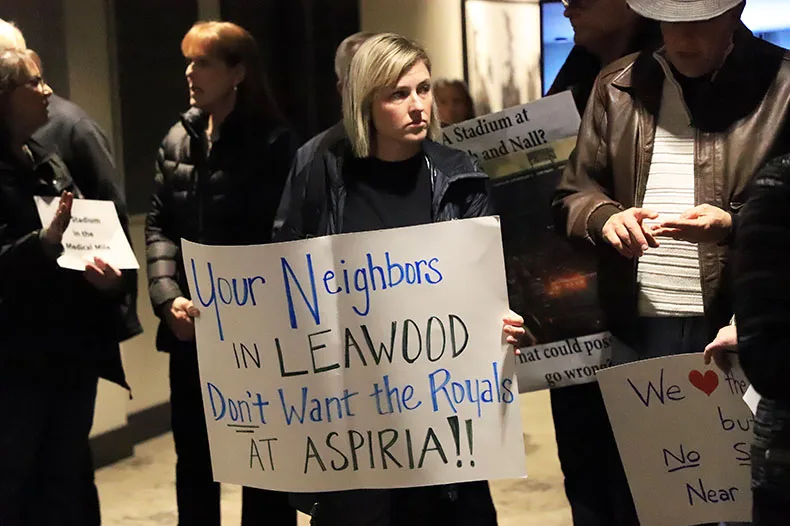 As questions swirl about the Royals eyeing the Aspiria campus for its new stadium, some Johnson Countians began voicing their opposition. Above, around two dozen Overland Park and Leawood residents crowded into the lobby of Overland Park City Hall Monday evening to push back on potential plans to put a new Royals stadium at the Aspiria campus. Photo credit Kaylie McLaughlin.
Support for an Overland Park stadium
“‘Why not?’ instead of ‘Why?’” — Katrina McHenry
I love the idea of the Royals coming to Johnson County. Compared to Missouri, Kansas knows how to create, develop and follow through on projects. I have been a Royals fan since Kauffman Stadium opened in 1973, and would be thrilled to have them closer to my neighborhood. Missouri will mess around and screw this up royally, pun intended, if they are left to find an option for the Royals. Look at how much (not much) they have accomplished already in the past 20 months. Meanwhile, the Kansas state government was able to vote for STAR Bonds for each team, the Royals and Chiefs separately, that would alleviate taxes for citizens and create a new home for each team at their desired location in Kansas. Not only that, but the Aspiria campus is surrounded by dining, shopping and other entertainment options to create a world-class destination ideally suited to baseball fans visiting from other cities and states. Such as contrast to the blighted area that currently surrounds Kauffman Stadium. Naturally, there will be logistics to resolve, such as traffic and stadium access. However, these are all things that can be taken care of. I would rather say “Why not?” than “Why?”
More accessible to JoCo Royals fans and businesses — Margi, Overland Park
I believe the Royals coming to JoCo is a fabulous idea. With such a high percentage of season ticket holders living within a few miles of the Aspiria campus, it makes sense to make it easier and more accessible to the fans. There are so many client-based businesses literally within walking distance its a great opportunity for companies to treat future and current clients to ballpark games, driving up local revenue. Which leads me to my next reason! Town center and Park Place ( particularly Park Place) consistently struggle to keep businesses in, and I know the amount of additional traffic flow will enable those businesses to not just survive but also be successful!
A “denser and modernized” Overland Park? — Ben, Prairie Village
I support the idea. I think the city of Overland Park is failing to endear citizens to a plan; they need to be pitching their vision! I get the impression, based on other major projects they’ve announced these past few years, they want to make the I-435/119th/Metcalf/Nall corridor much denser and modernized. Think of it like Kansas’ downtown of the KC metro. I believe it’d be great and there’d be many Kansans who’d visit/live there, especially if the Royals were a part of that. OP needs to lay out that this is the direction they’re going, regardless of the Royals being there or not.
Lead to investments in public transit? — Matthew, Overland Park k
The [current] stadium needs to be relocated, it’s inconvenient in every way. Overland Park is capable of accommodating the stadium, but it will require investment in — gasp! — public transit. One of the most startling things about growing up here is learning about the streetcars [the old Strang Line that connected Overland Park to Kansas City]. This used to be a metro that didn’t require a car. It could be again, and Overland Park would be better for it.
“Think about the next generation” — Walt, Overland Park
We also need to think about the next generation. Young people want to live near amenities like a ballpark. It gives them entertainment close to home and a sense of community. Kids who are 16 today will be 21 or 22 when this project is done. They’re the future fans. But here’s the biggest concern: the Royals are leaving Kauffman after the 2030 season. That’s a fact. If they’re rejected again, they could see this metro as unwelcoming and leave.
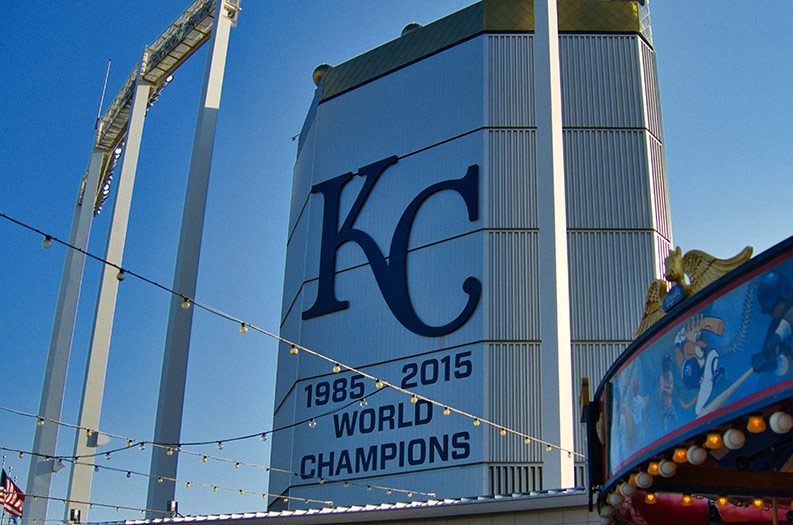 Kauffman Stadium at the Truman Sports Complex in Kansas City, Missouri. Photo credit Shutterstock.
Those who are undecided
Wants to see more plans — Nancy Becker
I feel like if people could see the proposed plan and how changes will be made to address concerns with traffic and such, it would help make people feel more positive.
“I’m on the fence” — D., Overland Park
The list of complaints I’ve heard about a stadium so far is not convincing. It’ll increase traffic to a (half-full) office park with 14,000 existing parking spaces, block off all access to any of the 4 hospitals within a mile, or somehow increase threats to The J. These arguments are not serious. I am on the fence about this development, but the more I hear the arguments being made against it, the more I lean towards supporting it.