
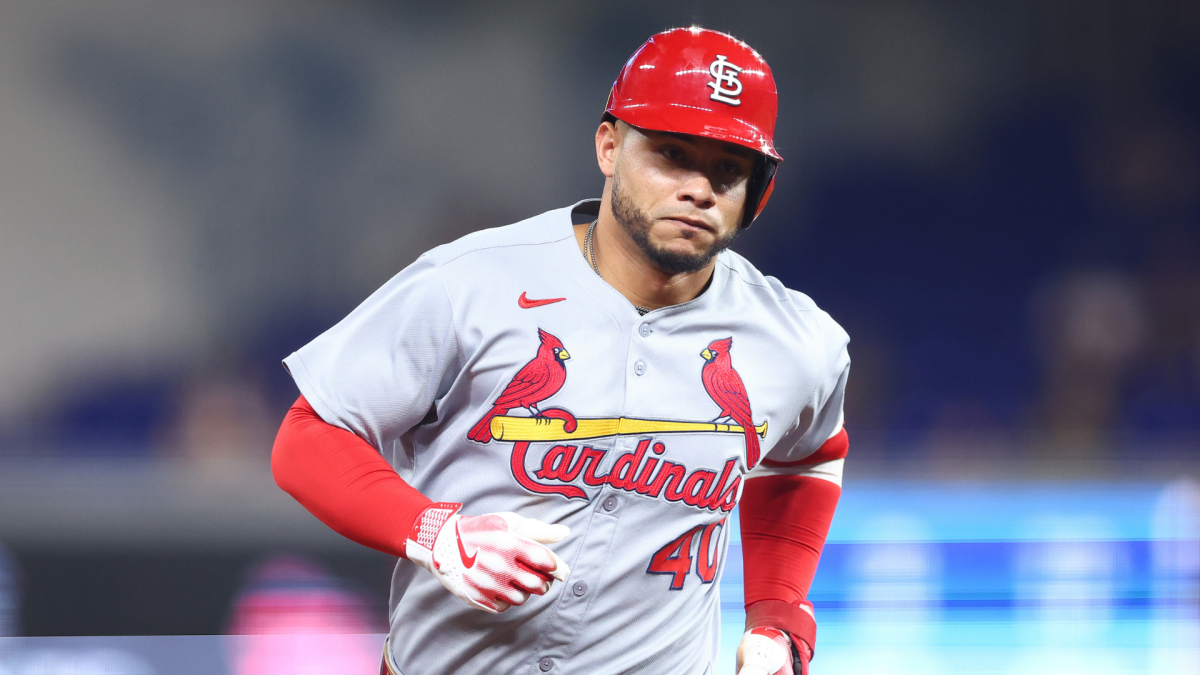
For the second time in a matter of weeks, the Boston Red Sox and St. Louis Cardinals have agreed to a trade involving a three-time All-Star honoree. First it was right-hander Sonny Gray, and now, on Sunday night, the Red Sox are adding first baseman Willson Contreras in a four-player swap.
As is tradition at CBS Sports whenever a notable trade happens, I appear to offer instant analysis. Below, you’ll find reports on every involved player and their potential fit. I also boil those parts down to a letter grade for both sides, though those are the least important parts of the piece.
Before moving on, here is the trade in its entirety:
Red Sox receive: 1B Willson Contreras, $8 millionCardinals receive: RHP Hunter Dobbins, RHP Yhoiker Fajardo, RHP Blake Aita
Willson Contreras traded to Red Sox: Boston acquires veteran slugger from Cardinals, per report
Dayn Perry
Now, let’s conduct some business.
Red Sox grade: A
Contreras, 33, hit .257/.344/.447 (123 OPS+) with 20 home runs in his maiden voyage as a first baseman. He continues to possess explosive bat speed and, for the first time in his career, he lifted and pulled more than 19% of his balls in play. Expect his raw stats to look significantly better if that sticks in 2026: whereas Busch Stadium plays as neutral or worse for right-handed hitters, Fenway Park happens to be one of the top destinations for a righty looking to pad his numbers.
Generally, bat speed is one of the main concerns for right-handed first baseman aging into their mid-30s. That variable not only impacts their slugging capacity, but also their ability to keep their strikeout rate in check. While Contreras swings and misses and punches out his fair share, it should be encouraging that he improved both his in-zone and overall contact rates in 2025 — and did so with only a slight reduction in his swing rate. Anything and everything can happen in this sport. Still, Contreras looks like he ought to be good for another above-average showing or two.


Contreras’ contract calls for him to be paid $18 million next season, $18.5 million in 2027, and an adjusted $7.5 million buyout on a club option for 2028, per The Athletic. He’ll also net $1 million here for agreeing to waive his no-trade clause. Minus what the Cardinals are sending over, the Red Sox will be responsible for $36 million over the next two-plus seasons. That’ll push the Red Sox closer to the first tax line, but there’s no excuse for them to stay under — not when they have a playoff-caliber roster in place that should be in contention for the American League pennant.
Plus, put another way, they’re paying Contreras almost the exact same terms the Chicago White Sox will pay Munetaka Murakami — the latter being younger, but arguably much riskier. (It’s also much less than the Baltimore Orioles are paying Pete Alonso, who shares some of the same general concerns as Contreras.)
It’s to be seen how the Red Sox fill out the rest of their infield. You figure Trevor Story will be back at shortstop, but otherwise? Boston has Marcelo Mayer, Ceddanne Rafaela, Kristian Campbell, and David Hamilton on hand. They also have reported interest in retaining free-agent third baseman Alex Bregman. And that’s without taking incumbent first baseman Tristan Casas into account. In other words, the Red Sox still have a lot of sorting out to do between now and Opening Day 2026.
If nothing else, the Red Sox were able to net an above-average stick on a short, cheap agreement for more of their pitching surplus without touching anyone they’re likely to miss in 2026 (Payton Tolle or Connelly Early) or compromising other pursuits. This, then, seems like another fine swap both ways.
Cardinals grade: A
If nothing else, you have to credit the Cardinals for paying down Contreras’ salary to get a better return. They did the same in the Gray deal (a move that also received an “A” grade). In total, the Cardinals will have spent $28 million to ensure that the Red Sox could take both players on. Expect St. Louis to throw around more coin to facilitate a potential Nolan Arenado trade later this winter.
Dobbins, 26, appeared 13 times and compiled a 4.13 ERA (100 ERA+) and a 2.65 strikeout-to-walk ratio before tearing his ACL in July. He’s a supinator who threw five pitches at least 9% of the time last season, including three different breaking balls: a shorter slider, longer sweeper, and a curveball that generated his highest whiff rate. Dobbins’ mid-90s fastball featured far more cutting action than expected, though the pitch-quality algorithms consider it to be a below-average offering anyway. (It’s hard to argue based on results, seeing as how opponents hit .316 and slugged .453 versus it.)
When Dobbins returns to the fold, he could figure into the back of the Cardinals’ rotation. Remember, St. Louis has already added two other prospective starters this winter: free-agent signing Dustin May and right-hander Richard Fitts, who came over as part of the aforementioned Gray trade.


Fajardo, 19, was acquired last winter from the Chicago White Sox in exchange for lefty Cam Booser. He’s a tall right-hander who spent most of last season in the Carolina League, tallying a 2.98 ERA and a 2.95 strikeout-to-walk ratio. Fajardo is, predictably, given his youth, a work in progress. His arsenal includes a pair of fastballs that can get into the mid-to-upper 90s, as well as a quality breaking ball. He’s thrown strikes and coerced a high rate of ground balls thus far, and there’s a clear pathway for him to become a big-league starter in due time. Stay tuned.
Aita, 22, was a sixth-round pick in the 2024 Draft. He made 23 appearances across Low- and High-A, scoring a 3.98 ERA and a 3.30 strikeout-to-walk ratio. Aita features a flatter plane to the plate and a tremendous feel for spin that manifests in (among other pitches) a quality slider. He’s a candidate to take a step forward with the right player development support, making him another possible big-league contributor — maybe even in a starting role if everything goes well.
It’s not the flashiest set of names, but top executive Chaim Bloom has successfully added three interesting arms who could log starts and/or innings over the years to come. That’s a nice piece of business considering how most front offices these tend to regard the value of non-elite right-right first basemen in their mid 30s.