
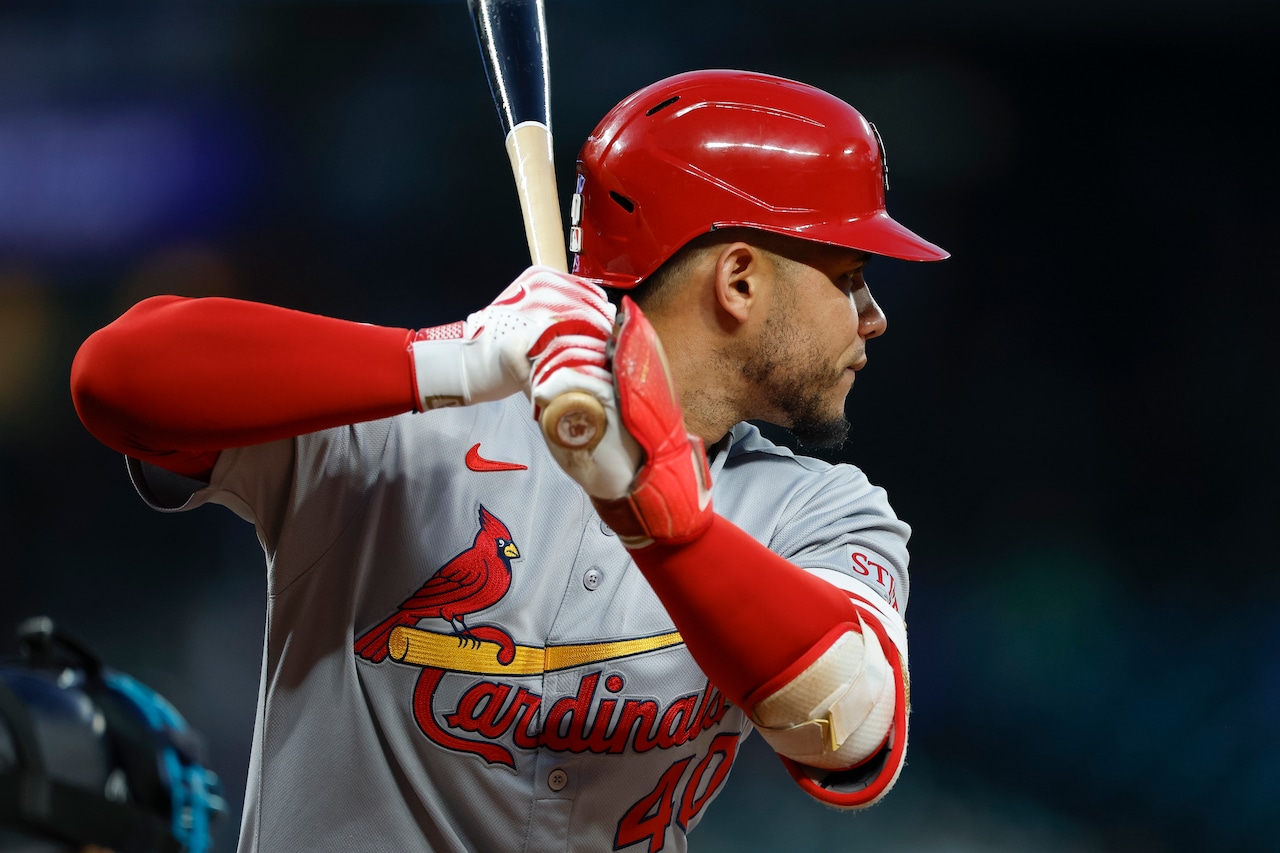
For the second time in a month, the Red Sox and Cardinals have struck a trade, with the Sox’ former chief baseball officer (Chaim Bloom) reaching a deal with his replacement (Craig Breslow).
Last month, the Sox addressed their rotation needs when they acquired Sonny Gray in exchange for two young pitchers. On Sunday, they took care of a hole in their lineup when they obtained Willson Contreras in return for three young pitchers. Both veterans had to waive their no-trade clauses to approve a deal to Boston.
Here are five quick thoughts on the trade:
1) Contreras fills an opening at first and adds some right-handed power.
At their end-of-season press conference, Breslow (and manager Alex Cora) acknowledged that they lacked slug in their lineup, having finished 15th in homers in 2025. Contreras fills that at least somewhat, and his offensive profile reveals a righty hitter with the ability to pull the ball in the air. That will play at Fenway.
But Contreras, while providing some pop, isn’t exactly a pure home run hitter. He had 20 last year and his career high is 24, which he hit in 2019. Only twice in his 10-year career has he hit more than 22.
His OPS last year was a rather unremarkable .791. On a good team, Contreras would probably slot in as a No. 5 hitter. Depending on what else the Red Sox do this winter, he’ll probably hit third or fourth, giving them a righty bat in the top third of the order to break up all the lefties (a group that might include Jarren Duran, Roman Anthony, Wilyer Abreu, Masataka Yoshida and others).
2) The Red Sox continue to avoid free agency like it’s some communicable disease.
The Sox remain one of just two major league teams who’ve yet to sign a major league free agent. The Colorado Rockies are the other.
That’s not to say that they haven’t taken on some money. Gray will make $41 million in 2026, with the Red Sox responsible for $21 million of that figure. For Contreras, the Red Sox will pay $34.5 million over the next two years and have an option for 2028. The $17.25 million average annual value a reasonable figure for an established run producer.
But the Contreras contract — he was signed to a five-year, $87.5 million deal by the Cardinals three years ago — is a somewhat inefficient one because the Cards signed him as a No. 1 catcher. His game-calling and defense were so poor, however, that he had to be shifted to DH and first base. As a starting catcher, the salary makes some sense. Paying him No. 1 catcher money to play first isn’t such a bargain.
3) It will be interesting to see if the Red Sox view Contreras an option at catcher.
The Red Sox have Carlos Narváez as their starter, and, for now at least, Connor Wong as their backup. Contreras isn’t someone who will play once or twice a week behind the plate, but if he could be sufficient enough back there to serve as a No. 3 catcher — and someone who can shift there late in games — that would help.
Positional flexibility is critical in today’s game and if Contreras can help out, even occasionally, at catcher, the Sox will gain an edge. There will be games when they need to hit for Wong late; if Contreras can move from first to catcher for an inning or two, that will be a positive.
Contreras didn’t catch a single inning last year but as recently as 2024, he started 51 games. He had logged just 11 career games at first base before 2025.
4) The player cost wasn’t unreasonable.
Hunter Dobbins is the headliner for the Cardinals, but probably tops out as a back-end starter, likely as a No. 5 guy. The Sox will lose some depth for their rotation, as they did when they gave up Richard Fitts for Gray. But neither was poised to be a rotation mainstay.
While Dobbins is the headliner, when all is said and done, Yhoiker Fajardo might be the most interesting piece for the Cards. Just 19, his stuff is impressive and, like Brandon Clarke in the Gray deal, could have the highest ceiling here.
It’s true that in trading Fitts and Dobbins, the Red Sox deleted some potentially important depth for their rotation. But they didn’t give up either of their best starting pitching prospects (Connelly Early, Payton Tolle).
5) There’s another hole to fill, but the Red Sox have options.
Simply adding one hitter to the roster isn’t enough for the Sox — that merely gets them back to ground zero. They need another impact bat to realize any improvement.
They could still add another bat at either second base or third, with Alex Bregman remaining an obvious target for the latter. A trade for Ketel Marte, who would fill a need at second, is another possibility.
Presumably, Mayer would fill whichever position isn’t covered.
Either way, there’s more work to be done. Let’s assume that from a production standpoint, Contreras can match what Bregman gave the Sox last season — a not unreasonable assumption. That would only put the Sox right back to where they were in early October, with not enough sock in the lineup.
Trading Dobbins could also make another rotation addition more likely, though the Sox still have plenty of options.