
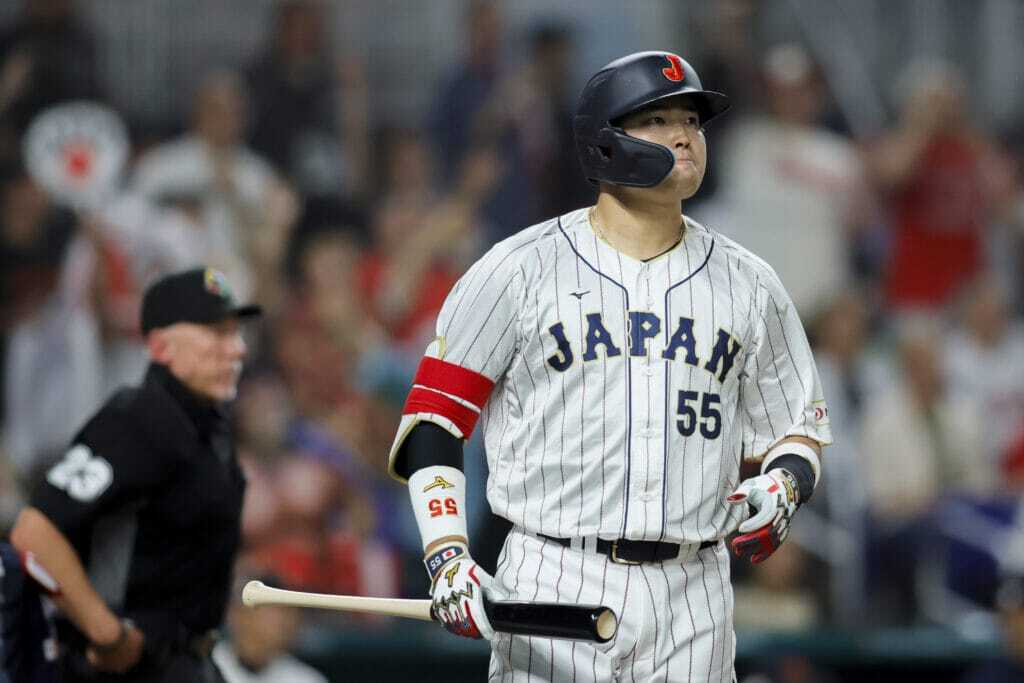
The White Sox rebuild keeps moving forward. They improved by 19 wins last season, thanks in part to the emergence of some of the young players in the organization, and now the Sox have reportedly added more young power to their lineup for 2026. As first reported by ESPN’s Jeff Passan, lefty Japanese slugger Munetaka Murakami is coming to Chicago on a two-year, $34 million deal. The team officially confirmed the signing on Sunday afternoon.
Murakami will be a valuable addition to the White Sox for multiple reasons, but there are two in particular that should excite south siders. The first is the unquestionable power in Murakami’s bat. In eight seasons for the Yakult Swallows of the NPB, he has 246 home runs, including a league-leading 56 homers in 2022, when Murakami was 22 years old. Injury limited Murakami to 69 games in 2025, but he still clubbed 24 longballs.
Given that the White Sox ranked 23rd in baseball in home runs last season, Murakami’s potential to go deep upwards of 30-35 times in a full season should make a significant difference in the team’s overall offense. Simply adding 30 to their team total from ’25 would move them from 23rd in baseball to 11th. It’s not yet clear whether the Sox will hold onto center fielder Luis Robert, Jr. until the midsummer trade deadline — USA Today’s Bob Nightengale reported on Sunday that the Mets and Reds have expressed interest of late — but if they do begin the season with Robert, Jr. on the roster, the Sox will have two serious power bats in the lineup. And if Robert, Jr. is gone by opening day, Murakami’s slugging ability will be needed all the more.
Another reason for Sox fans to like the Murakami signing is what he will mean for the infield defense. Murakami has experience at two of the spots the Sox need to fill: third and first base. With Miguel Vargas still going back and forth between the two positions himself, there would have been a hole at whichever spot Vargas wasn’t playing next season. Murakami essentially solves that problem. He has played a lot more third base in the past few years, which is better for the Sox defensively because it will make Vargas the primary first baseman.
Vargas’ defense has been something of a question mark since he reached the majors with the Dodgers in 2022, so a more regular position would conceivably give him an opportunity to keep improving. His defensive numbers are much stronger at first base over third, so if it works out that Murakami becomes the team’s primary guy for the hot corner, this is a plus for the team’s defense on the whole.
And at 25, Murakami has potential to be a long-term boon to the Sox offense and fits in nicely with the growing cadre of young talent on the major league roster. There’s an advantage to a two-year contract as well; it gives the Sox an opportunity to gauge Murakami’s success as he transitions from NPB to professional baseball in the United States without having committed to him beyond his age-27 season. There is also always the chance he does well before this two-year deal expires and the Sox retain Murakami on a contract extension. It’s arguably a win-win situation on that front.
There are reasons to be appropriately cautious with any Murakami-related enthusiasm, however. As often comes with a lot of power, Murakami has a healthy amount of swing and miss in his approach. His strikeout rate has hovered around 29% for the past three seasons, and it is probably wise to assume that number will be a bit higher against Major League pitchers. Murakami still draws walks at a high rate even when he is striking out, so it is also safe to hope that his strikeout rate won’t spike too high. But his K totals will be something to monitor when he starts facing MLB pitching.
Looking at the big picture, the per-year value of Murakami’s contract should be encouraging to Sox fans in terms of what it might mean for the direction the organization is moving financially. Murakami’s AAV is higher than Andrew Benintendi, whose five-year $75 million deal was the largest in Sox history. If the Sox are willing to commit $17 million a year to one player this offseason, it could mean the franchise’s pocketbooks might be opening a bit more going forward. Adding Murakami helps the team keep improving in the immediate future, and if the Sox are going to show further signs of willingness to spend on free agents, this bodes well for the club’s long-term future as well.
From the depths of the record-setting number of losses in 2024, the White Sox still have a long way to go to be competitive again, but signing Murakami is a positive step on multiple fronts. He should make the team better in 2026, and his contract could be a signal that the organization’s infamous frugality could be coming to an end.