
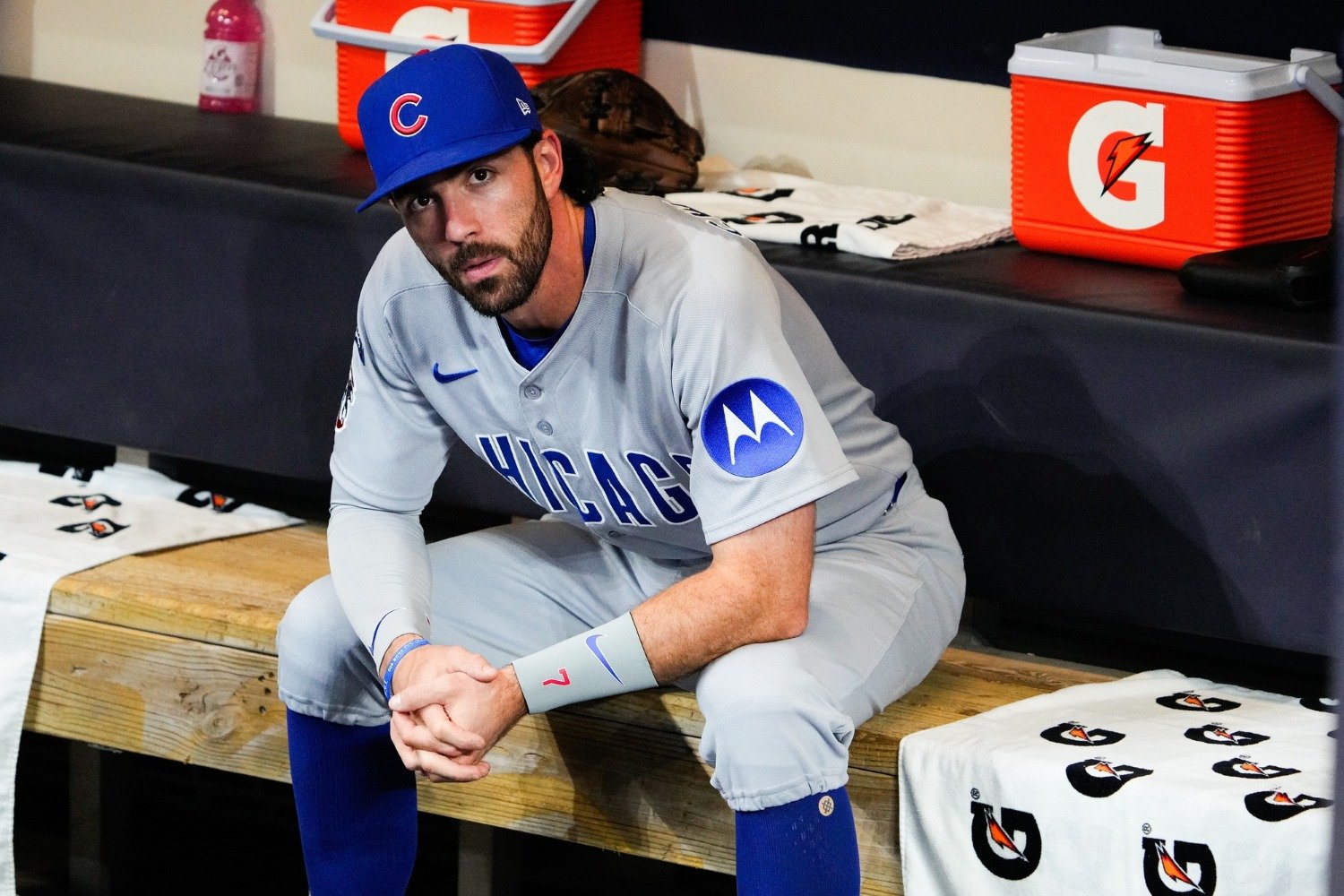
Dansby Swanson had a strong 2025 season. He only batted .244/.300/.417, with that middle number—the most important one, his on-base percentage—sagging alarmingly, but he cracked 24 home runs, stole 20 bases and made good adjustments, even as he endured some wretched luck and sequencing. His DRC+, according to Baseball Prospectus, was 113, marking him as well above average by process, even if his results were average or worse. That was the best DRC+ of his Cubs tenure, and an especially important bump from the 104 he posted in 2024.
As he ages, Swanson continues a negotiation with his own skill set and with opposing pitchers—though the latter, of course, is a highly adversarial one, so it can’t be as calm or simple as the one with himself. He’ll turn 32 in February, and he’s made significant adjustments to deal with the way his athletic baseline has changed and with things like the lingering core muscle injuries through which he played in 2024. Those adjustments paid off in 2025, in the form of more hard-hit balls, fewer grounders, and a stronger tendency to pull the ball in the air—all of which could (and perhaps even should) have led to more increased production than we really saw.
To see both what a material and valuable change he made and why it might not be sufficient, consider these charts of Swanson’s swing rate by pitch location for both 2024 and 2025.
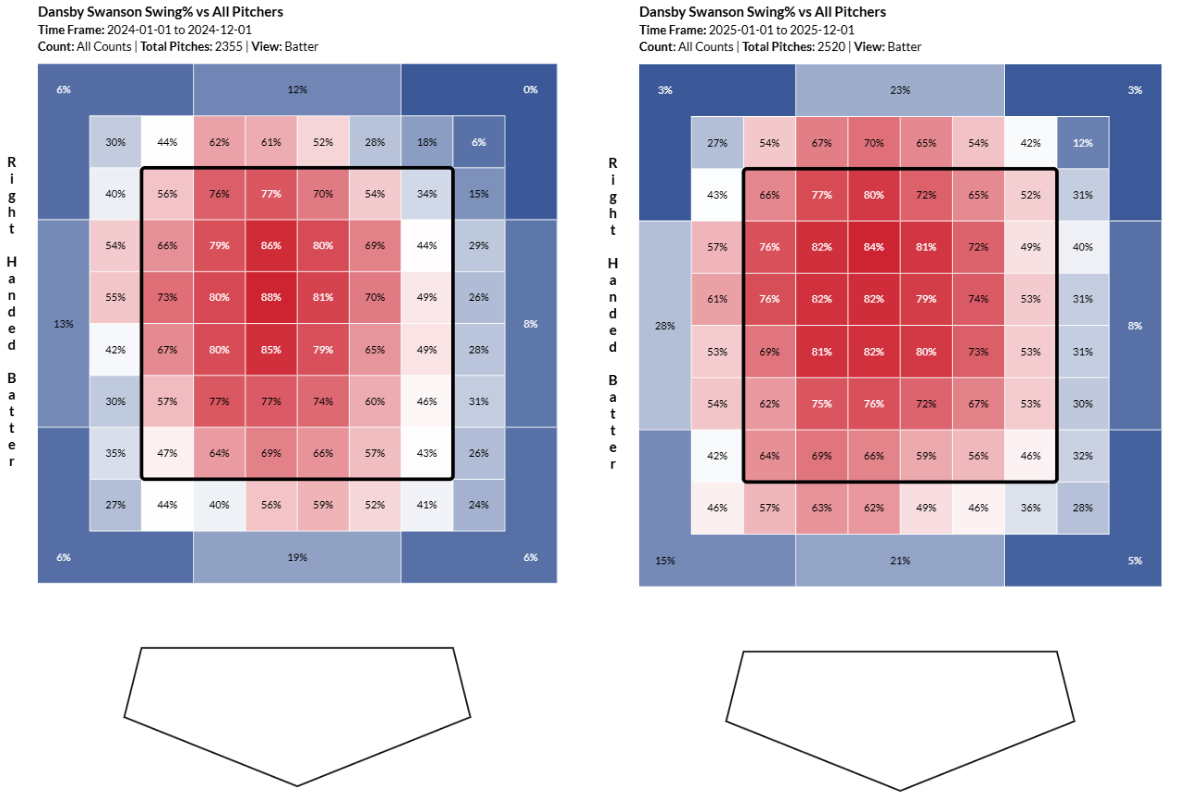
Swanson shifted his sights slightly upward in 2025, but only slightly. The focal point of his approach was still right around the same place it was last year, just above the belt and just on the inside half of the plate. However, he swung more almost throughout his swing range than he had the year before. He’s not a guy who will get fooled badly and chase wildly, far outside the zone. He will, however, slightly expand, and he will try to cover the whole zone. Using Statcast’s Attack Zone breakdown tells the story. Here are Swanson’s swing rate rankings among hitters with a substantial number of pitches seen in each Attack Zone category, for 2025:
Heart of Zone: 11th of 161
Shadow (Edges): 85th of 282
Chase and Waste (far out of the zone): 144th of 185
He leaned more into those tendencies in 2025 than he had the year before. That was partially because he was healthier than in 2024, and felt better swinging the bat, but it was also partially because his skills are evolving (and, to a mild extent, eroding). Swanson didn’t feel like he could be as discerning; he didn’t want to end up in unduly deep counts or miss his pitch to hit when it came.
According to SEAGER, a system devised by Robert Orr (then of Baseball Prospectus) to assess a hitter’s ability to balance selectivity and aggressiveness, Swanson got much better at that skill in 2025. SEAGER is made up of two components:
Selectivity: the percentage of a hitter’s good swing decisions (those with positive expected value based on the pitch’s location) that took the form of good takes on bad pitches to hit
Hittable Pitch Take Rate: the percentage of a hitter’s takes (all pitches on which they didn’t swing) that came on pitches with positive expected value for swings—thereby making them bad takes.
Somewhat counterintuitively (if you just glance at the heat maps above), Swanson’s selectivity rating changed very little from 2024 to 2025. In both years, just under half his good swing decisions were takes on bad pitches. His SEAGER shot up, though, because his take rate on pitches begging to be hit went down sharply, from 33.3% in 2024 to 27.9% in 2025. He didn’t let good pitches go by nearly as often. This is why he found the gap in left-center field more often, especially later in the season. It’s a big part of his improved contact profile.
However, Swanson will have to adjust again in 2026, in multiple facets. Unfortunately, though those tweaks were admirable responses to the challenges of hitting well as one ages, new challenges are right around the corner, and these tweaks won’t be enough to keep him a competent hitter. He’s never been good at making contact on swings outside the zone, and in 2025, that figure plummeted to 44.3%, the worst mark of his career. Without a change in approach, that will continue to get worse; out-of-zone contact has a steep aging curve.
So does bat speed, once a hitter turns 32. Swanson is at what the broader population experiences as a major inflection point for the loss of swing speed, so he’s going to struggle to generate the same power we saw in 2025 unless he can tighten up his zone and lock in on pitches he can drive. Getting more aggressive was key to his improvements this year, but next year, both the alarming share of those extra swings that already came up empty and the fact that a slower stick is likely to reduce his margin for error mean he will need to get more patient, instead.
Hitters decline at Swanson’s age. It’s a fact of life, in an extremely difficult game played at an extraordinary level of sheer athleticism. The Cubs, however, can ill afford to have Swanson take a step back. They need every bit of the production they got from him in 2025, for at least one more season. They can’t offer him a move off shortstop to make maintaining his offense easier, at least until 2027. They can’t reduce his workload much in terms of games played or started. They need Swanson to keep delivering big hits and tough at-bats, even though he’s reached the stage of his career where he needs to oscillate increasingly widely and make bigger and bigger changes each year, just to tread water at the dish. He’s between a rock and a hard cutter on the hands, and next season will be an exercise in very difficult extrication.