
One the common misconceptions is that there is a battle between stats people and traditional baseball people. The tragedy is that this isn’t really the battle. Ultimately, stats folks simply approach all of the big baseball questions through data. Sometimes they come to the same conclusions as traditionalists. Sometimes they don’t. Often times different people within the stats community do not agree. Those are always the most fun conversations.
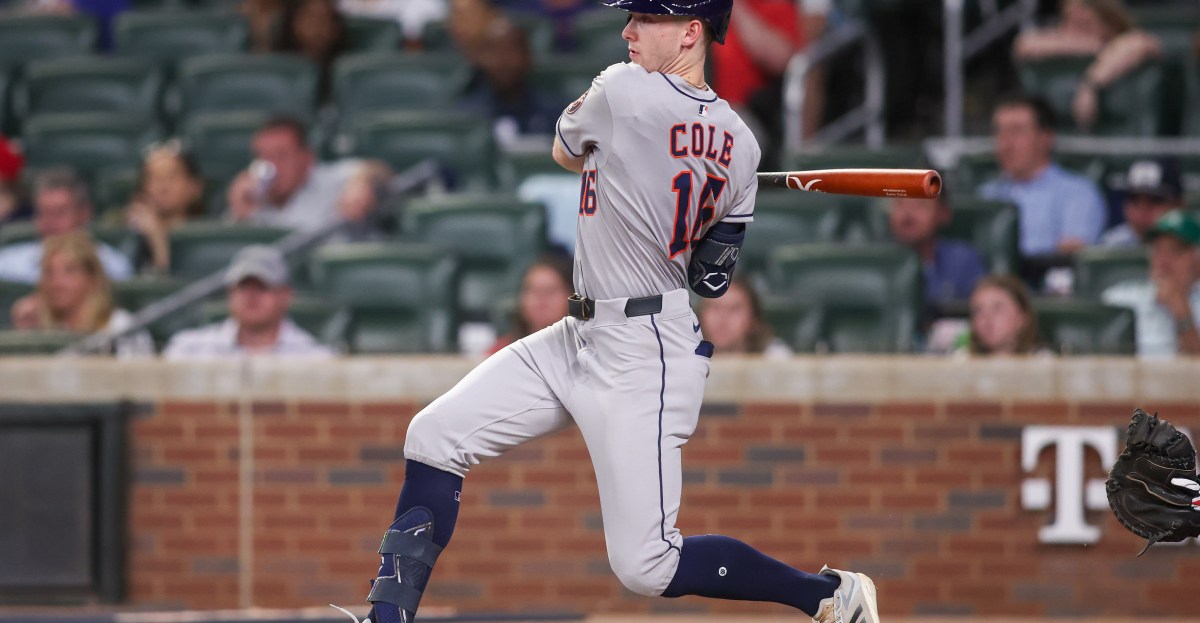
That happens when we get to the Astros center field question. So, the question we come to today is how detrimental strikeouts are for hitters? That comes into the forefront when we look at the difference between Jake Meyers and Zach Cole. Cole has done the same thing at every level. He is a tantalizing combination of power, speed, and patience. He also has a ton of swing and miss in his game.
2022: 27.1 K%2023: 31.8 K%2024: 37.7 K%2025: 35.1 K%
These are all minor league numbers. So, we aren’t talking about what he did in his September call up. He had a 38.5 percent K rate during those 52 plate appearances. This is in spite of a healthy walk rate at every level. So, Cole is not a chaser per se. He just swings and misses and does it often. It is one of the many reasons why there should be a sixth scouting tool. The hit tool measures a hitter’s ability to put the bat on the ball. There should be a plate discipline tool. Cole has five of the six tools covered. He just struggles putting the bat on the ball.
The question for us is how much that matters. That depends on who you ask and it is often situational. The Astros offense struggled last season for two different reasons. The main statistical reason is that their isolated power numbers tapered off considerably. They had 441 extra base hits in 2025. They had 470 in 2024. They had 524 in 2023. So, ultimately they are going in the wrong direction in the power department. Strikeouts have very little to do with that.
The second problem with the Astros offense was that they struggled considerably with runners in scoring position. This is particularly true with runners on third and less than two outs. That has everything to do with strikeouts. So, to say that strikeouts matter or don’t matter is overly simplistic. They sometimes matter and sometimes they don’t matter. Bases per out doesn’t look at strikeouts. Every out counts the same. It is one of many reasons why it can’t explain everything. The most important part of being a scientist or statistician is in admitting the limitations of your own research. Let’s start by looking at the minor league numbers for Zach Cole.
TBBB+HBPSBOutsBPO20231978137319.98720241193715198.86420251935718274.978Total50917570791.953
For those of you new to these articles, bases per out are calculated by adding total bases, walks, hit by pitch, and stolen bases and dividing them by the total number of outs a player accrues. Obviously, minor league numbers are tricky because sometimes players play in extreme run scoring environments. The Sugar Land numbers are skewed because many of the Pacific Coast League ballparks are considerably easier to hit in. So, I do not have a minor league to major league decoder ring.
What we have is a player that has succeeded at every level. As we saw earlier, he has also whiffed a ton at every level. So, whether he succeeds at the next level long-term is certainly open to question. There have been some players with his same profile that have succeeded at the big league level. Most have not succeeded. So, Cole looks like one of those classic high ceiling, low floor kind of players. He also serves as a stark contrast with current center fielder Jake Meyers.
TBBB+HBPSBOutsBPO20224792119.4872023118315244.63120241664511387.57420251281416261.682Total459119341011.605
There is never only one way to look at numbers. One way would be to point out that 2025 was clearly the best season of Meyer’s career and that it is very unlikely that he will produce those numbers again. A second way would be to see steady improvement from his career low in 2022 and so 2025 was the culmination of that growth. One way would be pessimistic about his prospects in 2026 and would likely point more towards the total as being a ballpark projection for him.
An optimistic view would look at real gains that Meyers made in contact rates, chase rates, and hard hit rates and predict more of the same in 2025. However, even the optimistic view would have to admit that there is a real chance that Cole outproduces those numbers as the everyday center fielder. Of course, he would also do so with a whole truck load of strikeouts and some of those would occur in situations where the Astros desperately need someone to put the bat on the ball.
This is one of the many reasons why the Astros have Jake Meyers on the trade block. Even if he produces like he did in 2025, he has a certain ceiling offensively because of his lack of power. They are also acknowledging the possibility that he won’t produce those numbers again. The trick is finding an organization that has something you want AND believes in the optimistic view of Meyers.
The fielding end of the equation also complicates things. Meyers has an impressive record in that same timespan. So, we like to look at multiple sources to get a more comprehensive view of fielding. We like to look at defensive runs saved (DRS), outs above average (OAA), and fielding run value (FRV). They all operate the same way, but obviously have different methods of getting there. Zero is average and everything above zero is good. I try not to show preference for one over the other.
2022: 402.2 INN, +5 DRS, +7 OAA, +5 FRV2023: 807.1 INN, +4 DRS, +7 OAA, +5 FRV2024: 1145.0 INN, +6 DRS, +13 OAA, +11 FRV2025: 844.0 INN, +5 DRS, +9 OAA, +8 FRV
If a typical every day center fielder plays 1200 defensive innings when they play 150 games then Meyers would likely produce about 7.5 defensive runs saved, 13.5 outs above average, and 10.9 fielding run value in a 1200 inning season. If ten runs equals one win then that version of Meyers would be worth about two wins above replacement defensively. That’s obviously pretty substantial.
Cole spent more time in center field in the minors than any other defensive position, but we do not have sophisticated defensive stats like we do for Meyers. Scouts would seem to indicate that Cole would likely be in the average range defensively. That has to be a part of the equation. Cole has the ability to play all three outfield positions, so the choice is not Meyers or Cole exclusively. The choice is Cole in center and what you can get for Meyers or Meyers and center and Cole serving as a fourth outfielder. It’s a fascinating debate and one that likely will continue until a resolution is reached on Meyers.