
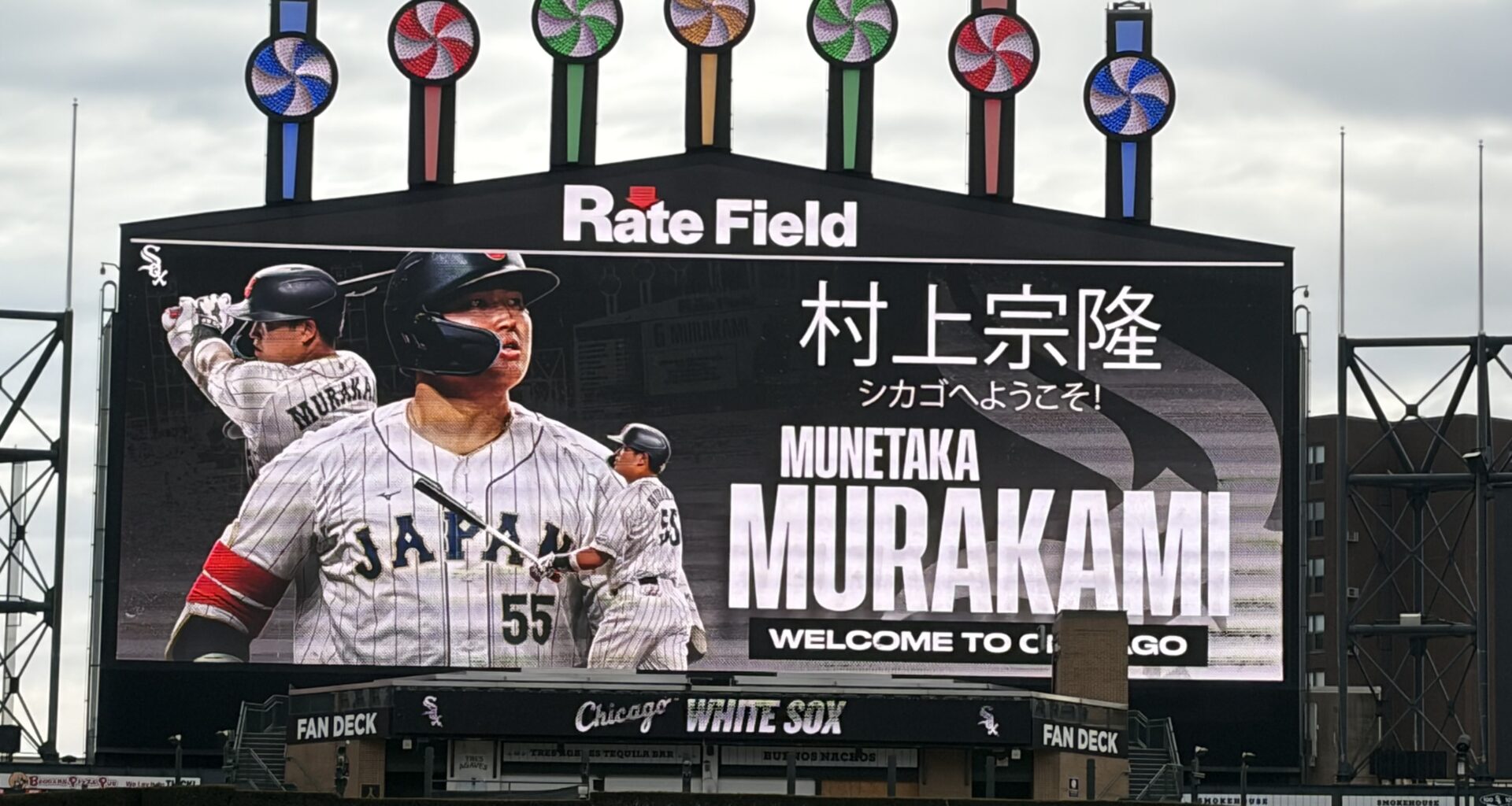
There’s an unavoidable dog caught a car element to the White Sox holding a press conference for landing a high-profile free agent in 2025, let alone one that exposes the oft-overlooked franchise to the baseball-loving island of Japan.
“I don’t know quite yet,” Chris Getz said in a candid moment, asked what the remaining budget room is for other areas of the 2026 roster after signing Japanese slugger Munetaka Murakami to be their primary first baseman.
His caution is understandable, since it was only this Thursday that he started to feel things were moving toward his last-place team landing the two-time MVP of NPB. Getz smiled broadly and proclaimed “we got our guy” when his utilitarian desire for a “left-handed infielder” that he expressed at the GM Meetings was referenced, with the unstated joke being that this is several orders of magnitude beyond what he had in mind. And at $17 million per year for the next two seasons, Murakami represents an outlay that would have had a difficult path to getting ownership approval were the single-season NPB record-holder not a box office draw and connection to an untapped new market in his own right.
“White Sox nation … you guys are in my heart,” Murakami recited in English, before pulling out a White Sox-branded sock literally out of his jacket sleeve and displaying it to the cameras. “Let’s get to work!”
The first morning after Murakami’s agreement with the team became official, White Sox chief revenue officer Brooks Boyer did not in fact already have a slate of theme nights and brand partnerships already lined up. Monday’s media event was the first time in almost three years that Guaranteed Rate Field’s conference and learning center (CLC) was used to introduce a free-agent signing, and took place only days removed from when Murakami choosing the rebuilding Sox seemed like a fringe possibility to shrug off. Surely a bigger market team, a more ready contender that had spent the bulk of his posting window focusing on other items would swoop in, or Murakami would opt for one of the longer, if not better, contract offers on the table. Sox officials were surprised by how little word leaked out of their pursuit leak out ahead of time, and didn’t dismiss easy jokes about the possibility that it simply was because no one believed it.
(This author pleads guilty).
In this environment, with this sudden swing of fate, the prevailing sense was just that the business side of the franchise will do something to capitalize on having one of the most famous Japanese hitters ever wearing their uniform, and ideally, they will do a lot. The flag that the Sox have found their way into planting for the franchise appears to be just as invigorating, if not more, than figuring out if Miguel Vargas will slide between Murakami and Colson Montgomery for lineup balance.
“We wanted to establish a presence in the [Pacific] Rim and that starts with hiring a scout, Satoshi Takahashi,” Keller said. “Once we were able to get him on board, I think that’s where those conversations became more real.”
“Got Jerry [Reinsdorf] up to speed on the reality of bringing in Mune,” said Getz, using Murakami’s preferred nickname. “The more he was hearing from me, and Brooks as well on the marketing front and the international impact that it can have in bringing in someone as significant as Mune, led us to get to the finish line. A lot of that was support from Jerry in the end.”
The flow of Murakami’s presser was halting at times, with the CLC full of both domestic and Japanese media for surely the first time in years. There was a pause before remembering to mention Murakami’s charitable donation to the St. James Food Pantry, the stilted silence of his official contract signing was broken by someone screaming “Go White Sox!” from the top row where team employees were seated. The Sox had a Japanese translator on hand, and Murakami has clearly been working on his English, but Getz acknowledged that there are plenty of accommodations they will need to prepare for bridging the language barrier and easing the slugger’s transition, with his food and nutrition plan being chief among them.
“We want to make this as seamless as possible and provide the support he needs because we just want him to go out there and be comfortable and play baseball,” Getz said.
In this forum of delirious surprise and celebration, it was awkward to try to discuss this deal in the way that it’s being couched across the league: a disappointing result for Murakami considering initial projections, a calculated risk, albeit an intriguing and marketable one, for the White Sox.
“My main priority was to find the best fit; whether the contract was long or not wasn’t really a factor,” Murakami said via interpreter. “Obviously I’ve heard that this club has lost a lot of games in the past, but that is in the past. I only look forward. I’m excited with the exciting young players that this club has.”
Realistically, the shortness of the deal has appeal for both sides, as the Sox are not overcommitted to a player who may not be viable at this level of baseball, and if Murakami is half the slugger he’s been in Japan, he’ll have a free-agency bonanza awaiting him at the age of 27. But Getz also went out of his way to talk up his good relationship with renowned agent Casey Close and Excel Baseball, who represents a slew of other players trusting the White Sox organization’s ability to launch big league careers in Kyle Teel, Chase Meidroth and Mike Vasil.
As a team where Murakami would get immediate full-time opportunity, but won’t be expected to be the face of the franchise, where he’ll be in a big market but not under a microscope, the current state of the White Sox threads the needle for a deeply flawed but intriguingly gifted star in such a unique way. It’s such that parsing what it means for the contention timeline to sign a slugger to a two-year deal, when he’s roughly the same age as Shane Smith, Sean Burke and Jonathan Cannon, feels out of theme with a day focused on celebrating this improbable outcome. Before asking “What on Earth is a dog going to be able to do with this car?”, it’s appropriate to just take a moment to marvel that such a question has to be seriously asked.
“This was a place he could just come in here and be himself, get comfortable, establish himself at the major-league level, and we’ll see where his journey takes him,” Getz said, wriggling away from another attempt to pin down a specific contention timeline. “We’re going to look up and all of a sudden we’re going to start working our way up the standings. We felt that a little bit last year — we’re going to take another jump next year and we’re just going to continue to build off this momentum.”
Privately, the White Sox look at the elements of Murakami’s setup that are common in NPB — his hands loaded far away from his body, a big leg kick to load into his back hip — and see length that can be shaved off his swing with the help of hitting director Ryan Fuller & Co. to adjust to higher-level velocity. Keller, who has scouted Murakami in person repeatedly since he was 22, revealed that he primarily was a catcher as an amateur, converted to third base upon entry in pro ball, and was expected to work on playing the outfield this past season until straining his oblique. Because of all that, the Sox view his first base defense as having more room for improvement than might have been initially perceived.
But those are all worthwhile avenues to walk down later on, as the days-old relationship between Murakami and the White Sox matures. Murakami’s participation in the World Baseball Classic for Samurai Japan was a given during the negotiation process, and while he’s expected to be training stateside and accessible to Sox coaches at the start of the new year and will report to spring camp when required, it could be a bit before he has a sustained stretch of time to work alongside his new team.
That’s another thing to figure out when the ink on Murakami’s contract is drier. Because beyond Curtis Mead’s place on the Australian team, or Lenyn Sosa’s place as Team Venezuela’s backup plan for Jose Altuve, a previous troubling sign for the White Sox was how few players they had that were even candidates to play in the WBC. Now, in a stunning about-face, they have one of the stars on the tournament favorite serving as a representative. For a team that usually doesn’t have the payroll to have days like Monday, they’re willing to make up the difference by being accomodating.
“It’s a big part of who he is,” Getz said. “We’ll make it work.”