
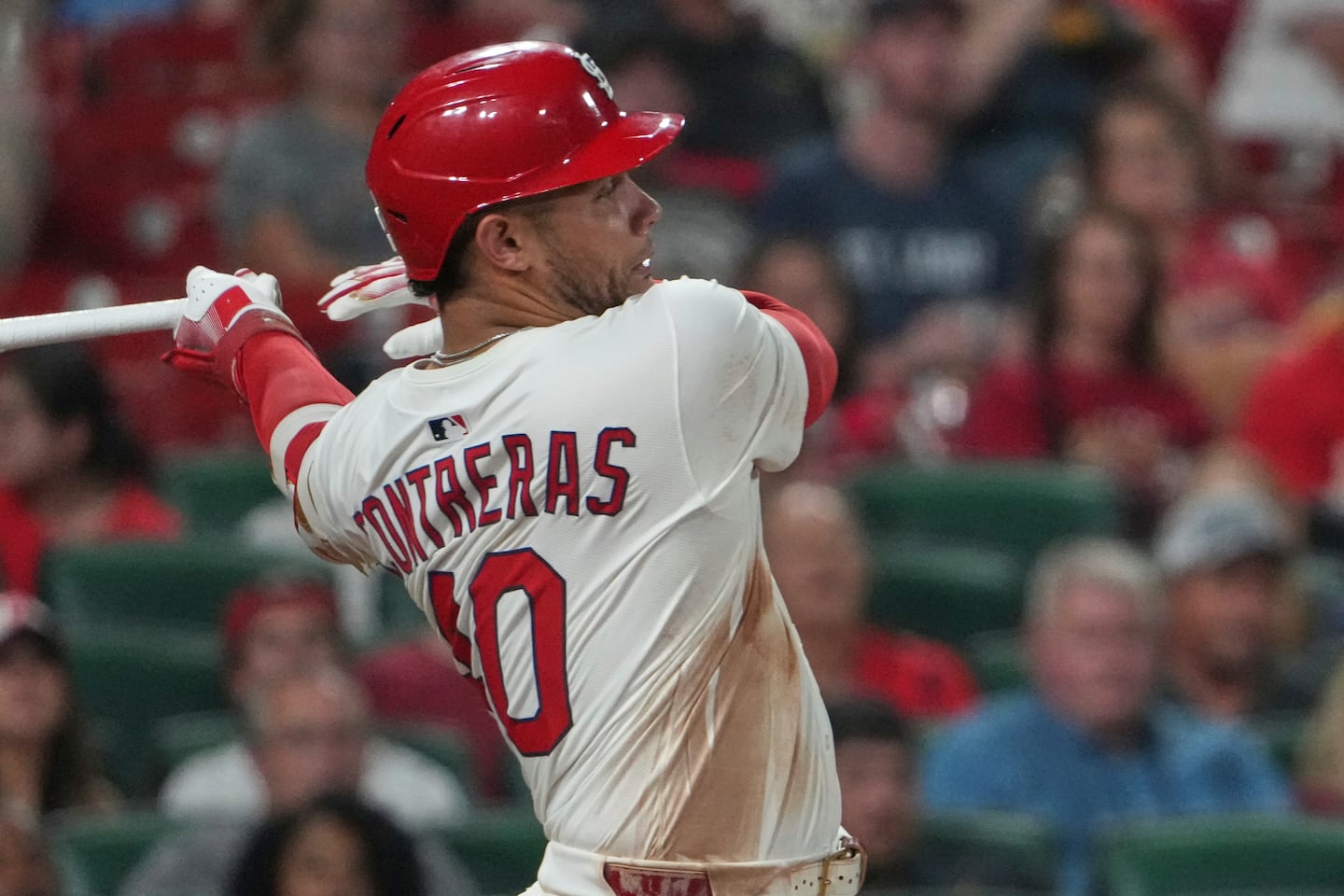
“This guy can hit,” said Cardinals president of baseball operations (and former Red Sox chief baseball officer) Chaim Bloom. “He has power to all fields. He really impacts the baseball, and in transitioning to first base this year, he was impressive over there. Really did a nice job, and the intensity and the competitiveness that he brings is something else.”
Get Starting Point
A guide through the most important stories of the morning, delivered Monday through Friday.
There’s a good chance that, with a move from the hitting graveyard of Busch Stadium (where pulled fly balls by righthanded hitters yielded a 1.431 slugging mark, fourth lowest in MLB) to Fenway (which turbocharged pulled fly balls by righties to produce a 2.020 slugging mark in 2025, the highest in baseball), Contreras can boost his already solid offensive numbers. Of particular promise to the Sox is that Contreras started pulling the ball in the air with greater frequency in 2025, doing so on 20 percent of balls in play — up significantly from previous years.
“If we can continue to build on getting the ball in the air to the pull side, and continue to hit the ball really hard, we’re going to be in really good shape,” said Sox chief baseball officer Craig Breslow. “That’s something that’s going to profile really well at our park.”
Interestingly, Contreras projects to put up very similar offensive numbers to Alex Bregman. According to the Steamer projections on FanGraphs, which predict future performance based on age and past performance, Contreras profiles to hit .248/.338/.446 in 2026. Bregman projects to carry a .262/.346/.441 line.
But therein lies the issue for the Sox. Contreras is a very good hitter and provides some balance to a group that skews lefthanded. But while he could offer a sizable improvement to the offense and defense at first base (both of which were woeful in 2025), the team still faces a Bregman-sized hole in the infield.
Meanwhile, a team that is trying to add righthanded balance is not only replacing Bregman’s production but also that of outfielder Rob Refsnyder, who signed a one-year, $6.25 million deal with Seattle on Monday. The 34-year-old crushed lefties last year, posting a .302/.399/.560 line in 138 plate appearances.
In other words, even with the addition of Contreras, the Sox lineup is thinner — especially from the right side — than in 2025. For a team that has articulated a desire to take another competitive step forward in 2026, there’s more to be done.
The Sox understand that.
“[Adding another position player is] a target. It’s a priority for us. … I think that there’s an opportunity to add another bat to the roster and complement the group that we have right now,” said Breslow. “We feel like we’ve got a competitive team and one that’s capable of a postseason run, but we also recognize that, at this point, the roster is probably incomplete, and it doesn’t make any sense to turn off specific paths to improving.”
On paper, there’s a hand-in-glove option to do so. The Sox remain interested in re-signing Bregman, whose offense, defense, and leadership on a young group of position players made a sizable impact on the team’s emergence as a contender in 2025.
Breslow declined on Monday to comment on negotiations with Bregman, but Sox officials have been direct in conversations throughout the industry about their desire to re-sign him after he opted out of his three-year deal. Still, a desire to sign a player is no guarantee that a deal will be done. (See: Bogaerts, Xander.)
The Sox have made 10 trades this offseason without a free agent signing. They’ve taken on some money — despite $28 million in subsidies from the Cardinals in separate trades for Contreras and Sonny Gray, the Sox’ projected payroll for luxury tax purposes sits around $240 million-$245 million — right up against the 2026 luxury tax threshold of $244 million.
Still, team officials expect the Sox to spend past the threshold in an effort to build on the club’s first playoff appearance since 2021. But how far? Would they be willing to sign Bregman or the other top infielder on the market, Bo Bichette, for $25 million-$30 million a year? (Marcelo Mayer could play second if Bregman is re-signed, or third if Bichette is added.)
The team could also consider a trade for a player such as Ketel Marte, but after its flurry of trades, might be reluctant to move pitchers Payton Tolle or Connelly Early, whom the Diamondbacks would likely need in a deal for their second baseman.
“My job is to be mindful of balancing the short term and the long term, And there’s only so much that you can dig into your system and trade before you start to impact your ability to sustain success over time,” said Breslow. “And so free agency is part of the equation here.”
But what will the equation yield? Right now, that answer remains unknown. The team still needs to solve for the variable of a second middle-of-the-order bat this offseason.
Without Mahomes, Burrow, or Jackson, what is the AFC playoff outlook?
Alex Speier can be reached at alex.speier@globe.com. Follow him @alexspeier.