
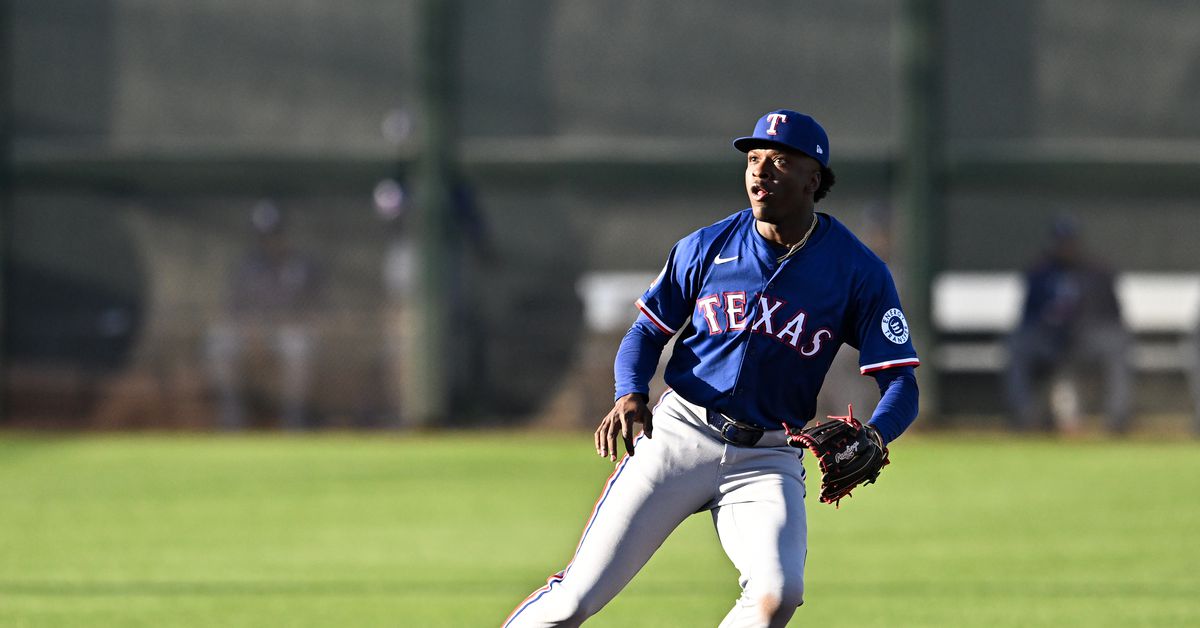
The top prospect in the Texas Rangers organization is Sebastian Walcott, and there’s not really any debate about that. Walcott seemed to be a consensus top 20 guy heading into the 2025 season, and he has climbed the ranks in the updates this month. In their latest update, Baseball America has Walcott as the #7 prospect overall,* and Kiley McDaniel has Walcott ranked #4 overall in his update earlier this week.
* Roki Sasaki and Jackson Jobe are still on the BA list, while McDaniel has removed them from consideration for his list, so you can consider Walcott #5 instead of #7 on BA’s list if you want.
Walcott has gotten off to a decent start offensively at AA Frisco, slashing .234/.331/.396 with 8 steals in 10 attempts. As a reminder, Walcott is still just 19 years old, and won’t turn 20 until right before the 2026 season starts. Not only did he start the season as the second-youngest player in AA, he would be the third-youngest player in high-A if he were at Hub City.
Walcott’s ETA is still to be determined — its not out of the question that he could be in the Opening Day lineup in 2026, and one would expect that he would be in the majors by 2027. An open question, however, is what position he will play. In his two-plus years of professional ball, he’s played mostly shortstop, with some third base mixed in. His defense has improved, with McDaniel, in the update linked above, saying “Walcott has gone from a long shot shortstop to now looking like an average long-term defender at the position”. If he doesn’t stay at shortstop, he would also profile well at third base or right field in the majors.
Walcott is big — I remember being struck by this photo of Walcott standing next to Alejandro Osuna, and the contrast between Walcott looking long and lean and Osuna looking like a fireplug. Eleanor on BlueSky noted that everyone is going to look short next to Walcott, who is listed at 6’4”, and who, given his age, might possibly get a little taller in the next year or so.
It occurred to me that that seemed awfully tall for a shortstop, and I wondered if there were many other major league shortstops that tall. So I went on Stathead and searched out every player with at least 500 games in the majors at shortstop who was listed at 6’4” or taller.
It was a short list, consisting of one player — Cal Ripken, Jr.
Ripken ending up at shortstop, incidentally, was the subject of much discussion back in the day. In the minors he split time between shortstop and third base, but played more third than short. When he got a cup of coffee in the majors at the end of 1981, he played a little more shortstop than third base, but it was only 9 starts and 18 games in the field in all that he played.
At the start of the 1982 season, the 21 year old Ripken was the starting third baseman for the Baltimore Orioles, replacing Doug DeCinces, who was traded to the California Angels for outfielder Dan Ford over the winter. Veterans Lenn Sakata and Rich Dauer were the regulars at shortstop and second base, respectively. Through June 30, 1982, Ripken only appeared at three games at shortstop, all as part of late game maneuvering after the starting shortstop had left the game.
Then, on July 1, 1982, Orioles manager Earl Weaver filled out a lineup card that had Ripken at shortstop. Ripken wouldn’t start a game at third base again until 1996. It was a weird move, made in the middle of the season, with Glenn Gulliver and Floyd Rayford getting some time at third base but, for the most part, Dauer and Sakata continuing to be regulars, with Dauer playing third base and Sakata second base.
It was a move that was the subject of much criticism at the time, in no small part because Ripken was considered to be too big to be an effective defender at shortstop. But Earl Weaver — one of the all time great managers — was someone who didn’t worry about the critics. He saw Ripken as a shortstop, and felt that was the position where he would be best. And he was right.
If we expand the search to 200 games, we get only three other players: turn of the century (and former Texas Ranger) utility man Andy Fox and current major leaguers Elly de la Cruz and O’Neil Cruz. Elly de la Cruz, listed at 6’5”, is the starting shortstop for the Cincinnati Reds currently, while O’Neil Cruz (6’7”) has moved to center field for the Pittsburgh Pirates.
What if we drop the threshold by one inch, and look at players with at least 500 games at shortstop? Doing that expands the total to 16 players, and they are interesting mix.
Aside from Ripken, who played 3001 major league games, only two players in this group played at least 1500 major league games (regardless of position) — Alex Rodriguez and Derek Jeter (although Derek Jeter apparently said in a podcast recently that he wore #2 because when the Yankees drafted him he was measured at 6’2”, so read into that what you will). Rodriguez, of course, moved to third base when he was traded to the Yankees.
Next in career games is Ian Desmond, at 1478. Desmond moved from shortstop to the outfield when he signed with the Rangers prior to the 2016 season, and only played 917 games at shortstop in his career. Fifth and seventh on the list are Ron Hansen, whose career spanned from the late 50s to the early 70s, and long-time utility man Bill Almon, who spent 15 years in the majors but still only got 616 games at shortstop in his career.
Sixth is Troy Tulowitzki, who was a superstar before injuries — particularly bone spurs on his heels — cut his career short. Eighth is Carlos Correa, whose injury travails — including seeing two mega-contracts get nixed in free agency due to his medicals — are well known. Ninth is Tony Kubek, whose career was cut short at age 29 due to nerve damage in his neck and spinal column.
Tenth is Didi Gregorius, another guy whose career was disrupted by medical issues, including a kidney disorder, a torn UCL, and “pseudogout.” Eleventh is Corey Seager, who I think y’all have heard of.
12th through 16th consists of Jordy Mercer, Roy Smalley the Elder, Andre Rodgers (someone I’d never heard of who played in the 50s and 60s), A’s first rounder Bobby Crosby (whose career was disrupted by a back issue), and Virgil Stallcup, who had a short career right after WWII.
So there’s not a lot of really tall shortstops in major league history. Of course, there aren’t a ton of players who are 6’4” or taller and who have played a lot of major league games, period — B-R shows just 160 position players 6’4” or taller who have played at least 500 major league games. The ones with the most games played tend to be first basemen or corner outfielders.
I will end this by saying I’m not suggesting any conclusions should be taken from this about Walcott, his future, or where he should play. It was just something I was thinking about that I thought would be interesting to look at.